

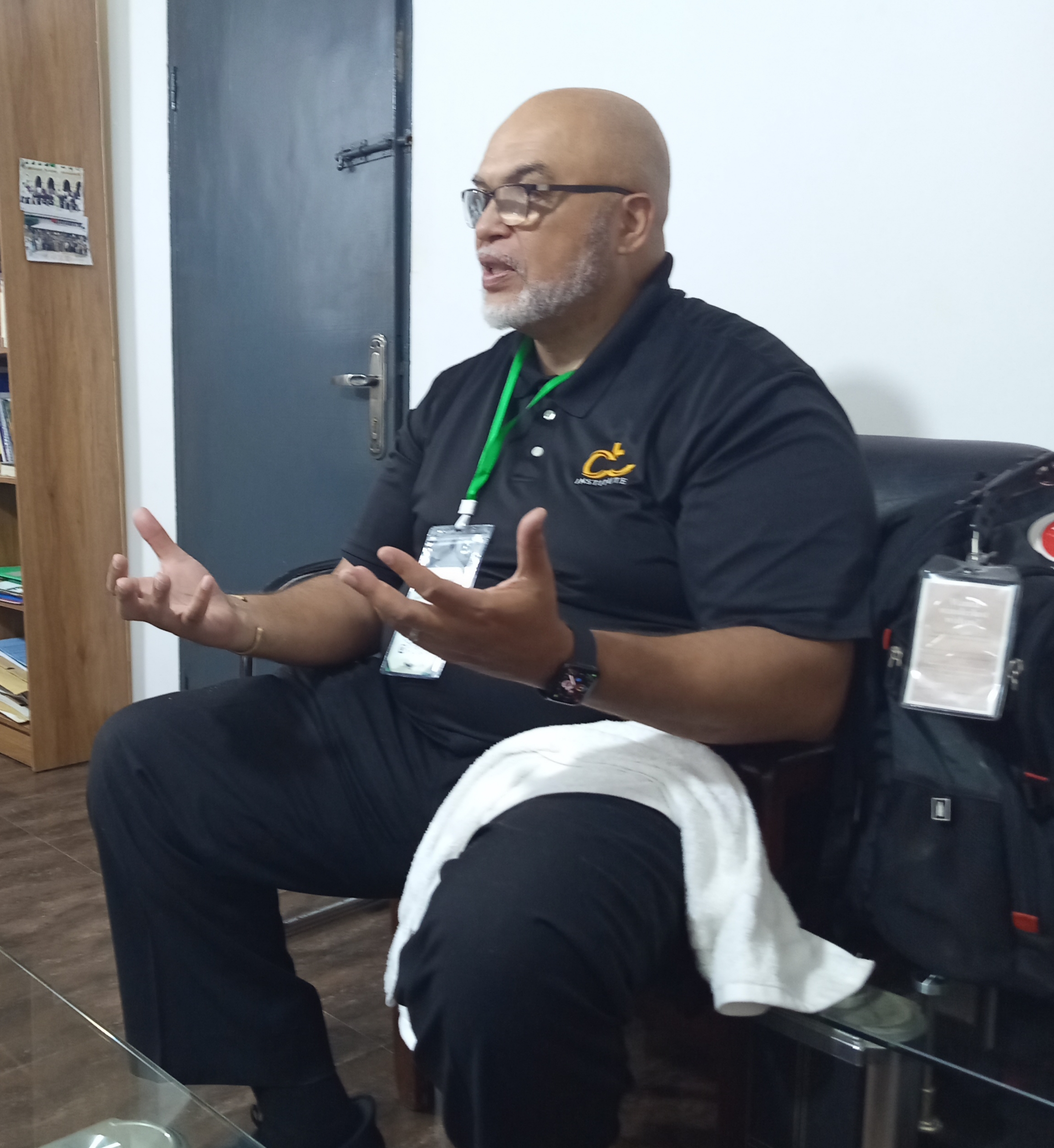
This a continuation of the interview with Dr D.Z.Cofied, An American missionary who came to Nigeria recently for a three-day discipleship programme at the West Africa Theological Seminary, Ipaja Lagos. He spoke with some select media including Church Times Nigeria. Here is a link to the first part of the interview https://churchtimesnigeria.net/its-time-for-africa-to-lead-the-global-church-us-missionary-part-1/ find below excepts of the concluding part of the interview .
The Americans brought us prosperity gospel and you implied earlier we need to take the gospel back to them. Ironically Nigeria is being infiltrated more by foreign missions. There is this Eastern Orthodox Church from Russia coming to Africa. They are already gaining ground in Nigeria especially in the middle belt region. How will you react to this?
I don’t think the Eastern Orthodox Church is new. They have been in Ethiopia for centuries. They claim to have the Ark of the Covenant. There has always been this cycle in the church which makes it look like something is new. But in actual fact nothing is new. It is only new to those who are seeing it for the first time.
There has been the movement from the traditional and orthodox to a generation that says we want something more contemporary. And then when you get to that side of the contemporary and the relevant, there’s a group that says, ‘No, we need something more orthodox and traditional.
I think the number one positioning factor in a church is its worship style, more than anything else. If everybody’s preaching and teaching the word, it is the worship style that determines who comes. And so, the Eastern Orthodox Church coming to Africa is nothing new, it’s just new to you. In another 25 to 30 years, it’s going to be old, and somebody else would be looking for something new.
The irony is that the mega churches, the prosperity theology, the materialism around them is dying in the US. And we exported it on stations like TBN and Daystar but it is dying in the US right now as I speak. Many of the mega churches are now having empty chairs on Sundays.
So what theology is replacing the materialistic gospel in the US?
I’m not sure if it’s being replaced adequately with anything. I think what we have in the US are people who are disgruntled, many of whom have given up on church
A professor once told me people are finding seeming church experiences in other places outside of church. They find it in a bar or at a concert, where a secular singer invokes what they believe is the presence of God or brings a gospel song into their concert. They have a religious experience when they climb a mountain or when they go out on the ocean. For this generation, that has become an adequate substitute for Church which is so unfortunate.
I think discipleship is the solution to this drift. People are longing for relationship and longing for value. Some people are complaining that they do not feel any connection within the church system even when they actively involved in church work.
The truth is people are looking beyond the Sunday morning experience. They want a relationship with God that can hold them for the rest of their lives. If we are able to achieve that in our churches then we’re poised for a revival. The challenge right now is how to stop the church from doing what they are doing and do what Jesus commanded us to do.
The sad reality I must say also is that we have an incomplete view of what success is. The standard of success in the church when the church was given birth to was its sending capacity.
Jesus commanded us to go into all the world. But all that changed when Constantine became the emperor in Rome. It is at that point that the message of Jesus was no longer a threat politically. They discovered Jesus was not interested in being king on earth but in our hearts.
And Constantine made a declaration that the church did not have to worship in secret again. That was when the Church began to have public worship spaces like every other religion. That was when our success model changed from our sending capacity to our seating capacity. This started around 300AD. By 900AD building structures became the signature of success, not building people.
That model has stayed in place so that now when you see a pastor, the question is not how many people God is using him to grow to the stature of Christ. The question is how many people he can seat? And if you have a little church, it is believed you don’t have a significant ministry. Seating capacity is now the standard of success.
After arguably 1500 years of that being the standard of success it shifted to the number of services we hold as our standard of success. Those who have one service now feel inferior to those who have multiple services. Then we shifted from our service capacity to our site capacity where success in ministry is determined by how many branches we have.
I think now we have to go back to our sending capacity, our sharing capacity, and our love capacity, which all of us can be successful at. I believe that if we really want to define success in ministry, biblically, every pastor has to be able to be successful.
How can that be done?
The question that should agitate the average pastor is, how can I be faithful with the people God has blessed me with so that at the end of my journey, I hear Jesus say, ‘Well done good and faithful servant?’
I am.asking that because if we use the world standard, I’m not going to be successful, and many of us won’t be successful. By the world standard, I have to have multiple locations in multiple cities, multiple states, multiple countries, I have to have multiple jets and multiple cars and a mansion in order to be successful.
I’m not saying these are bad, what I’m saying is that those parameters cannot be the standard of success, because if if they are, Jesus was not successful.
Are you advocating a house church model like we have with the church in Iran? Do you think that is applicable to every country?
Yeah, absolutely, I think it is applicable. What is happening in Iran and some other places where Christians are being persecuted and they have to go underground is an attempt to go back to house churches. The scripture talks about Christians meeting from house to house. They didn’t own buildings. They met in public places and people’s homes.
But arguably, the church was at its best at birth, and that’s why I believe in those countries where churches are persecuted. The vibrancy of our faith becomes so great, because those churches can’t get intoxicated on the size of their buildings.
When the church was born and the sending capacity of the church determined its success, pastors were equippers. When the seating capacity of the church became the standard, pastors shifted from being equippers to being entertainers. Pastors now are no longer servants, they have become celebrities.
Now their objective is to attract people. A church is looking for a pastor who can attract people to church not a pastor whose messages can transform people. Now we look for and celebrate the celebrity pastor, not the servant leaders. And if he entertains well on Sunday, people come to see the show, but don’t leave to be salt and light.
What would you consider the greatest challenge of the church
One of the struggles we have in churches is that many times people are fighting to get glory that belongs to none of them. The pastor wants glory, the deacon wants glory, the elder wants glory, the musician wants glory, the singer wants glory. And the glory doesn’t belong to any of us; it’s supposed to go to God.
In this circumstance what will you tell pastors?
I will tell them to do everything they can to live and minister in the way that pleases the Lord, even when it’s contrary to what people are doing.
Houston, Texas has a lot of large churches, and it’s very tempting to try to emulate and imitate these large churches. Many preachers are sounding the same way because there’s a model for success they are imitating.
As we speak, in the US, we’re in a period of transition where a lot of pastors, great preachers, celebrated preachers are now retiring or dying. I went to a concert to see an artist, and the artist is on stage and was being cheered by the audience. About 15 minutes later, there was another artist on the stage, and the women were screaming and hollering about. And then I saw the first artist that was being cheered out of stage. He had no security, nobody was around him, and nobody was hollering, he was on his phone, and I looked, I said, ‘That’s the guy who was just on the stage, but he’s walking around now and nobody’s paying attention to him.’
The Holy Spirit said to me, ‘You won’t always be on the stage and you won’t always be in the limelight. And when you get off the stage and out of the light, nobody will pay attention to you.’
That’s why a servant has to live, understanding that you won’t always be on the stage and the lights won’t always be on you. This should make you to learn how to live when you get off the stage.
The point is a church should not be built on a personality, place and programme. If these three things are what a church is built on such church will not be able to stand the test of time.
