

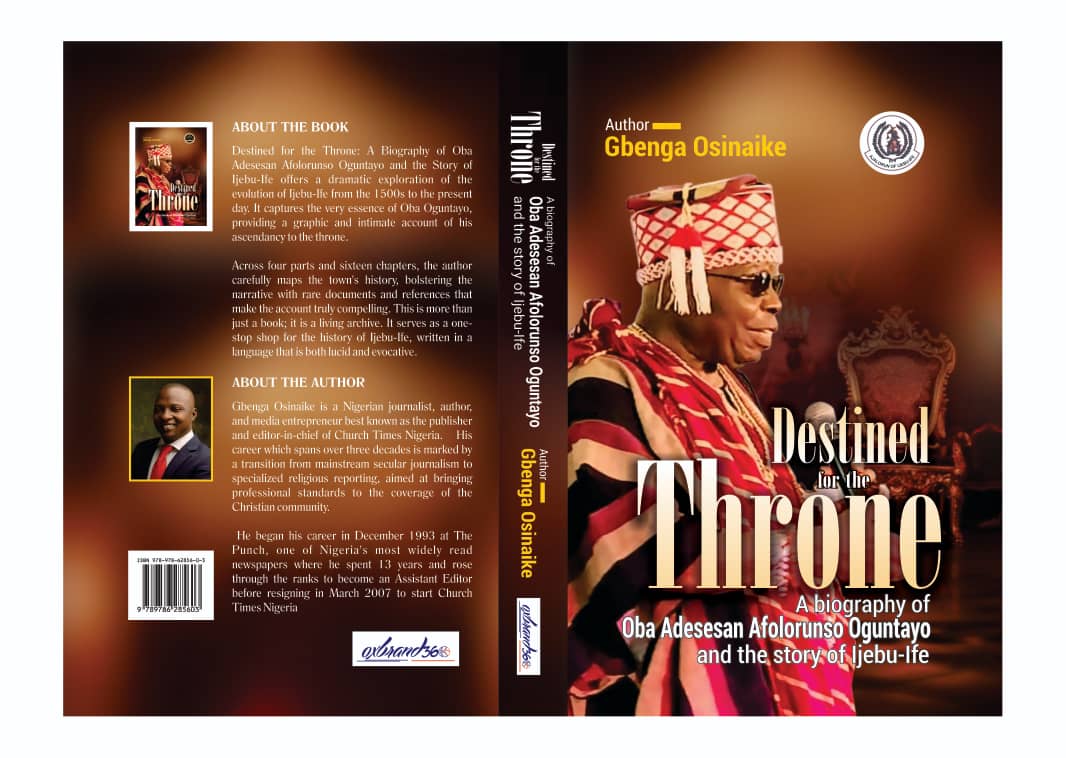
Book: Destined for the Throne: A Biography of Oba Adesesan Afolorunso Oguntayo and the Story of Ijebu-Ife
Author: Gbenga Osinaike
Reviewer: Prof. Adebayo A. Aina
The book, Destined for the Throne: A Biography of Oba Adesesan Afolorunso Oguntayo and the Story of Ijebu-Ife, authored by Gbenga Osinaike and foreworded by Prof. Babatunde Adegbemi Onakoya, is a must-read book for the old, middle, and younger generations alike.
Without mincing words, this 358-page book has been coherently written to preserve the life of the revered Kabiyesi, Oba Adesesan Afolorunso Oguntayo, and the history of Ijebu-Ife for generations yet unborn.
The book is structured into four distinct parts. The first part is an expository account of the genealogy and roots of the Ijebu-Ife people.
The people of Ijebu-Ife are exceptional not only for cherishing their roots but also for maintaining their cultural identity and deep attachment to Ile-Ife—the cradle of the Yoruba race.
This section delves into the migration story from Ile-Ife to Ijebu-Ife in the 15th century, guided by a prophecy directed at Olofin Ogbolu. The directive to leave had to be obeyed despite the earlier charge given by Oduduwa to all his offspring.
Another fascinating legend captured here is the act of walking on spread mats across the sea through magical powers, which speaks volumes about the strength and valor of the immigrants.
Furthermore, the narrative of their journey toward an unknown destination—knowing they could only settle where they found the symbol of settlement called the Eru (a special sacred tree deeply rooted in cultural, spiritual, and medicinal significance)—is deeply interesting. It illuminates the fraternity shared between the immigrants and Erunwon.
The section also tracks the demise of Olofin Ogbolu and the laudable ascendancy of leadership by Olofin Gbelu, his immediate younger brother, who ultimately led the people to present-day Ijebu-Ife.
In addition, this section explains how the name Ife-Ijebu (meaning “Ife people in Ijebuland”) was later changed to Ijebu-Ife by colonial rulers.
It excellently discloses the superb political and spiritual structures existing before the incursion of colonial rule, demonstrating how all eleven (11) villages in the settlement faithfully supported and submitted to the leadership of the Ile-Ife immigrants.
The book informs us that the name Ajalorun was originally an appellation of Olofin Oduduwa in Ile-Ife, which was retained in place of the latter.
The political power hierarchy is structured such that the Ajalorun sits at the top, followed by the Ilamuren, then the Odis, the Osogbo, and finally the Pampas. The transition from one Ajalorun to another is made seamless across the three (3) ruling houses: Afurukeregboye, Olufesogbade, and Amesofe.
The reviewer’s attention was particularly drawn to the impactful address on how our revered father ably downplayed the highly controversial claim regarding the Ijebu being descendants of Oduduwa, as well as the superiority of power claims between the Ajalorun of Ijebu-Ife and the Awujale of Ijebuland.
It similarly provides enlightenment on the age-long power tussle between the Akarigbo of Remo and the Awujale of Ijebuland. In short, it is a must-read book for all royal fathers in Ijebuland.
The author successfully traces genealogically the impact of the 1st to the 41st Ajalorun of Ijebu-Ife. The most interesting Olofin to arrest the reviewer’s attention is Oba Ogbogbo Mu-ju-ida, the 20th Olofin, who was a female Oba.
She was uniquely admitted into the Oro groove, paving the way for women to be accepted into the cult throughout Ijebuland; she stands as a progenitor of Oba Afurukeregboye and the current Ajalorun of Ijebu-Ife.
T
he second part delves into the birth of our royal monarch, Oba Adesesan Afolorunso Oguntayo. The author brings to the fore his humble beginnings, family challenges, and business entrepreneurship.
His parents, Madam Omolade Safiratu and Mohammed Raji Osigbadewa Oguntayo, endured the sad experience of repeated stillbirths until the birth of young Adesesan. Adesesan was a child born into mixed feelings, yet he survived all early trepidations.
Kabiyesi was exceptionally brilliant in his youth, and by dint of hard work, he excelled all through his elementary, secondary, and university education.
This brilliant track record took him to the United Kingdom to complete his accountancy programme at the Leeds College of Commerce, supported by a federal government scholarship.
His entrepreneurship skills revolve around the courage to take calculated risks and the downplaying of greed among employees—traits that are highly worthy of emulation. I implore everyone to sip from this well of knowledge by securing a copy of this valuable book.
Part three relays the journey to the throne. The author stylishly explains the intricacies, threats, scheming, love, and bitter lessons attached to the ascendancy of the Alayeluwa. It is indeed a fascinating account, rendered with consistency, coherence, and emotional depth by the author.
Here, we cannot fail to recognize the place of the partnership and support provided by Oba Oguntayo’s in his success story. May God grant our late Olori, Yeyeluwa Ruphina Olayinka Oguntayo, eternal rest in the bosom of her creator. Amen.
This section is both deeply emotional and ethically grounded.
Part four emphasizes the importance of religious ceremonies in the kingdom, showcasing the intricate relationship between the natural and spiritual realms. It stresses that the spiritual realm plays an overarching role, helping human beings organize reality while imposing the sanctions of social morality on natural existence.
Besides, it recalls the historical importance of the 401 deities as sources of harmonious cooperation among subjects in the Ijebu-Ife community.
Furthermore, the accolades showered on the royal monarch, Oba Adesesan Afolorunso Oguntayo, implicitly showcase his communitarian practices, disciplinarian outlook, astute educational focus, philanthropy par excellence, and his identity as a devoted man of God and lover of his people.
These leadership features are worthy of emulation and should be imbibed by all and sundry.
Prof. Adebayo A. Aina is Professor of African Philosophy and Ethics at the Department of Philosophy
Olabisi Onabanjo University, Ago-Iwoye, Nigeria He could be reached on Email: adebayoaina@oouagoiwoye.edu.ng. Telephone 0803-472-8963
