

By Oyewole O. Sarumi
Grace and peace to you in the name of our Lord Jesus Christ, the Prince of Peace.
I have spent over several decades labouring in the gospel of Jesus Christ, and in all those years, I have never witnessed a time when the church needed clarity on the matter of war more than it does today. The world is watching us. The nations are in turmoil. And in the midst of this chaos, two voices have emerged from within Christendom speaking directly against each other.
One is the voice of Pope Leo XIV, the Bishop of Rome, who recently declared that “God does not bless any conflict” and that no disciple of Christ “ever stands on the side of those who yesterday wielded the sword and today drop bombs.” The other is the voice of Pastor Chris Oyakhilome, who has publicly stated that Pope Leo is wrong, that some wars are justifiable, and that God supports certain conflicts where His people are involved.
Pastor Chris views are not strange. They are derived from those of conservative US Christian groups, particularly evangelicals and Christian Zionists, who support the war on Iran, interpreting it through an apocalyptic “end times” lens. Leaders like John Hagee argue the conflict aligns with divine prophecy, framing it as a necessary battle against enemies of Israel. Many in this group believe Middle East conflicts, including the war on Iran, signify the biblical end times and hasten the return of Jesus. They often aligns with US policies that strongly support Israel and urge aggressive action against Iran, viewing the conflict as a divine plan. Some supporters believe leaders like Donald Trump are “anointed” to act in these, according to complaints reviewed by The Military Religious Freedom Foundation.
Someone sent me a video of Pastor Chris making these remarks, and I confess that I watched it with a heavy heart. He cited Old Testament examples, Israel fighting wars at God’s command, the conquest of the Promised Land, the displacement of nations. He argued that the Israelites could not enter their inheritance without war. And his conclusion, as best as I could discern, was that God loves and supports the US-Israeli war against Iran and that believers should stand behind it.
With respect to my brother in Christ, I must say plainly: Pastor Chris is wrong. And it is my duty as a teacher of the Word to explain why, not from a place of personal animosity, but from a deep love for the truth of the gospel and the character of the God revealed in Jesus Christ.
The Pope Cannot Bless War, and Neither Should Any Christian Leader
Let me begin with a point that should be obvious but clearly needs restating. The Pope, by the very nature of his office as the spiritual father of millions of Catholics and a moral voice to the world, cannot lend his support to war. Even when a legitimate reason for armed conflict exists, and I will address the question of just war shortly, the Pope’s role is always to sue for peace, to call for dialogue, and to plead for the sparing of innocent lives.
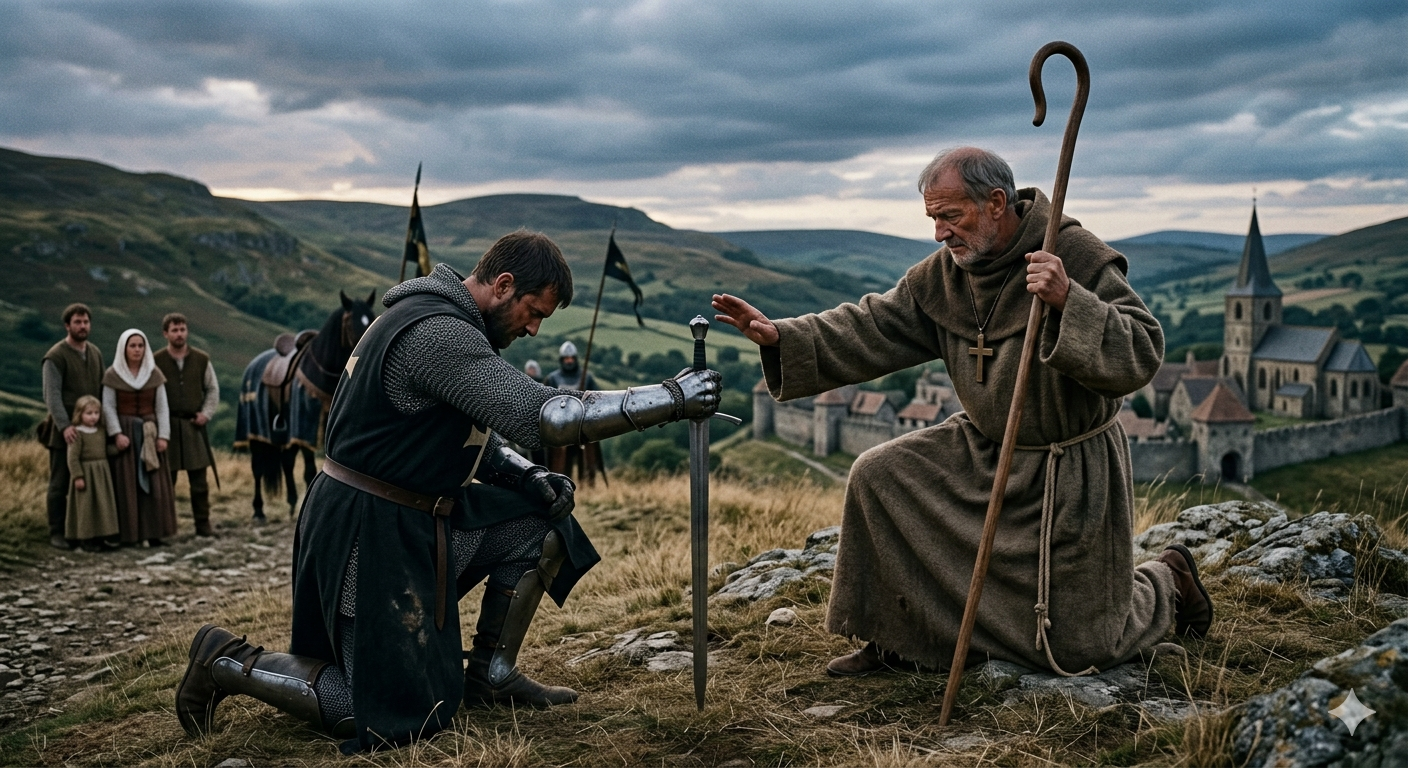
This is not weakness. This is faithfulness to Christ. When Peter drew his sword in the Garden of Gethsemane to defend his Lord, he had what many would consider a legitimate reason. The Son of God was about to be arrested by an armed mob. Peter was acting in defense of the innocent. He was acting out of loyalty to his Master. And yet Jesus said to him: “Put your sword back into its place. For all who take the sword will perish by the sword” (Matthew 26:52).
Notice carefully what Jesus did not say. He did not say that Peter’s cause was unjust. He did not say that the mob had a right to take Him. He simply commanded Peter to sheathe his weapon. The Prince of Peace came to establish a kingdom not advanced by the edge of the sword but by the power of sacrificial love.
The early church fathers understood this with a clarity that shames many of us today. Justin Martyr, writing in the second century, declared that Christians “who formerly murdered one another now refrain from making war even upon our enemies.” Tertullian, the great North African theologian, asked: “Shall it be lawful for the son of peace to take part in battle when peace itself is not lawful for him?” He answered his own question with an emphatic no, arguing that the Lord, “in disarming Peter, disarmed every soldier.”
These were not pacifists in the modern political sense. They were men who took the words of Jesus with absolute seriousness. They understood that to follow Christ meant to renounce the sword as a means of advancing God’s purposes. The kingdom of God does not come through bombs and missiles. It comes through the proclamation of the gospel and the quiet witness of a transformed life.
Pope Leo XIV is standing in this ancient tradition. When he says that “God does not bless any conflict” and that no disciple of Christ stands on the side of those who drop bombs, he is not expressing a political opinion. He is declaring the plain teaching of the New Testament. And any Christian leader who claims otherwise bears the burden of explaining how his position aligns with the words and example of Jesus.
The Old Testament Does Not Settle the Question for the New Covenant Believer
Now let me address Pastor Chris’s appeal to the Old Testament. He is correct that God commanded Israel to engage in wars of conquest. He is correct that the Israelites could not enter the Promised Land without displacing nations through armed conflict. The historical record of the Old Testament is undeniable on this point.
But here is where Pastor Chris’s argument falls apart. He fails to reckon with the fundamental shift that occurred when the New Covenant was established in the blood of Jesus Christ. The Old Covenant was given to a specific people, national Israel, for a specific purpose in a specific period of redemptive history. Under that covenant, God used Israel as an instrument of judgment against nations whose sin had reached its full measure (Genesis 15:16). Under that covenant, Israel was a theocratic nation with geographic borders, a standing army, and laws governing warfare.
But we are not Israel. We are not living under the Old Covenant. We are not a theocratic nation with a divine mandate to wage war on God’s behalf. We are the church, a gathered assembly of Jew and Gentile, slave and free, male and female, united not by ethnicity or geography but by faith in the crucified and risen Messiah.
The apostle Paul made this distinction abundantly clear. He wrote to the Ephesians that Christ “has broken down in his flesh the dividing wall of hostility” between Jew and Gentile (Ephesians 2:14). He explained that the law with its commandments and regulations has been set aside so that Christ might create “one new man” in place of the two (Ephesians 2:15). The old categories, chosen people versus outsiders, holy nation versus pagan nations, have been transcended in Christ.
This means that we cannot simply lift Old Testament warfare passages and apply them to modern nations as if nothing has changed. The United States is not Israel. Iran is not Canaan. Donald Trump is not Joshua. And Pastor Chris is not a prophet authorized to declare which side God supports in a geopolitical conflict.
The Puritan John Owen, perhaps the greatest theological mind of his generation, warned against this very error. He wrote extensively about the danger of mixing covenants, of taking what belonged to the Old Covenant administration and treating it as if it were binding or normative for New Covenant believers. He argued that the law, including its civil and ceremonial provisions, was “weak and unprofitable” for bringing about the righteousness that God requires. That does not mean the law was bad. It means it was never intended to be the final word.
The true and living God revealed in Jesus Christ is not a tribal deity who blesses one nation’s bombs over another’s. He is the Father of our Lord Jesus Christ, who “makes his sun rise on the evil and on the good, and sends rain on the just and on the unjust” (Matthew 5:45). He is the God who, in Christ, was reconciling the world to himself, not counting their trespasses against them (2 Corinthians 5:19). He is not taking sides in the Iran war. He is weeping over the innocent blood being spilled on both sides.
What the New Testament Actually Says About How Christians Should Live
Let us turn to the New Testament itself and ask a simple question: How are followers of Jesus instructed to relate to enemies, to violence, and to the nations of this world?
The answer is so clear that it requires no theological gymnastics to understand.
Jesus said: “Love your enemies, do good to those who hate you, bless those who curse you, pray for those who abuse you” (Luke 6:27-28). He did not add a footnote saying “except when your nation is at war.” He did not create an exemption for geopolitics. He commanded His disciples to love enemies as a non-negotiable mark of their identity as children of the Most High.
The apostle Paul, writing to the Romans, gave the same instruction: “If possible, so far as it depends on you, live peaceably with all” (Romans 12:18). He urged believers never to avenge themselves but to leave room for the wrath of God. He quoted Proverbs: “If your enemy is hungry, feed him; if he is thirsty, give him something to drink” (Romans 12:20).
Peter, the same man who once drew a sword in defense of Jesus, later wrote to the churches: “Do not repay evil for evil or reviling for reviling, but on the contrary, bless, for to this you were called, that you may obtain a blessing” (1 Peter 3:9).
Where in any of these passages do we find permission for Christians to cheer on war, to celebrate the dropping of bombs, to declare that God supports one nation’s military campaign over another’s? It is simply not there.
The early church took these commands with radical seriousness. Before Constantine, before Christendom, before the church became allied with earthly power, Christians refused military service. They would not take oaths. They would not bear arms. They understood that to follow the crucified Lord meant to renounce the way of the sword.
Ignatius of Antioch, writing as he was led in chains to his own martyrdom, exhorted the churches to “be gentle in power, not using the sword against those who attack, but turning the other cheek.” He wrote that “it is better to be a Christian than to be a king,” because the kingdom of Christ is not of this world and does not advance by worldly means.
Now, I am not a pacifist in the strictest sense. I have already acknowledged that some wars are justifiable. Fighting against the Nazis in World War II was justifiable. Responding with a preemptive strike to an imminent and inevitable attack is justifiable. When Hamas abducted Israeli citizens on October 23, I understood why Israel and the United States responded militarily, and I said so at the time. There are circumstances where armed force is the lesser evil.
But that is not what we are dealing with in the current US-Israeli war against Iran. What we are hearing is that military strikes occurred while dialogue and negotiation were ongoing. The voices of Americans against this war are staggering. America’s traditional allies have backed off. Many have seen this conflict as unjustified and unnecessary. And into this situation walks a prominent Christian leader saying that the Pope is wrong to oppose the war and that God supports it.
This is not theological insight. This is religious nationalism dressed up in biblical language. It is the same error that has plagued the church since Constantine first marched his army under the sign of the cross.
The God Revealed in Jesus Christ Does Not Bless Wars
Let me say something that should be obvious to every Christian who has read the Gospels with an open heart. The God revealed in Jesus Christ does not bless wars where people are killed. He does not take sides in conflicts where innocent blood is being spilled. He is not an American. He is not an Israeli. He is not Iranian. He is the Holy One of Israel who sent His Son to die for the sins of the world—including the sins of Americans, Iranians, Israelis, and every other nation on earth.
Pastor Chris cited Old Testament examples of God commanding war. But he failed to explain the character of the God who would support the killing of people by another people. And here is the crux of the matter: The Old Testament must be read through the lens of the New. The partial revelation given to Israel must be interpreted in light of the full revelation given in Jesus Christ.
The author of Hebrews opens his letter with this exact principle: “Long ago, at many times and in many ways, God spoke to our fathers by the prophets, but in these last days he has spoken to us by his Son” (Hebrews 1:1-2). The Son is the final Word. The Son is the exact imprint of God’s nature. If we want to know what God is truly like, we do not look first to the conquest of Canaan. We look to Jesus hanging on the cross, praying for His murderers: “Father, forgive them, for they know not what they do.”
The Puritan Richard Baxter, a man who lived through the English Civil War and saw Christians killing Christians in the name of Christ, wrote with anguish about the tendency of believers to baptize their political passions with religious language. He urged his readers to remember that “God is love” and that “he that dwells in love dwells in God.” He warned that when Christians take sides in wars and declare God’s blessing on their faction, they risk making God in their own image rather than being conformed to His.
Pope Leo XIV is not being naive. He is not ignoring the realities of a fallen world. He is simply refusing to do what Pastor Chris has done, to reduce the gospel to a tribal endorsement of one side over another. The Pope said that “no cause can justify the spilling of innocent blood.” He said that disciples of Christ “never stand on the side of those who yesterday wielded the sword and today drop bombs.” This is not controversial. This is Christianity 101.
The Associated Press reported that Pope Leo amplified his criticism of the Iran war on April 10, 2026, telling Chaldean Catholic bishops in the Vatican that “God does not bless any conflict” and that the lands of early Christianity have been “desecrated by the blasphemy of war and the brutality of business, with no regard for people’s lives.” He called for a special vigil for peace in St. Peter’s Basilica.
This is what spiritual leadership looks like. Not cheering for bombs. Not declaring which nation God favors. But standing in the gap, pleading for peace, and bearing witness to the Prince of Peace.
A Word to My Fellow Christian Leaders
I write this not as an enemy of Pastor Chris. I have no personal quarrel with him. I think he loves the Lord and desires to serve the gospel. But on this matter, he is dangerously wrong, and silence from other leaders would be complicity.
We must stop treating the Bible like a collection of proof texts to be weaponized in support of our political preferences. We must stop conflating the United States or Israel with Old Testament Israel. We must stop claiming that God blesses wars simply because they are being fought by nations we admire against nations we fear.
The apostle Paul wrote to Timothy that “God desires all people to be saved and to come to the knowledge of the truth” (1 Timothy 2:4). All people. Not just Americans. Not just Israelis. Not just Christians. All people. Including Iranians. Including Muslims. Including the families of those who are being killed by bombs dropped in this conflict.
When we pray, we should pray for peace. When we speak, we should speak for reconciliation. When we act, we should act as ambassadors of the kingdom that is not of this world.
The Pope is right. Pastor Chris is wrong. And any Christian leader who believes otherwise should explain, with Scripture and reason, how his position aligns with the words of Jesus, the teaching of the apostles, and the witness of the early church.
Conclusion
Let me close with a story. During the First World War, as Christians from Germany and England and France killed each other in the trenches, a group of believers gathered on the battlefield for a Christmas service. They sang “Silent Night” together. They exchanged gifts. They prayed. And then, the next day, they went back to killing each other because the nations told them to.
That is the tragedy of Christians who forget that their primary allegiance is not to any earthly nation but to the King of Kings. That is the tragedy of pastors who bless wars instead of weeping over them. That is the tragedy of believers who imagine that God takes sides in conflicts where His children are killing His children.
I do not know all the complexities of the US-Israeli war with Iran. I do not know what truly happened in the negotiations. I do not know the classified intelligence that led to the strikes. But I know this: God does not bless the dropping of bombs to kill over 100 innocent children in school. God does not answer the prayers of those who make war. And no disciple of Jesus Christ should ever stand on the side of those who spill innocent blood.
The Pope, by the nature of his office, will always sue for peace and dialogue. That is what he is supposed to do. That is what Jesus did. That is what the apostles did. That is what every Christian leader should do.
Pastor Chris is welcome to his opinion. He is welcome to support the war if his conscience permits. But he should not claim that God supports it. He should not claim that the Pope is wrong for refusing to bless it. And he should not pretend that his position is obviously biblical when the weight of the New Testament testimony stands against him.
As for me, I stand with the Prince of Peace. I stand with the Pope who calls for prayer and vigil rather than vengeance. I stand with the early church fathers who laid down their swords rather than pick them up in the name of Christ. And I call on every Christian leader reading these words to do the same.
May the Lord grant us wisdom, courage, and above all, peace in a world that is been perverted by His creatures. Amen.
Prof. Sarumi is a Bible scholar and theological teacher with over forty years of experience in gospel ministry, committed to helping believers understand the Word of God in its proper context and apply it faithfully to their lives.
