

By Oyewole O. Sarumi
The global energy environment is currently undergoing a volcanic shift, transitioning from the heavy, labour-intensive industrial models of the mid-20th century to a digitized, hyper-efficient era defined by artificial intelligence and robotic precision.
For Nigeria, a nation that has long tethered its national pride to the ownership of massive refining infrastructure, this transition has brought a painful moment of reckoning. The recent admissions emerging from the highest levels of leadership at the Nigerian National Petroleum Company Limited regarding the persistent failure of the Port Harcourt Refinery serve as more than just a corporate update; they represent the final collapse of a failed economic philosophy.
As an observer of the international oil and gas business for over four decades, I have watched many nations grapple with the “sunk cost fallacy,” but the Nigerian situation is perhaps the most acute example of how sentimental attachment to moribund assets can derail an entire national economy.
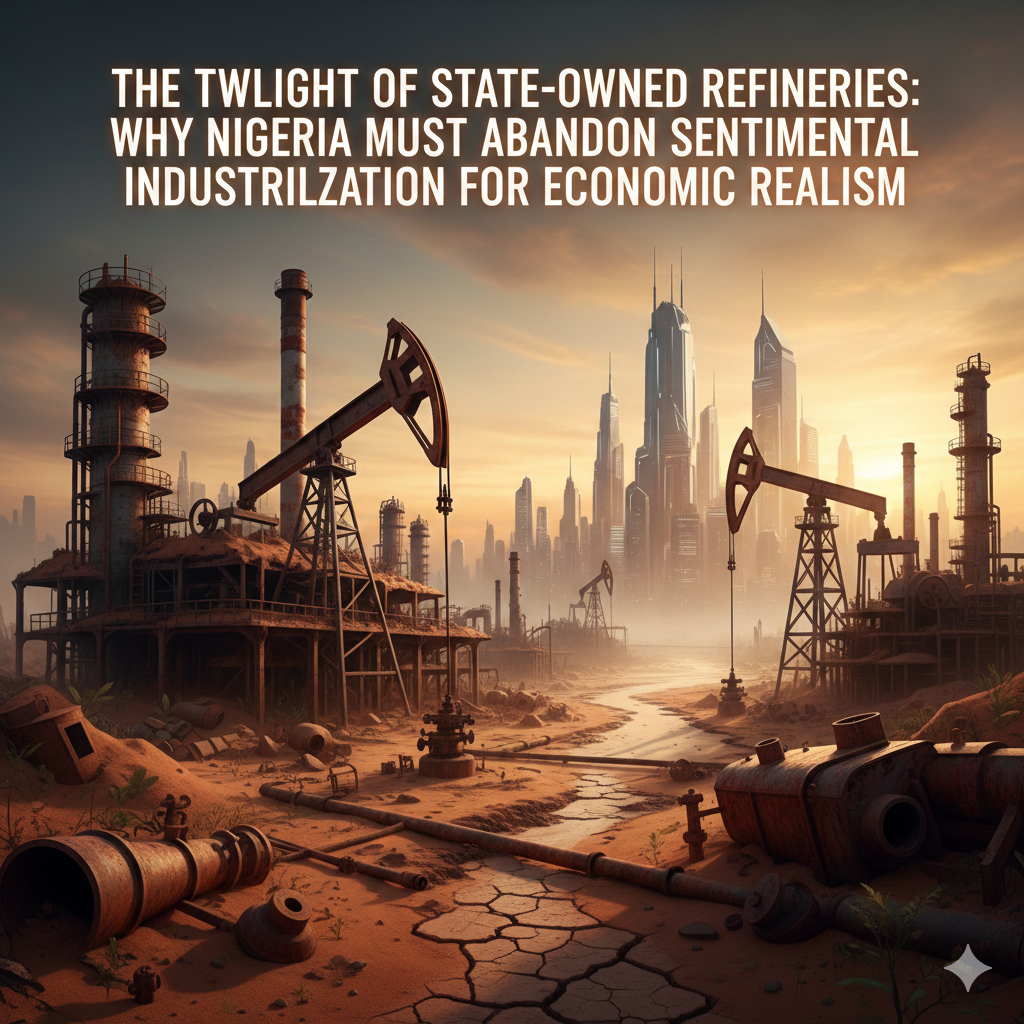
The fundamental problem lies in the refusal to acknowledge that the refineries in Port Harcourt, Warri, and Kaduna are no longer industrial assets in the modern sense; they have become fiscal black holes. For decades, the narrative was that these facilities simply needed a bit more “Turn Around Maintenance” or a more committed management team to return to their glory days. However, the hard data of 2026 tells a different story.
When a facility like the Port Harcourt Refinery undergoes rehabilitation at the staggering cost of $1.5 billion, only to be shut down within six months due to sustained financial losses, we are no longer looking at a technical glitch. We are looking at a systemic rejection of a 19th-century business model by a 21st-century market.
The economic reality is that the Nigerian state, as currently structured, lacks the commercial DNA required to run complex refining operations profitably.
To understand why these refineries must be sold off or scrapped, one must look at the technological chasm that now exists between legacy state infrastructure and the new generation of private-sector giants.
The modern refinery is no longer just a collection of pipes, boilers, and distillation columns. It is a data-driven ecosystem. In the world’s leading refineries, AI algorithms manage real-time feedstocks, adjusting chemical processes by the second to maximize high-value yields like Premium Motor Spirit and Jet A1 while minimizing waste.
The legacy plants in Nigeria were designed in an era when labour was cheap, data was manual, and environmental standards were secondary. Attempting to “modernize” these plants is akin to trying to install a high-end computer operating system on a typewriter.
You can polish the keys and replace the ribbon, but it will never be a laptop. The sheer inefficiency of these plants, which often struggle to exceed a fifty percent utilization rate even when they are “functional,” means they are losing value on every barrel of crude they process.
The human cost of maintaining this charade is equally indefensible. Current estimates suggest that the wage bill for the combined staff of these three idle refineries exceeds two billion naira every single month.
This is money being diverted from healthcare, education, and critical infrastructure to pay a workforce that is essentially overseeing a graveyard of steel. In any other private-sector enterprise, such a situation would lead to immediate liquidation.
Yet, in the public sector, political sentiment and the influence of powerful unions have kept these refineries on life support for decades. The argument that these plants provide jobs is a hollow one; real job creation comes from profitable, growing industries, not from state-subsidized stagnation. By holding onto these assets, the government is not protecting jobs; it is subsidizing inefficiency at the expense of over two hundred million citizens.
The emergence of the massive private refinery complex in the Lekki Free Trade Zone has fundamentally changed the chess board. For the first time in its history, Nigeria has a private-sector cushion that provides domestic energy security without requiring the state to manage the complexities of refining.
The fact that this single private entity is already contributing a hundred percent of domestic consumption and has saved the nation six trillion naira in importation costs over a nine-month period proves that the state-run model is obsolete. With plans already in motion to double the capacity of this private complex to nearly one point four million barrels per day within the next three years, the question becomes even more pointed: what role could three small, broken, and technologically backward state refineries possibly play in this market? They cannot compete on price, they cannot compete on volume, and they certainly cannot compete on efficiency.
If we look at other oil-producing nations, such as Angola, we see a much more pragmatic approach to energy infrastructure. The Angolan model has increasingly leaned toward partial privatization and the invitation of international partners who bring not just money, but operational expertise and skin in the game. Nigeria, conversely, has spent decades awarding contracts to service providers who have no long-term interest in the profitability of the assets.
A contractor’s goal is to finish the contract and get paid; an owner’s goal is to ensure the plant runs for twenty years. By refusing to sell these refineries to entities that actually know how to run them, Nigeria has remained trapped in a cycle of “fix and fail.”
The argument for selling Nigeria’s refineries is not just a local debate; it is supported by global precedents where state-owned oil companies (NOCs) shifted from operational management to strategic oversight. Consider Saudi Aramco, the gold standard of oil companies.
While the Saudi state retains majority ownership, Aramco operates with the discipline of a private corporation. Their strategy has never been to keep “ghost refineries” alive. Instead, they have aggressively restructured their downstream business, focusing on high-integration and petrochemicals.
When Aramco realized that purely state-led operational models were becoming cumbersome, they launched an IPO and sought global partnerships to ensure every asset in their portfolio was either profitable or discarded.
Brazil’s Petrobras offers an even more direct lesson for Nigeria. Faced with massive debt and inefficiency in its downstream sector, Petrobras launched a “Divestment Plan.” This wasn’t a sign of failure, but a strategic “portfolio optimization.”
They sold significant stakes in refineries, such as the Landulpho Alves Refinery to the Mubadala Capital group, to ensure that these assets were in the hands of specialized operators who could extract value from them. The result was a more competitive domestic market and a leaner, more profitable Petrobras that could focus on its core strength: deep-water exploration.
The data from emerging markets consistently shows that private-sector refineries outperform state-owned ones in two key areas: capital efficiency and technological adoption. In many OPEC nations, the shift toward privatization has led to a 35% drop in employment intensity, meaning fewer people are doing more work, and a 40% increase in total output.
This is the “secret sauce” that makes the 21st-century refinery model, like the one being scaled by Honeywell and Dangote, so superior to the 19th-century NNPCL legacy model.
In nations like Kuwait, the Strategy 2040 plan explicitly calls for increased private-sector participation in domestic fuel retail and refining to “foster competition and enhance efficiency.” Kuwait realized that having the state as the sole player in the downstream sector led to a lack of innovation. By opening the doors to private operators, they ensured that their refineries remained technologically relevant and economically viable.
Nigeria, with its new private-sector giant now meeting 100% of domestic demand, has already achieved the hardest part of this transition: ensuring energy security. The state refineries are no longer a “necessity”; they are a “luxury” the nation cannot afford.
The most compelling argument for immediate divestment is the opportunity cost. When a nation spends N2 billion a month on salaries for non-productive assets, it is essentially taxing its future. In my five decades of consulting, I have seen that the most successful “Thatcherite revolutions” in the energy sector occur when governments stop trying to be businessmen. By selling these refineries, even at scrap value, the Nigerian government would achieve three things:
- Stop the Bleeding: Eliminate the massive monthly drain on the federation account.
- Unlock Real Estate: Repurpose the thousands of hectares of prime industrial land for modern, AI-integrated energy parks or modular refineries.
- Signal Maturity: Prove to global investors that Nigeria is a nation governed by economic logic rather than political sentiment.
The “scrap and sell” model is often viewed as a defeat, but in the oil and gas business, it is frequently the most profitable move. Selling the components of a 40-year-old refinery can provide immediate liquidity, and the land itself can become a hub for new, private-sector investments that actually create jobs. As we have seen in the revitalized basins of Brazil, the “departure of assets that are less adherent to the strategic plan” is the first step toward a national economic revival.
The path forward requires a level of political will that transcends traditional Nigerian politics. The President must realize that the most “pro-people” move he can make is to stop the bleeding. The refineries in Port Harcourt, Warri, and Kaduna should be offered for outright sale to the highest bidder. If no one wants to buy them as functional units because they are too far gone, then they should be sold as scrap.
The land they sit on is valuable and could be repurposed for modern industrial parks or modular refineries that are actually suited for today’s market needs. This is not a retreat; it is a strategic repositioning. It is about moving from “sentiment-based asset management” to “value-based economic leadership.”
The fiscal implications of holding onto these moribund assets are also tied to the nation’s broader budgetary challenges. When the federal budget is built on ambitious oil production targets that are rarely met, every kobo wasted on a non-performing refinery compounds the national deficit. We have seen how over-projecting revenue leads to mid-year fiscal crises.
Selling these refineries would not only provide a massive one-time influx of cash to the federation account but would also permanently remove a massive recurring expenditure from the books. It would signal to the international investment community that Nigeria is finally serious about market-oriented reforms and is no longer interested in protecting the “cesspool of corruption” that has characterized the downstream sector for half a century.
In conclusion, the era of the state-run refinery in Nigeria must come to an end as the right path to take for the nation is clear. The nation must follow the lead of its OPEC peers by aggressively divesting from moribund assets. The evidence is overwhelming, the cost is unbearable, and the alternative is already working. We cannot continue to throw good money, money that we do not even have, after bad business deals.
The “Dangote Revolution” has provided the perfect exit ramp. With a private-sector leader already proving that refining can be profitable and efficient in Nigeria, the state has no further excuse to cling to its “cesspool of corruption.”
The admissions by the current NNPCL leadership should be the final nail in the coffin of the “rehabilitation” narrative. It is time to drop the sentiment, embrace the technological reality of the 21st century, and sell these assets to those who can make them work, or simply let them go.
The future of Nigeria’s energy security lies in private-sector efficiency and a transparent, deregulated market, not in the rusting pipes of a forgotten era. The transition from a sentimental owner to a disciplined regulator and tax collector is the only way to ensure that Nigeria’s oil wealth finally benefits its people.
