

By Gbenga Osinaike
A couple of days ago, I stumbled upon a video where the famed televangelist Kenneth Copeland made a brief remark on Psalm 23, zeroing in on the phrase “I shall not want.”
I became interested in what he was saying because this is one Psalm that has become almost like a song on the lips of every Christian; even non-Christians can recite it offhand.
However, Copeland’s perspective on “I shall not want” felt strange to me. He attempted to use the Psalm to justify a life of opulence, making a case for people who want God to satisfy their luxury wants rather than just their basic needs.
Indeed, on face value, the line “I shall not want” seems like a blank check. It appears to suggest that a believer is entitled to whatever they desire from God and that God is obligated to fulfill every request. It is this misunderstanding that leads many Christians to put pressure on God. In the pursuit of what we want, there is always the temptation to veer into greed.
Is God Obligated to Grant Our Every Want?
It is important that we consider the Psalm again and ask ourselves: Is it really saying we can demand that God fulfill our wants rather than our needs? Is God obligated to grant our every desire even when it is not in tandem with His will? James 4:3 warns us about this exact posture: “You ask and do not receive, because you ask amiss, that you may spend it on your pleasures.”
If we do get our selfish desires, is that an indication that we are in tune with God and that He is pleased with us?
Before examining the Psalm directly, I would like to share a passage that often fascinates me: Psalm 106:13–15: “They soon forgot His works; they did not wait for His counsel, but lusted exceedingly in the wilderness, and tested God in the desert. And He gave them their request, but sent leanness into their soul.” (NKJV)
Each time I read this scripture, I am awed by the reality that God can grant us what we want, yet we can still experience leanness of soul. That scripture aptly describes what happened to the Israelites in Numbers 11, where they grew tired of eating manna and demanded meat.
God granted their fleshly craving by providing quail; however, because their hearts were rebellious and ungrateful, their selfish demand led to spiritual emptiness—a lean soul. This proves that receiving answers to selfish desires is not proof that God is pleased with us.
Understanding “I Shall Not Want”
Now, let us return to Psalm 23 with a focus on “I shall not want.” Copeland enthusiastically used that line to indicate that God is obligated to meet our desires, not just our needs, and his audience applauded him.
Yet, there is danger in pulling scripture out of context to justify personal ambition in prayer. By doing so, we distort the truth because we lose sight of the framework the Psalmist intended.
Before running with the declaration “I shall not want,” we must look at the foundation of the Psalm: “The Lord is my shepherd.”
That first clause is not only profound, but it also demonstrates a vital truth that those who place undue emphasis on prosperity fail to grasp.
If God is our shepherd, it stands to reason that we are His sheep. Indeed, Psalm 100:3 reminds us: “Know that the Lord, He is God; it is He who has made us, and not we ourselves; we are His people and the sheep of His pasture.”
The natural question then is: What are the wants of a sheep?
Consider the relationship between a sheep and a shepherd.
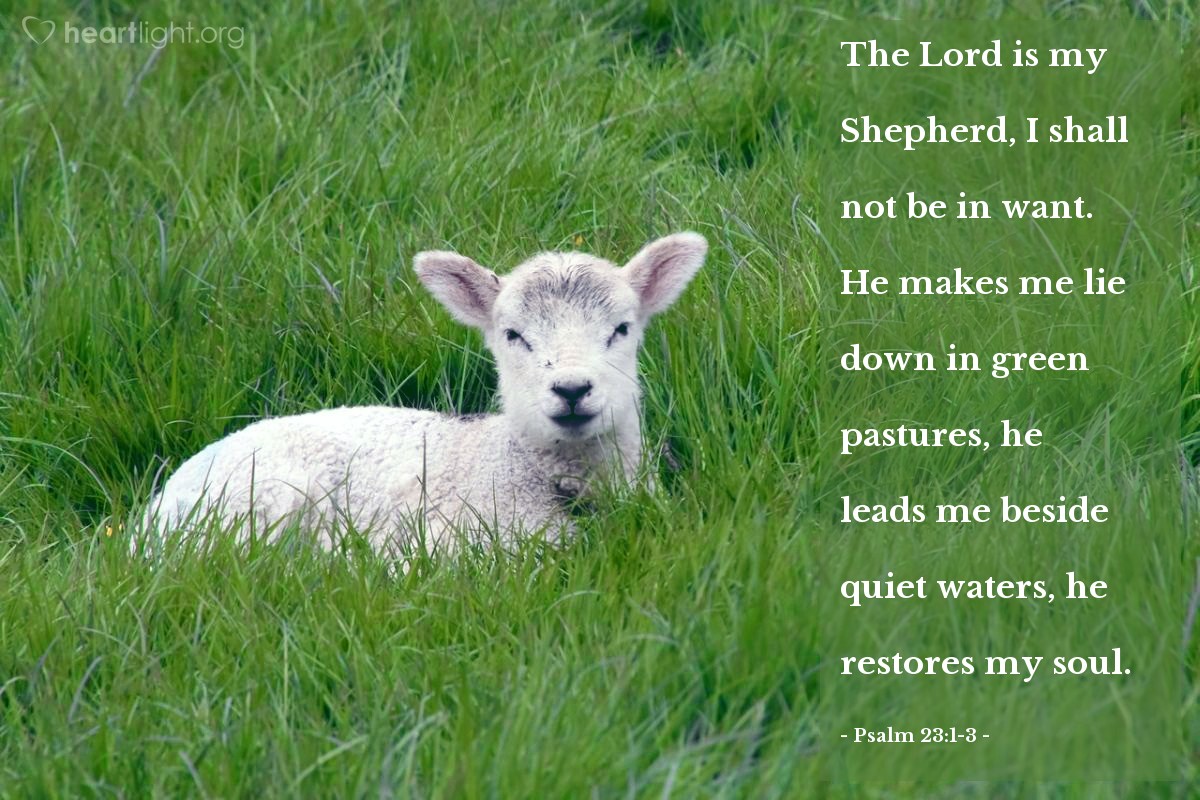
The sheep simply follows where the shepherd leads. The truth is, what a sheep wants is basic: green grass and clean water. The sheep is not overly ambitious; it is content and at peace wherever the shepherd guides it.
Is it not intriguing that the Psalmist uses the imagery of a shepherd to describe God’s relationship with us? If God is my shepherd, I am a sheep, and by implication, my desires are defined and restrained because my nature as a sheep does not demand excess. That does not mean I cannot experience abundance; it simply means that when abundance comes, I am willing to hold it loosely and let go when necessary.
A sheep does not hoard grass. It simply follows the shepherd to where green pasture is available. This reveals that God provides for us in balanced ways. In a practical sense, there is no urge for luxury built into the nature of a sheep. A sheep has needs that can only be met by the shepherd, and though those needs are simple, only the shepherd can satisfy them.
That opening declaration—The Lord is my shepherd—shows that Psalm 23 is not a proof text for purveyors of material prosperity. Instead, it reminds us of how fundamental our real needs are and what we should prioritize in prayer.
The Psalm in Full Context
Reading further, the Psalm continues along the line of what a sheep truly requires.
Verse 1 reveals complete provision: “I lack nothing.” However, lacking nothing exists strictly within the context of being a sheep dependent on its shepherd. It further tells us that God makes us lie down in green pastures and leads us beside quiet waters. Under the shepherd’s guidance, there is no place for anxiety or frantic pressure. Anything that drives us into toxic ambition is not of God.
The shepherd leads the sheep along right paths. We remain in right standing with God as long as we remain submissive sheep who do not rebel against His direction.
We are further assured that whatever trials we face, God will carry us through. We can remain at peace even in trouble because the Good Shepherd guarantees our safety.
The Psalm reminds us that God meets our needs in the presence of our enemies, not necessarily in their absence. He prepares a table before us, ensuring peace even in hostile environments.
This glorious Psalm concludes with: “Surely goodness and mercy will follow me.” These are spiritual blessings that money cannot buy, reserved for those who follow the Shepherd. It ends with the promise that we will dwell in the house of the Lord forever.
Nowhere in this Psalm does it validate human greed or a craving for things outside God’s design. The Scriptures remind us that everything we need for life and godliness has already been provided; our role is to receive these provisions through prayer, faithful labor, and trust.
As the Apostle Paul reminds us in 1 Timothy 6:6–8: “Now godliness with contentment is great gain. For we brought nothing into this world, and it is certain we can carry nothing out. And having food and clothing, with these we shall be content.”
While there is no sin in achieving greatness or accumulating wealth with the purpose of redistributing it, material gain must not become our ultimate pursuit. And it does not mean we should lack ambition or refrain from owning possessions. It simply means our ambition should be within the framework of God’s purposes and will.
Jesus clarified this order of priority in Matthew 6:31–33: “Therefore do not worry, saying, ‘What shall we eat?’ or ‘What shall we drink?’ or ‘What shall we wear?’… For your heavenly Father knows that you need all these things. But seek first the kingdom of God and His righteousness, and all these things shall be added to you.” God supplies what brings glory to Him, not what feeds our self-indulgence.
He Is Our Shepherd, Not Our Servant
When our hearts are aligned with God, He is more than capable of providing the material resources we need, knowing those things will not capture our devotion. But the moment we approach God with a spirit of entitlement—or measure our worth by material possessions—we misrepresent His character.
He is our Shepherd, not our servant. A shepherd determines what the sheep needs; a servant merely takes orders from the master. We do not dictate terms to God. He knows precisely what we need, and as our Shepherd, He will faithfully provide it.
The ultimate truth is that we are stewards of material blessings. As 2 Corinthians 9:8 reminds us, God abounds toward us so that “always having all sufficiency in all things, [we] may have an abundance for every good work.” We are blessed with more than enough because God intends for us to be distributors, not reservoirs.
