

By Oyewole O. Sarumi
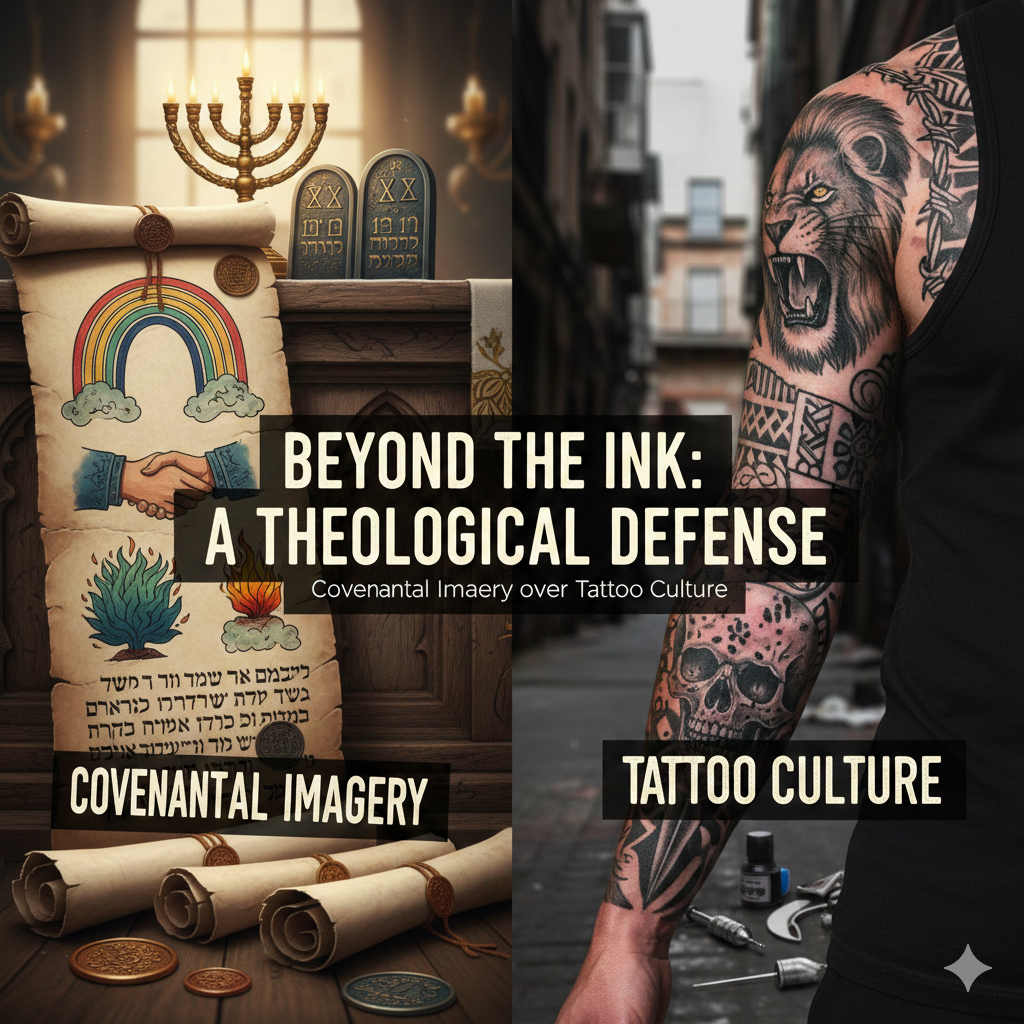
In recent weeks, a significant controversy has swept through the public square and social media, sparked by high-profile pastors claiming that the Bible not only permits tattoos, but suggests that God the Father and Jesus Christ themselves possess them.
By citing passages like Isaiah 49 and Revelation 19, these leaders have argued that the “engravings” on God’s palm and the “writing” on the Messiah’s thigh are divine justifications for modern body art.
While the intent may be to appear culturally relevant or “missional” to a tattooed generation, this trend has created a theological crisis among believers who look to their leaders for sound doctrine.
As shepherds and scholars of the Word, we must address this head-on especially when leaders who are supposed to be guardians of soul are leading people astray.
Let’s ask this rhetorical question: Is it possible that we are witnessing a massive hermeneutical “reach”? When we lift ancient Near Eastern metaphors out of their covenantal soil and transplant them into 21st-century tattoo parlours, we do more than just make a cultural observation, we risk committing eisegesis of the highest order.
To suggest that the Creator of the universe is subject to the needle is not just a misunderstanding of text; it is a misunderstanding of the nature of God’s holiness and His specific commands to His people.
This article seeks to provide a rigorous, professional, and exegetical debunking of these claims. By returning to the original Hebrew and Greek contexts, we will demonstrate that these “marks” are not fashion statements, but profound legal and covenantal symbols of ownership that far transcend the surface of the skin.
The Hermeneutical Hazard: Eisegesis vs. Exegesis
Now, before digging into specific texts, we must address the “how” of our study. Many pastors are guilty of “eisegesis”, reading their own cultural preferences into the Bible. To find a “tattoo” in Isaiah or Revelation requires us to ignore the linguistic, historical, and literary frameworks of those books.
True exegesis, drawing the meaning out of the text, reveals that God’s use of “marking” imagery is never about body art, but about ownership, permanence, and covenantal loyalty. This should be noted as we move forward in this piece.
Isaiah 49:16 – The “Engraving” of a Covenant vs. The Application of Ink
The centerpiece of the “divine tattoo” argument rests almost entirely on a literalist reading of Isaiah 49:16: “Behold, I have engraved you on the palms of my hands; your walls are continually before me.” To the modern reader, “writing on the hand” evokes the image of a tattoo. However, a robust theological examination reveals that this is not a description of body art, but a profound statement of judicial permanence and covenantal intimacy.
The Linguistic Reality: Haqaq and Architectural Permanence
The Hebrew verb translated as “engraved” is haqaq (חקק). In the biblical lexicon, haqaq is far more aggressive and permanent than the mere application of ink. It refers to the action of hewing, carving, or hacking into a hard surface like stone, clay, or metal.
- The Root of Law: This is the same root used in the Old Testament to describe the “decreeing” of laws (Proverbs 8:15) and the “carving” of statues.
- The Materiality of the Metaphor: When God uses haqaq, He is drawing on the imagery of an architect or a king carving a permanent record into a monument. A tattoo is a superficial treatment of the skin; an engraving is a structural alteration.
- Ink vs. Incision: While a tattoo can be faded or removed, an engraving, in the ancient mind, was as permanent as the object itself. God is not saying He has a “drawing” of us; He is saying we have been carved into His very agency and His economy.
The Contextual Logic: A Response to Divine Abandonment
To understand the “why” of this verse, we must look at the “why” of the chapter. Remember that Zion (Israel) is in exile, lamenting in verse 14: “The Lord has forsaken me, my Lord has forgotten me.”
God’s response is a masterpiece of anthropomorphism, assigning human traits to God to communicate a spiritual truth. In the Ancient Near East, it was common for people to tie cords around their fingers or “bind” signs to their hands as mnemonic devices to avoid forgetting a duty (the basis for the Tefillin). God effectively says: “I do not need a string around My finger to remember you. I have carved your very likeness into the palms of My hands.”
The choice of the “palm” is intentional. The palm is the centre of a man’s labour, agency, and action. By “engraving” Zion on His palms, God is declaring that He cannot move His hands, He cannot act in history, without seeing the needs of His people. It is a metaphor for uninterrupted providence, not a cosmetic choice.
The Legal Conflict: The Holiness of the Divine Body
Finally, we must apply the Analogy of Faith, the principle that Scripture cannot contradict itself. If we interpret Isaiah 49:16 as a literal tattoo, we force a contradiction with Leviticus 19:28, where God commands: “You shall not make any cuttings in your flesh… nor tattoo any marks on you: I am the Lord.”
- The Pagan Connection: The Levitical prohibition was designed to separate Israel from the pagan nations (like the Canaanites and Egyptians) who used tattoos for cultic mourning or to mark themselves as slaves to false deities.
- The Character of God: It is exegetically irresponsible to suggest that Yahweh, who explicitly banned tattoos as a form of “defilement” for His people, would then use that exact pagan practice to describe His own nature.
God does not use the language of the “profane” to describe the “holy.” He uses the language of monumental inscription to show that His love is etched deeper than any ink could ever reach.
Deuteronomy 6:8 – The Covenantal “Sign” vs. The Permanent Mark
A common argument used by those attempting to modernize the text is that the “binding” of God’s law onto the body in Deuteronomy 6:8 was a precursor or command for tattooing. However, a robust exegetical look at the Hebrew text and the historical development of Jewish worship reveals that this was never intended to be a permanent marking of the flesh, but a pedagogical ritual of the heart and mind.
The Linguistic Foundation: ’Ot (The Sign)
The Hebrew text commands Israel to bind the words of the Shema as a sign (’ot) upon the hand and as frontlets (totafot) between the eyes.
- The Meaning of ’Ot: In the Old Testament, an ’ot (אות) is a signal, a beacon, or a monument. It is used to describe the rainbow after the flood (Gen 9:12) and the Sabbath (Exodus 31:13). Crucially, these “signs” are not biological alterations; they are reminders that point toward a larger covenantal reality.
- The Meaning of Totafot: While the etymology is debatable, “frontlets” refers to a headpiece or a band. It implies something worn on the body, not something injected into the skin.
The Historical Interpretation: The Tefillin as Active Devotion
For over two millennia, the Jewish community, the original recipients and guardians of the Torah, has interpreted this command through the practice of Tefillin (phylacteries).
- Removability vs. Passivity: The Tefillin consist of black leather boxes containing specific Torah scrolls, strapped to the arm (near the heart) and the forehead (near the brain). The genius of this “binding” is that it is removable. A tattoo is a passive, one-time event that requires no further engagement. In contrast, the Tefillin must be physically bound to the body every morning. It is an active, liturgical act of “putting on” the mind of God, a daily re-consecration that a tattoo cannot replicate.
- The Proximity to Power: The strap on the arm is traditionally wound toward the heart, and the box on the forehead rests above the “third eye.” This placement was never meant to be a decorative statement but a spiritual alignment of the affections and the intellect.
The Metaphorical Intent: Action and Perception
Beyond the physical ritual, the “hand” and “between the eyes” are classic biblical idioms for agency and worldview.
- The Hand: Represents the seat of strength and labor. To have the Law on the hand means that every deed, every transaction, and every stroke of work must be governed by God’s justice.
- Between the Eyes: Represents the seat of perception. To have the Law there is to see the world through the “lens” of the Torah.
So, by reducing this to a discussion of tattoos, these pastors strip the text of its transformational weight. God is not asking for a display on the skin; He is demanding the total surrender of the will (hand) and the reason (forehead).
The Systematic Contradiction
Furthermore, we must address the logical fallacy of using Deuteronomy to support tattoos. If Deuteronomy 6:8 commanded tattoos, then God would be ordering His people to violate the Law He gave just chapters earlier in the Levitical Code.
Theological Consistency: God does not issue contradictory commands. He would not ban “marks on the skin” (kethobeth qa’aqa) in Leviticus 19:28 only to turn around and require them in Deuteronomy. The “binding” was always intended to be a covenantal accessory, a physical symbol of a spiritual reality, never a pagan-style marking of the flesh as being projected by this pastors.
Revelation 19:16 – The Inscription of the King vs. The Modern Needle
In the contemporary debate, perhaps no passage is more frequently weaponized than the description of the returning Christ in Revelation 19:16: “On his robe and on his thigh he has a name written, King of kings and Lord of lords.” Proponents of the “divine tattoo” theory point to this as a literal “thigh piece,” suggesting that if Jesus bears ink, the prohibition for believers is nullified. However, this interpretation collapses under the weight of apocalyptic genre analysis and Greco-Roman historical context.
The Literary Genre: The Language of Apocalyptic Vision
The book of Revelation belongs to the genre of Apocalyptic Literature, which communicates through “word-pictures” and symbolic archetypes rather than literal, physical descriptions.
- The Consistency of Symbolism: In the same vision, Jesus is described as having “eyes like a flame of fire” (v. 12) and a “sharp sword” coming out of His mouth (v. 15).
- The Hermeneutical Trap: If a pastor insists that the name on the thigh is a literal tattoo, they must, by the same logic, argue that Jesus has a physical steel blade protruding from His esophagus and that His eyeballs are composed of literal combustion. These are not physiological descriptions; they are theological declarations. The sword represents the power of His Word; the fire represents His holy omniscience; the “written name” represents His unquestionable sovereignty.
The Cultural Context: The Statuary of Conquerors and Deities
To John’s first-century audience, the image of a name written on a “thigh” would immediately evoke the imagery of votive statues and monuments.
- The Living Monument: In the Greco-Roman world, it was a common artistic practice to engrave the name of a deity or a conquering hero directly onto the thigh of a bronze or stone statue. A famous example is the Arringatore or various statues of Apollo, where the artist’s dedication or the subject’s title was etched into the most muscular part of the leg, symbolizing strength and stability.
- The Message to the Empire: John is depicting Jesus as the Ultimate Monument. Unlike the statues of Caesar that would eventually crumble, Jesus is the Living King whose title is etched into the very seat of His power. He is not a man with a tattoo; He is the King whose authority is foundational and permanent.
The Linguistic and Physical Placement: Gegrammenon
The Greek text uses the word gegrammenon (γεγραμμένον), a perfect passive participle of grapho, which simply means “it has been written.”
- The Robe and the Thigh: The text specifies the name is on “his robe and on his thigh.” In the context of a rider on a horse, the “robe” (the himation) would naturally drape over the thigh.
- The Hilt of the Sword: Many scholars suggest the inscription was on the hilt of the sword or the scabbard that rested against the thigh. In ancient warfare, the thigh was the place of the sword (Psalm 45:3: “Gird your sword on your thigh, O Mighty One”). To have “King of kings” written there is to say that His military victory is derived from His divine identity.
- The Absence of Ink: There is no mention of stigma (the Greek word for a mark or brand or tattoo). To project 21st-century tattoo culture onto this text is to ignore the rich memories of Roman victory processions and the specific ways kings were honored in the ancient world.
In the theological conclusion, we have to consider authority, not aesthetic. Therefore, by interpreting this as a tattoo, we diminish the Christological weight of the passage. The name is written on His thigh to signify that His strength (the thigh being the strongest muscle used for standing and battle) is entirely defined by His Lordship.
Let’s consider exegesis vs. Imagination in this angle.
We must not trade the Majesty of the Monumental Christ for a “culturally relevant” Christ. Jesus does not return as a rebel with a tattoo; He returns as the Sovereign Judge whose title is woven into His very garments and etched into His eternal power.
The Parody: The Mark of the Beast and the Theft of Allegiance
To fully dismantle the “divine tattoo” narrative, we must look at the dark mirror of God’s “marks” found in Revelation 13:16–17. The “Mark of the Beast” is perhaps the most misunderstood concept in modern eschatology, but when viewed through the lens of biblical typology, its purpose is clear: it is a Satanic parody of the covenantal signs established in the Torah.
The Strategic Anatomy: Forehead and Right Hand
The Enemy is rarely original; he is a master counterfeiter. The placement of the Beast’s mark on the forehead and the right hand is a direct, mocking imitation of the “binding” found in Deuteronomy 6:8.
- The Forehead (The Seat of Intellect): Just as God commanded His Word to be “frontlets between your eyes,” the Beast demands the forehead. This signifies the conquering of the mind. It represents an ideological alignment, a worldview shift, and the total surrender of one’s belief system to a godless order.
- The Hand (The Seat of Agency): Just as the Israelite was to bind the Law to his hand, the Beast marks the right hand. This represents cooperation and labour. It signifies that one’s strength, career, and economic participation are now “branded” by the service of the Enemy.
The Linguistic Weight: Charagma vs. Tattoo
The Greek word used for “mark” is charagma (χάραγμα). In the first-century context, this word carried heavy political and economic connotations that have nothing to do with personal body art:
- The Imperial Seal: It was the term for the official stamp or seal used on government documents to prove authenticity.
- The Serpent’s Bite: It was used to describe the “mark” left by a serpent’s sting.
- The Coinage: It referred to the image and superscription of the Emperor on a coin.
A charagma was a symbol of state-sanctioned ownership. To possess the mark was to be “certified” by the system. By reducing this to a literal tattoo or a piece of ink, modern teachers trivialize a massive spiritual reality: the charagma is about who owns your soul.
The Theological Stakes: Allegiance, Not Aesthetics
When pastors frame the “marks” of Scripture as tattoos, they inadvertently strip the Bible of its covenantal urgency.
- In the Ancient Near East, slaves were sometimes branded to show they belonged to a master.
- Soldiers were sometimes marked to show they belonged to a general.
The question in Revelation is not about whether you have ink on your skin; it is about whose “brand” you bear in the spiritual realm. If you have the “Seal of God” (Rev. 7:3), your mind and actions are governed by the Spirit. If you have the “Mark of the Beast,” your mind and actions are governed by the World.
The conclusion of the Matter is that by making the “marks” in the Bible about tattoos, we move the focus from the internal heart to the external skin. We make the Gospel about a fashion choice rather than a life-and-death choice of allegiance. As leaders, we must remind our congregations that God is not looking for followers who “get a tattoo” of His name, but for followers whose very thoughts (forehead) and actions (hand) are so saturated with His Word that they are visibly distinct from the world.
Conclusion: A Call to Hermeneutical Integrity
As shepherds of Christ’s Church, our primary responsibility is to “rightly divide the word of truth” (2 Timothy 2:15). While the pressure to remain “culturally relevant” is immense, we must never sacrifice the depth of the Biblical narrative for the sake of a modern trend.
To suggest that God or Jesus has a tattoo is to engage in a shallow literalism that ignores the rich, monumental, and covenantal language of the biblical authors. God does not need ink to be faithful; His Word is carved into the very foundations of reality. Jesus does not need a “thigh piece” to prove His power; His Lordship is written in His resurrection and His eternal reign.
Let us lead our people back to a worship of the Monumental Christ, the One whose love is deeper than any engraving and whose authority is more permanent than any mark. Let us stop baptizing the culture into the text and start letting the text transform the culture.
I rest my case, and let’s hope for a “new day” in our hearts.
Maranatha!
Prof. Sarumi, a Bible teacher and Scholar, writes from Lagos
