

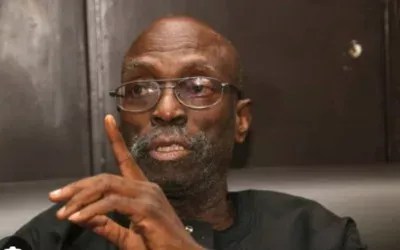
By Bolanle BOLAWOLE
turnpot@gmail.com 0705 263 1058
Unlike Comrade Dipo Fashina (aka Jingo) and Comrade Segun Osoba, Comrade (Professor) Biodun Jeyifo never taught me at the University of Ife (renamed Obafemi Awolowo University), Ile-Ife. But like other Marxist lecturers at the university such as Professor Toye Olorode, Idowu Awopetu, G. G. Darah, Malam Femi Taiwo and many others, BJ actually taught me outside the classroom walls.
He was a beacon and shining light of the radical Left at Great Ife. He was one of those lecturers who taught their students what they were not paid to teach, according to our military dictators who victimised them relentlessly for doing that. Yet, they were undeterred. The more they suffered, the more committed to the struggle they were. They raised our consciousness. They ensured we did not just pass through the university without the university passing through us.
Many of the yesteryear Marxist lecturers might not have taught us officially, but they poured themselves into us unofficially. They were our Staff Advisers. They were comrades whose doors were opened unto us any time, any day; their pockets as well! They were our backbones, coming to our rescue any time we ran into trouble waters – and these were many!
Today, what makes many of us their students tick were not the subjects or courses we studied in the university but the consciousness they aroused in us and the worldview they shared that travelled far beyond the narrow confines of the four walls of a classroom. They were our leading lights. They were our role models. They “opened” our eyes to “see” beyond the mundane and the ordinary. They laid the world and its intricacies bare before us. We cannot but be eternally grateful to them for this!!
I took what I learned from them at Ife with me to my first place of work at the Ibadan-based Sketch newspapers (now defunct). Although I was employed as a Senior Reporter to operate from the Newsroom, I also added Features writing into my schedule. So I had a seat in the Newsroom and another seat in the Features department, so much so that my News Editor, Mr. Kayode Muritala, and his assistant, Baba Israel Ojo, often wondered where I rightly belonged!
Whenever I was needed in the Newsroom and was not there, they would say “E lo wo ni Features!” Yes, they would come looking for me at the Features Department! At some point my whereabouts became less predictable when I also started contributing to Mr. Phil Aragbada’s “Insight” pull-out pages in the Sunday Sketch! Hence, I became the butt of cruel jokes among some of my colleagues for doing three jobs but getting paid for only one! But, today, it has paid off handsomely for me!
I carried that mindset also with me into PUNCH newspapers. For the brief period that I was in the Newsroom there, I also wrote Features articles. I travelled and conducted interviews with notable personalities. The first of such interviews was with my former Head of Department of Philosophy at Ife, Professor J. Olubi Sodipo.
Prof. sent through me to my editor, Comrade Nojeem Jimoh – the editor of editors – his autographed book (just published at the time) titled “Knowledge, belief & witchcraft: Analytical experiments in African philosophy”), which he co-authored with Barry Hallen. Comrade Nojeem graciously asked me to keep the book, which adorns my bookshelves to this day.
I did not stop at that: When I was moved to the Features department, I also continued to write news stories. Not only that, I took up columns and insisted the newspaper must begin again to carry Editorial comments. There was a time I had responsibilities over the Advert/Advertorial departments as well as poke my nose into the Printing and Circulation departments! BJ and the other comrades taught us to multi-task – and untiredly, too!
To BJ and our other senior comrades at Ife and the other campuses we owe a world of gratitude for not being “triangular”, “efico” or “bookworm” students who shunned “extra-curicullar activities” such as Socialist/Marxist-cum student union activities!
I will forever remember an intervention by BJ at the iconic Oduduwa Hall. The hall was packed full. Everyone knew that BJ could be described as a student of Professor Wole Soyinka. Yes, in the literary world; but there the similarities end. Ideologically, both men appear poles apart. You knew where BJ stood on the ideological divide. Not so, Soyinka. Soyinka had just delivered a critical lecture against the Nigerian Leftists/Marxists on June 27, 1980. It was a memorial lecture in honour of Dr. Walter Rodney, the Guyanese historian and activist, author of the seminal “How Europe underdeveloped Africa”
In an event meant to honour Rodney, a Leftist scholar and political activist believed to have been gruesomely assassinated by the reactionary Guyanese authorities, Soyinka unleashed a tirade of criticisms and scathing attacks on the Left. It was not Soyinka’s first.
Compare this with what ex-President Olusegun Obasanjo did at ex-Gov. Peter Ayodele Fayose’s recent birthday event, when Obasanjo seized the podium provided by Fayose to white-wash the former governor in public glare!
Will Soyinka be allowed to get away with blue murder, as it were? Not with BJ! BJ took the podium and held Soyinka’s feet to the fire. Pulling no punches, BJ thundered: “Rightocracy or Leftocracy: take position!” The hall erupted!
BJ’s call to Soyinka was clear and direct: Stop being ambiguous! Stop sitting on the fence! Climb down and let’s see on which side of the ideological divide you belong! Stop running with the hare and hunting with the hound! Stop the ambivalence! “No” to prevarication! Stop obfuscating issues with a language that rigmaroles!
Despite Soyinka’s advertised radical political activism against the state, BJ consistently accused his former teacher and his works as being often metaphysical, full of contradictions and ideological tensions, and myths that obscure social realities!
For a very long time to come, “Take position” took over the entire Great Ife campus. It became the conclusion of every argument. Take position! We will miss BJ!
Since his transition, a lot has been written on the place of Comrade BJ in history. One of them, written by Sola Adeyemi, University of East Anglia, UK and titled “Biodun Jeyifo (5 January 1946 – 11 February 2026)”, has been edited here for brevity. Enjoy it:
“Biodun Jeyifo, who died at the age of eighty, was one of the most formidable and beloved figures in African letters: a critic of rare moral clarity, a teacher whose influence spanned continents, a playwright and poet whose creative imagination was inseparable from his political commitments, and a family man whose gentleness at home stood in striking, endearing contrast to the intellectual ferocity he could summon in debates.
“His passing marks the end of an era in Nigerian and African literary scholarship, for he belonged to that generation of thinkers who believed that literature mattered not merely as an aesthetic pursuit but as a vital instrument for understanding, challenging and transforming society. In a career that stretched across more than five decades, he helped shape the intellectual architecture of modern African criticism, leaving behind a legacy that will continue to animate classrooms, theatres and scholarly conversations for years to come.
“Born on 5 January 1946, in a Nigeria still negotiating the complexities of late colonial rule, Jeyifo came of age at a moment when the country’s cultural and political energies were surging. The ferment of the 1960s and 1970s – independence, civil war, the rise of radical student movements, the flowering of modern African literature – formed the crucible in which his intellectual identity was forged.
“He studied at the University of Ibadan, an institution that had already produced some of the continent’s most influential writers and scholars, and where he distinguished himself as the first student in the English Department to earn a first-class degree; it was also there that he first encountered the ideas that would shape his life’s work: Marxist theory, Yoruba performance traditions, and the conviction that criticism must be accountable to the lived experiences of ordinary people. These commitments would remain constant, even as his thinking evolved and deepened over the decades.
“One of the most defining chapters of Jeyifo’s early career was his role in the founding and consolidation of the Academic Staff Union of Universities (ASUU), a union that would become central to the defence of academic freedom and the struggle for better conditions within Nigerian higher education. As one of its pioneering organisers, he helped articulate the union’s intellectual and moral foundations, insisting that the university must serve the public good rather than the whims of military or civilian power…
“As an essayist and critic, Jeyifo possessed a rare combination of analytical rigour and imaginative sympathy. His writing was marked by a clarity of thought that never descended into dogmatism, and by a generosity of spirit that allowed him to engage seriously with positions he did not share.
“He wrote with equal authority about canonical figures such as Wole Soyinka and Ngũgĩ wa Thiong’o, and about lesser-known playwrights, poets and performers whose work he believed deserved wider attention. His essays were often animated by a sense of urgency, a belief that literature was not a luxury but a necessity in societies grappling with inequality, authoritarianism and the unfinished business of decolonisation. Yet, he was never merely polemical; his criticism was grounded in close reading, historical context, and a deep respect for the craft of writing.
“His contributions to theatre studies were particularly influential. Jeyifo was among the first scholars to articulate a sustained Marxist reading of African drama, arguing that the stage was a site where the contradictions of postcolonial society could be both exposed and imaginatively reconfigured. His work on Yoruba theatre, especially his analyses of the Alarinjo tradition and the popular travelling theatre movement, remains foundational…
“As a teacher, Jeyifo was legendary. Generations of students, first, in Nigeria, later in the United States, China and elsewhere, remember him as a mentor who demanded excellence but offered unwavering support. Many of this came out in the tributes celebrating his 80th birthday only a month ago.
“He had a gift for making difficult ideas accessible without diluting their complexity, and he encouraged his students to think critically, write boldly and engage the world with intellectual honesty. Many of his former students have gone on to become leading scholars, writers and cultural practitioners in their own right, and they often speak of him with a mixture of reverence and affection. He was, in the best sense, a teacher of teachers…
“What, then, is the legacy of Biodun Jeyifo? It is, first and foremost, a body of scholarship that will continue to shape the study of African literature and theatre for generations. His essays remain models of critical clarity; his analyses of Yoruba performance traditions are indispensable; his writings on Marxism and African drama continue to provoke and inspire.
“But his legacy is also found in the countless students he taught, the colleagues he supported, the writers he championed, and the institutions he helped strengthen. It is found in the conversations he sparked, the debates he enlivened, and the intellectual communities he nurtured.
“Perhaps most importantly, his legacy lies in the example he set: that of a scholar who believed that ideas matter, that criticism must be grounded in ethical commitment, and that intellectual life is inseparable from the pursuit of truth and justice.
“He showed that it is possible to be rigorous without being rigid, passionate without being dogmatic, and critical without losing sight of the humanity of others. In an age often marked by cynicism and fragmentation, his life stands as a reminder of the power of thought, the importance of integrity, and the enduring value of intellectual generosity.”
It could not have been better said! Comrade Biodun Jeyifo, rest in power!
- Former editor of PUNCH newspapers, Chairman of its Editorial Board and Deputy Editor-in-chief, BOLAWOLE was also the Managing Director/Editor-in-chief of The Westerner news magazine. He writes the ON THE LORD’S DAY column in the Sunday Tribune and TREASURES column in New Telegraph newspaper on Wednesdays. He is also a public affairs analyst on radio and television
