

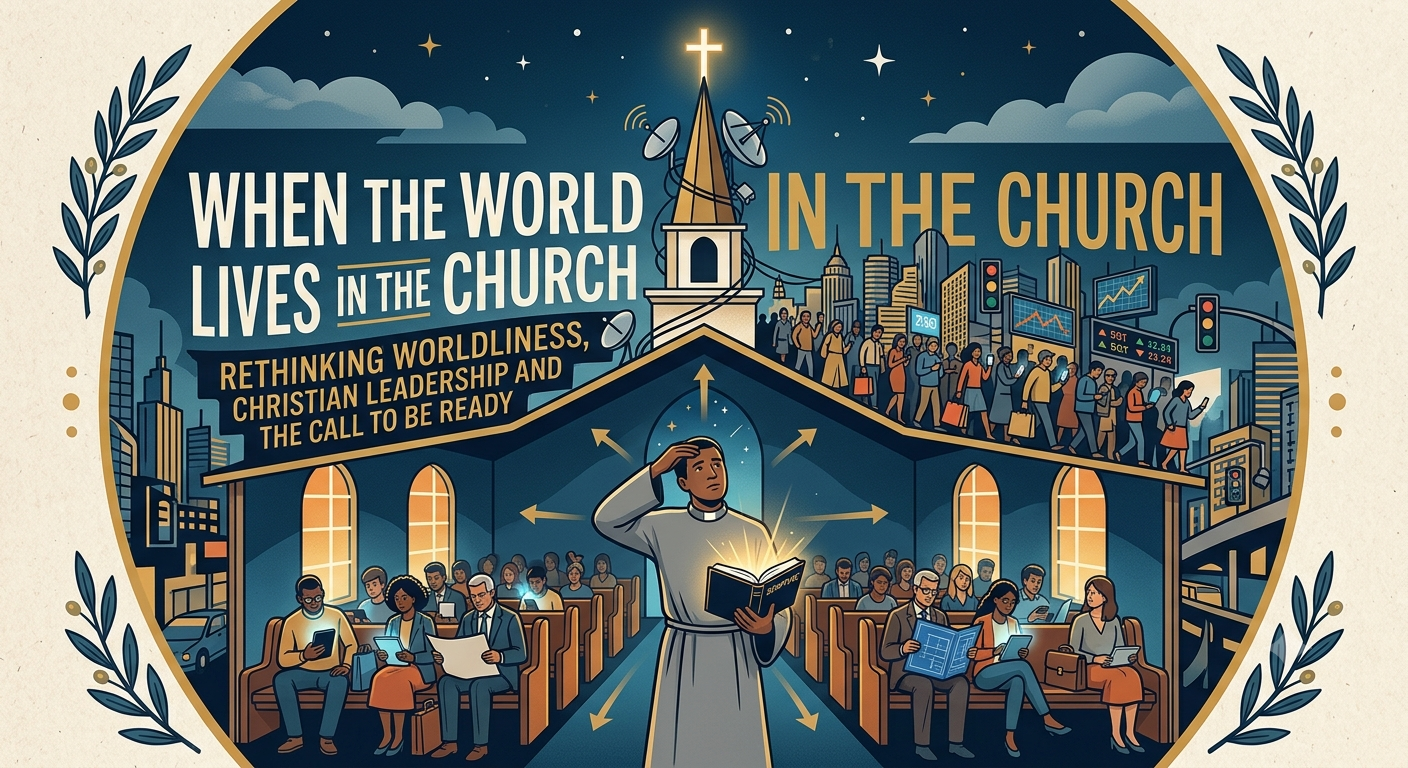
....A Theological and Leadership Reflection on Living for Christ in a World That Is Passing Away
By Oyewole Sarumi
Introduction: The Worldliness We Have Learned to See, and the Worldliness We Have Failed to See
For more than four decades of walking with Christ, teaching Scripture, developing leaders, mentoring ministers and observing the Church across generations, I have become increasingly persuaded that one of the most dangerous problems confronting contemporary Christianity is not simply that the Church has become too much like the world. The deeper problem is that we may have become so accustomed to certain forms of worldliness that we no longer recognise them as worldliness at all.
When many Christians hear the word worldliness, their minds immediately travel to familiar territory. They think about drunkenness, smoking, gambling, pornography, sexual immorality, profanity, inappropriate entertainment, immodest dressing and other visible behaviours that the Church has historically warned against. These concerns are not insignificant. Scripture certainly calls believers to holiness, purity and self-control.
From the foregoing, let me ask a more searching questions.
- What if worldliness is much deeper than the things we have traditionally forbidden?
- What if a Christian can avoid alcohol and still be worldly?
- What if a believer can refuse to gamble, never watch pornography, attend church every Sunday, pay tithes faithfully, serve in the choir, preach from the pulpit and still be deeply entangled with the spirit of this age?
- What if the greatest evidence of worldliness is not necessarily what a Christian does with his body, but what he does with his heart?
The Apostle John writes: “Do not love the world or the things in the world.” He then identifies the essential currents flowing through the world’s system: the desires of the flesh, the desires awakened by what the eyes see, and the arrogant pursuit of status and self-importance.
Then comes a statement that, in my view, deserves far greater attention than it often receives: “The world is passing away, and the lust of it; but he who does the will of God abides forever.” — 1 John 2:17»
Beloved readers, that is the issue. The world is passing away. That is the theological reality that should reshape Christian leadership, ambition, business, ministry, wealth, career, politics, education and personal priorities.
The world is not our final home. Our achievements are temporary. Our bank accounts are temporary. Our buildings are temporary. Our titles are temporary. Our academic degrees are temporary. Our businesses are temporary. Our political influence is temporary. Our social media platforms are temporary. Even our physical lives are temporary.
Yet we often live as though the temporary is permanent and the eternal is uncertain. That is the tragedy of Christian worldliness.
THE BIBLE’S DEFINITION OF WORLDLINES IS LARGER THAN OUR RELIGIOUS VOCABULARY
The word “world” in the New Testament does not always mean the physical planet or humanity itself. God created the world, and John 3:16 tells us that God loved the world. Christians are therefore not called to hate humanity or withdraw from society.
The concern is the world-system, the organised pattern of human life that seeks to function independently of God, celebrates self rather than surrender, elevates material success above spiritual faithfulness and treats the present age as though it were ultimate. This is why worldliness can hide inside respectable Christianity.
The most dangerous form of worldliness may not always look rebellious. Sometimes it looks successful. It wears an expensive suit. It sits in the boardroom. It occupies a church office. It carries a ministerial title. It receives awards. It speaks Christian vocabulary. It quotes Scripture. It posts Bible verses on social media.
And yet, underneath the religious appearance, the heart is quietly governed by the same values that govern the world: status, wealth, recognition, influence, comfort, power and applause.
This is why the question is not simply, “What are you doing?” The deeper question is: What are you living for?
Paul writes: “Set your mind on things above, not on things on the earth.”— Colossians 3:2. Please Notice the language. Paul does not merely say, “Stop doing bad things.” He says, set your mind.
The battle is taking place in the imagination, the affections and the orientation of the heart. What occupies your mind when nobody is asking you to think about anything?
Please answer these questions honestly: What do you dream about? What do you worry about? What makes you feel successful? What makes you feel insignificant? What do you fear losing? What do you secretly envy? What do you spend your life pursuing?
These questions may reveal more about our worldliness than the list of sins we proudly claim to have avoided.
A CHRISTIAN CAN BE MORALLY CLEAN AND SPIRITUALLY WORLDLY
There is a form of worldliness that is easy to identify because it is visible. There is another that is far more subtle because it is respectable.
A man may never enter a betting shop, yet spend his entire life worshipping money.
A woman may never watch pornography, yet be consumed by the lust for admiration.
A minister may never use vulgar language, yet be addicted to applause.
A business leader may never engage in obvious immorality, yet sacrifice integrity for profit.
A Christian may never drink alcohol, yet be intoxicated by ambition.
A pastor may preach against materialism while measuring his own ministry by attendance, buildings, influence and social status.
A professor may teach Christian ethics while privately being governed by the desire for recognition.
A church may preach holiness while competing with another church over who has the largest auditorium, the most sophisticated media presence or the most influential members.
This is why the Church must recover a more comprehensive theology of worldliness.
Worldliness is not simply loving sinful things. Worldliness is loving temporal things more than eternal things. It is allowing the present age to occupy the throne that belongs to Christ. It is allowing what is passing away to become more important to us than what will last forever.
Jesus told a story about a rich man whose land produced abundantly. His response was to build bigger barns, store more possessions and secure a comfortable future.
The man had a business strategy. He had an investment strategy. He had a retirement strategy. He had a wealth preservation strategy. But he had no strategy for eternity.
He spoke to himself about his possessions, his future and his comfort. He had enough for many years, he thought.
But God said to him: “Fool! This night your soul will be required of you.” — Luke 12:20» The man’s problem was not that he had wealth. His problem was that he had wealth without eternity.
He had possessions but no perspective. He had accumulation but no eternal orientation. He had prepared for years but not for eternity.
Jesus concluded: “So is he who lays up treasure for himself, and is not rich toward God.” — Luke 12:21. That is a terrifying possibility.
To be rich in the eyes of men and poor before God. To be celebrated on earth and unknown in heaven. To build a great career but a weak soul. To build a great ministry but neglect one’s family. To build a great organisation but lose one’s first love. To gain influence but lose intimacy with Christ.
THE WORLD IS PASSING AWAY, BUT WE ARE BUILDING AS THOUGH IT WILL LAST FOREVER
The Apostle John gives us a prophetic perspective that contemporary Christian leaders desperately need. The world is passing away, every generation thinks its moment is permanent.
The Roman Empire thought it would last forever. Kings and emperors built monuments to their own greatness. Political regimes believed their authority was unshakable. Industrial empires rose and disappeared. Corporations that once seemed invincible collapsed. Fortunes were accumulated and then lost. Generations came and went. Yet humanity repeatedly behaves as though the present moment is eternal.
Friends, Christian leaders are not immune. We can become so absorbed in constructing organisations that we forget that we are ultimately preparing people for eternity.
We can spend years building churches and neglect building disciples. We can invest heavily in infrastructure and little in character. We can measure attendance but fail to measure transformation.
We can celebrate growth while ignoring spiritual maturity. We can create powerful platforms without producing deep disciples. We can become experts in attracting crowds but strangers to the ministry of forming Christlike people. This is particularly important in an age of digital visibility.
The contemporary leader is constantly exposed to metrics: followers, views, likes, shares, subscribers, impressions, engagement rates and online reach.
These metrics have their place. Digital communication can be a powerful instrument for evangelism, education and leadership. But the danger begins when the metrics of the platform become the metrics of the soul.
A post can go viral and still be spiritually empty. A preacher can become famous and still be spiritually dry. A church can become large and still be shallow. A Christian can become influential and still be worldly.
The question remains: Is Christ becoming greater, or are we simply becoming more visible?
THE DAYS OF NOAH: WHEN NORMAL LIFE BECAME A SUBSTITUTE FOR ETERNAL LIFE
One of the most sobering descriptions Jesus gave concerning the end of the age is found in Matthew 24. He said: “As the days of Noah were, so also will be the coming of the Son of Man be.” Then Jesus described a society eating, drinking, marrying, building and carrying on with ordinary life.
The problem was not that people were eating. The problem was not that people were marrying. The problem was not that people were building houses. The problem was that God had disappeared from their consciousness. Life had become so normal that eternity had become irrelevant.
This is perhaps one of the greatest dangers facing contemporary Christianity. We are not necessarily rejecting God. We are simply becoming too busy for Him. We are not always denying eternity. We are simply living as though it can wait. We are not necessarily abandoning church. We are simply allowing the cares of life to occupy the centre of our hearts.
Jesus warned that the Word could be choked by “the cares of this world and the deceitfulness of riches” (Matthew 13:22).
Notice the subtlety. The seed is not necessarily destroyed by persecution. It is not necessarily attacked by atheism. It is choked, slowly, quietly and gradually. The Word remains present, but it becomes unfruitful.
This is a warning to Christian leaders. A leader may still preach while becoming spiritually distracted. A pastor may still minister while losing his hunger for God. A professor may still teach theology while losing the wonder of Christ. A Christian executive may still attend church while becoming completely consumed by corporate advancement. A believer may still carry a Bible while the world carries his heart.
The danger is not always that we stop being religious. Sometimes the danger is that we remain religious while becoming increasingly worldly.
THE GREATEST IDOL OF OUR GENERATION MAY BE SUCCESS
Our generation has perfected the art of celebrating success. We admire wealth, influence, celebrity, large platforms or congregations, and visible achievement. We also admire people who appear to have “made it.”
There is nothing inherently wrong with achievement. Scripture celebrates diligence, wisdom, excellence and stewardship. Joseph became a national leader. Daniel served in government. Lydia was a businesswoman. David was a king. Solomon built institutions. Paul was an intellectual and a tentmaker.
The problem begins when success becomes our identity. When achievement becomes our worth. When wealth becomes our security. When influence becomes our god. When recognition becomes our reward. When we begin to ask, “How can I become great?” rather than, “How can I become faithful?”
Jesus fundamentally changed the definition of greatness. “Whoever desires to become great among you shall be your servant.” — Matthew 20:26.
The world asks, “How many people serve you?” Christ asks, “How many people have you served?”
The world asks, “How high have you risen?” Christ asks, “How many people have you lifted?”
The world asks, “How much do you own?” Christ asks, “How faithfully have you stewarded what I gave you?”
The world asks, “How many people know your name?” Christ asks, “Do you know Mine?”
This is where Christian leadership must become countercultural.
THE GLOBAL CHURCH IS GROWING, BUT GROWTH MUST NOT BE CONFUSED WITH DEPTH
Most contemporary research presents a fascinating picture of Christianity.
Pew Research Center’s recent global research shows that Christianity remains the world’s largest religious group, while also documenting significant shifts in religious affiliation and demographic patterns.
Between 2010 and 2020, Christianity’s share of the global population declined, while religiously unaffiliated populations grew in many parts of the world. At the same time, sub-Saharan Africa has become the demographic centre of global Christianity.
This should matter deeply to African Christian leaders.
Nigeria and sub-Saharan Africa have become increasingly important to the future of global Christianity. Pew’s 2025 analysis of religious switching found that Nigeria was among the countries surveyed where Christian retention among those raised Christian was exceptionally high.
But numerical strength must never be confused with spiritual maturity. A growing Church must ask:
- What kind of Christians are we producing?
- Are we producing disciples who can stand when culture shifts?
- Are we producing leaders who can resist corruption?
- Are we producing young people who can live holy lives in an age of sexual confusion?
- Are we producing professionals who can maintain integrity when unethical practices are profitable?
- Are we producing entrepreneurs who understand that wealth is a stewardship rather than an idol?
- Are we producing pastors who can distinguish between God’s presence and public applause?
- Are we producing Christians who can use technology without being controlled by it?
The challenge for Africa is not merely to become the demographic centre of global Christianity. The challenge is to become a spiritual centre of Christian depth, holiness, leadership and transformation.
The world does not need another generation of Christians who merely know how to attend church. It needs Christians who know how to live for Christ.
THE BRIDE IS NOT MERELY WAITING; SHE IS PREPARING
One of the most powerful images in Scripture is that of Christ as the Bridegroom and the Church as His bride.
Jesus’ parable of the ten virgins in Matthew 25 is sobering because all ten were waiting.
All had lamps. All expected the Bridegroom. All looked similar for a while. But when the cry came at midnight, the difference became visible. Five were ready. Five were not.
The lesson is not merely about predicting the timing of Christ’s return. It is about spiritual preparedness.
The wise virgins lived with the expectation that the Bridegroom could come. That expectation shaped their preparation.
There is a profound connection between expectation and holiness. John the Beloved writes: “Everyone who has this hope in Him purifies himself, just as He is pure.” — 1 John 3:3. This is a remarkable principle.
The hope of Christ’s return is not supposed to produce speculation. It is supposed to produce sanctification. The person who truly longs to see Jesus becomes increasingly concerned about the condition of his heart.
He cannot comfortably harbour bitterness. He cannot celebrate secret sin. He cannot make permanent accommodation with compromise. He cannot continually postpone repentance. He cannot be indifferent to holiness.
He begins to ask: “Lord, if You came today, what would You have found in me?” That is not legalism. That is love. A bride who loves her bridegroom prepares for his arrival.
The expectation of Christ’s return should therefore affect how we lead, how we speak, how we spend money, how we conduct business, how we treat people and how we use influence.
THE PURITANIC WARNING : SIN IS NEVER CONTENT TO REMAIN SMALL
The Puritans understood something that modern Christianity often forgets: sin rarely announces its final destination when it first enters the heart.
John Owen’s famous warning is often paraphrased as the principle that sin must be put to death, or it will progressively weaken the soul.
His teaching on mortification was not an invitation to self-righteousness. It was a call to radical dependence on the grace of God in the struggle against indwelling sin.
The contemporary Christian leader needs this theology. We must stop asking only, “Is this technically a sin?” We should also ask: Where is this desire taking me?
A little compromise can become a habit. A habit can become a pattern. A pattern can become a stronghold. A stronghold can eventually reshape identity. That is why spiritual discernment matters.
A Christian should not merely ask, “Can I do this?” The better question is: “Will this help me love Christ more?”
Paul says: “All things are lawful for me, but not all things are helpful.” — 1 Corinthians 6:12»
Christian maturity begins when we move beyond asking only what is permitted and start asking what is profitable for the soul.
AUGUSTINE AND THE RESTLESS HEART
Augustine’s famous reflection in the opening of his Confessions remains remarkably relevant to modern leadership. He wrote that the human heart is restless until it rests in God. That diagnosis explains much of our contemporary culture.
Why do we constantly seek more? More money. More recognition. More followers. More influence. More possessions. More experiences. More achievements. More visibility.
This is because the human heart is searching. But the tragedy is that we often attempt to satisfy an eternal hunger with temporary things.
Let’s remember that no amount of money can satisfy an eternal soul. No title can give permanent significance. No building can secure immortality. No number of followers can remove the fear of death. No professional achievement can replace reconciliation with God.
This is why Jesus’ question remains devastatingly relevant: “What will it profit a man if he gains the whole world, and loses his own soul?” — Mark 8:36»
The question is not whether you can gain the world. The question is whether the world can gain you while you are trying to gain it.
THE LEADERSHIP CRISIS IS ULTIMATELY A HEART CRISIS
May I make it clear as a scholar of Leadership, Christian leadership is not first about competence. It is about character. Yes, competence may put you on a platform. However, your character determines whether you can remain there without destroying yourself and others.
The Church needs leaders who understand that the greatest threat to their calling may not come from outside the Church. It may come from inside their own hearts.
Do you know that: David did not fall because he lacked spiritual experience. Solomon did not fail because he lacked wisdom. Samson did not fail because he lacked supernatural power. Judas did not fail because he lacked proximity to Jesus.
Each story reminds us that spiritual privilege does not eliminate the need for spiritual vigilance. This is why Paul told the Corinthians: “Let him who thinks he stands take heed lest he fall.” — 1 Corinthians 10:12»
The Christian leader must therefore cultivate an inner life that is stronger than the public platform.
We must learn to pray when nobody is watching, and to repent when nobody is applauding. To serve when nobody is celebrating and give when nobody is recording. Then to forgive when nobody is rewarding us and remain faithful when nobody is measuring our performance.
The true test of leadership is not what happens on the platform. It is what happens in the secret place.
A WORD TO THE CHRISTIAN EXECUTIVE , ENTREPRENEUR AND PROFESSIONAL
My message to Christian professionals is not that you should abandon ambition. It is that you should redeem ambition.
Do not stop building. Build differently. Do not stop creating wealth. Create wealth ethically. Do not stop pursuing excellence. Pursue excellence for God’s glory. Do not stop leading organisations. Lead them with justice.
Do not stop influencing culture.. Influence it without becoming captive to it.
Do not retreat from the marketplace. Enter the marketplace as salt and light.
Joseph did not abandon Egypt. Daniel did not abandon Babylon. Esther did not abandon the palace. Nehemiah did not abandon government responsibility.
The biblical model is not withdrawal from society. It is faithfulness within society without surrendering one’s identity to society.
This is the balance Christian leaders must recover. We are in the world, but not of it.
We work in Babylon without allowing Babylon to work its way into our hearts. We build businesses without allowing businesses to build idols in our hearts.
We use money without allowing money to use us. We embrace technology without allowing technology to disciple us. We pursue influence without allowing influence to become our god.
THE QUESTION WE MUST ASK ABOUT OUR DIGITAL AGE
Today, our smartphones have created a world in which we can carry the entire marketplace of human desire in our pockets.
Every day we are exposed to images designed to stimulate desire. Advertisements tell us what we lack. Social media tells us who is winning.
Algorithms learn what captures our attention. Platforms reward outrage, envy, comparison and self-promotion.
The digital economy is often built around one scarce commodity: human attention. This makes the Christian doctrine of worldliness extraordinarily relevant.
John speaks of the lust of the flesh, the lust of the eyes and the pride of life. The Modern technology has not invented these desires. It has industrialised them.
The smartphone did not create envy. But it can give envy 24-hour access to our minds.
Social media did not invent pride. But it can provide an unlimited stage upon which pride can perform.
Advertising did not invent covetousness. But it can place thousands of objects of desire before our eyes every day.
This is why Christian leaders must develop a theology of attention. How has your attention gradually shaping your affection. And what shapes your affection eventually shapes your direction.
THE GREAT DIFFERENCE BETWEEN BELIEVING CHRIST WILL COME AND LOVING HIS APPEARING
Paul speaks of those who “love His appearing” (2 Timothy 4:8). That is a different spiritual condition from simply believing that Jesus will return.
A person can believe in the Second Coming intellectually and still live as though Christ will never return. But when the heart truly loves His appearing, eternity begins to influence the present.
The Christian who loves Christ’s appearing thinks differently about money, time, power, success, suffering, forgiveness, holiness, leadership, and about death.
Such a believer begins to live with the awareness that one day every title will disappear, every possession will be left behind and every human applause will fall silent.
What will remain? Christ, And what we have done with what He entrusted to us.
Paul says:”We must all appear before the judgment seat of Christ.” — 2 Corinthians 5:10»
Let it be known to you dear leaders, that the above verse is about leadership. It is a business verse. That is also a ministry verse. Then, it is a family verse and a personal holiness verse.
We often forget this: One day, every Christian leader will stand before Christ. Please not before a denomination, a board, social media handler, not before an academic committee or a political party, but before Christ our Lord and the Judge of the whole earth.
And the question will not be, “How famous were you?” It will be, “Were you faithful?”
THE CHURCH MUST RECOVER THE THEOLOGY OF ETERNITY
Perhaps one of the most urgent needs of contemporary Christianity is the recovery of eternal perspective.
We need to preach heaven again. We need to preach judgment again. We need to preach holiness again. We need to preach the return of Christ again. We need to preach the resurrection again. However, not as instruments of manipulation or fear, but as central realities of Christian hope.
The early Christians lived with a strong awareness of eternity. Their faith was not merely a weekly religious activity. It was a total reorientation of life.
They understood that Christ had conquered death. They believed history was moving toward the return of the King. They therefore viewed themselves as pilgrims and strangers in the world.
The Letter to Diognetus, an early Christian text from the second century, expressed this paradox beautifully by describing Christians as people who live in the world but do not belong to its ultimate order. That remains a powerful description of Christian identity.
We are citizens of earthly nations, but our deepest citizenship is heavenly. We participate in economies, but our ultimate treasure is not economic. We build institutions, but we know that only God’s kingdom is eternal.
We serve in time while preparing for eternity. That is the Christian worldview.
A FINAL EXAMINATION OF THE HEART
Let me ask you some questions, not as a judge, but as a fellow traveller and teacher who has spent many years examining his own heart before God.
- What occupies your thoughts most frequently?
- What do you fear losing more than you fear losing your intimacy with God?
- What do you spend your best energy pursuing?
- If God removed your title, would you still know who you are?
- If your business failed, would you still believe your life had meaning?
- If your ministry became smaller, would you still love Christ?
- If nobody applauded you, would you still serve?
- If Christ returned tonight, would you be glad?
These are not theoretical questions. They expose the centre of the heart.
Perhaps the greatest spiritual crisis of our time is not that Christians no longer believe in Jesus.
Perhaps it is that many Christians believe in Jesus while becoming increasingly fascinated with everything else.
We believe in heaven but live for earth. We believe in eternity but measure everything by immediate results. We believe Christ is coming but organise our lives as though He will never come.
We sing about surrender while protecting our idols. We preach holiness while negotiating with compromise. We speak about revival while tolerating spiritual dryness. We call ourselves disciples while allowing culture to disciple our desires.
Friends, the Church must awaken. Not merely to another programme. Not merely to another conference. Not merely to another revival slogan. But to the eternal reality of Christ.
THE CRY OF THE BRIDE
Let me end this long piece by saying that the Bible does not end with the Church becoming increasingly comfortable with the world. It ends with a Bride waiting for her Bridegroom.
The final invitation of Scripture is: “The Spirit and the bride say, ‘Come!'” And the Lord responds: “Surely I am coming quickly.”
Then comes the response that should become the heartbeat of every Christian leader: “Amen. Even so, come, Lord Jesus!”
Dear leaders, “That is the heart of a Church that has remembered eternity.” That is the heart of a leader who has not been captured by the spirit of the age. That is the heart of a Christian who understands that the world is passing away.
My burden, after decades of teaching and leading, is that we must raise a generation of Christians who do not merely know how to succeed in this world but know how to remain faithful to Christ while living in it. We must raise leaders who can build without worshipping what they build.
Leaders who can prosper without becoming possessed by prosperity. Leaders who can influence culture without becoming captive to culture. Leaders who can use technology without allowing technology to shape their souls. Leaders who can enter the marketplace without selling their convictions. Leaders who can become successful without forgetting that success is temporary. Leaders who can stand before Christ with clean hands and a clear conscience.
The question before us is not whether we should work, build, lead, create, innovate or prosper.
We should. However, the question is what occupies the throne of our hearts while we do these things. For the Christian, Christ must remain King.
Maybe we have forgotten these: On one hand, our careers, businesses, wealth, influence, ministries and our earthly lives are temporary.
On the other hand, Christ is eternal. His kingdom is eternal. His Word is eternal. His promises are eternal. And those who belong to Him will live forever.
Therefore, let us not merely believe that Jesus is coming. Let us live as people who expect Him. Let us lead as people who will give an account to Him. Let us work as people who know our labour is ultimately for Him. Let us build as people who understand that only what is built in obedience to God will have eternal value. Let us pursue holiness, not because we are trying to earn grace, but because we have received grace.
Let us examine our hearts, not because we are afraid of Christ, but because we love Him. Let us loosen our grip on the passing world and strengthen our grip on the coming Kingdom.
And when the world asks us why we refuse to live as though this life is all there is, let our lives provide the answer. We are waiting for a King. We are preparing for a Kingdom. We are living for eternity.
And when He comes, may He find us faithful. May He find us watching. May He find us ready. May He find us working. May He find us holy. May He find us loving His appearing. May He find us with our lamps burning and our hearts awake.
And may the deepest cry of the Church once again become: “Even so, come, Lord Jesus.” Amen.
Maranatha!!!
Prof. Sarumi, a pastor and teacher of the Word, write from Lagos. Tel. 08033041421, Email. oyewolethecoach@gmail.com
