

By Oyewole Sarumi
There was a time when a church quarrel, however painful, remained largely within the walls of the sanctuary and the circle of those who had covenanted together in membership. Discipline was handled through the slow, awkward, biblical machinery of private conversation, witnesses, and congregational discernment.
The surrounding culture might hear rumours, but it rarely possessed the means to adjudicate the dispute in real time, in public, and with a permanent record. That world has gone. So, we are watching and witnessing a case that would not stay in the church auditorium.
The recent public rupture at a prominent Lagos Pentecostal congregation is not merely another church leadership crisis. It is a window into a new kind of ecclesiastical reality, one in which the church’s official communication channels can become the very instruments of its fragmentation, and in which a pastor’s appearance, marital history, and administrative competence are tried before a jury that no one appointed and no one can dismiss.
The bare outline is familiar enough by now. A board of trustees moved to remove a senior pastor, citing governance concerns, doctrinal and moral controversies, and a previously undisclosed recording in which the founding pastor had named a different successor. The pastor rejected the removal as constitutionally invalid and insisted that he remained the duly appointed leader. Both sides published statements. Both sides claimed the same official platforms. The church’s social media accounts became a contested territory, with one faction warning the public that statements appearing on those accounts did not represent the board’s position, and the other faction using those same accounts to reject the board’s authority. Long before the trustees formalised their decision, however, the online audience had already reached its own verdict. The pastor’s tattoos, his dreadlocks, his remarriage, and his performance of a certain kind of accessible, aesthetically contemporary Pentecostalism had been the subject of relentless digital commentary. The institutional crisis did not create the online judgment; it merely ratified it.
This is the central hermeneutical fact that pastoral leaders must grasp. The digital public sphere is not a neutral transmission belt for the church’s message. It is a juridical space, a site where authority is constructed, contested, and dismantled. And the church has largely entered that space without the theological, legal, and strategic equipment necessary to steward it. The result is not simply bad public relations. It is a failure of pastoral governance, a failure of spiritual formation, and, in some cases, a failure of love.
When the Comment Section Becomes a Tribunal
The most important shift in religious authority over the past two decades is not the decline of church attendance in the West, nor the rise of the megachurch, nor the proliferation of online worship services. It is the relocation of judgment. The court that now tries pastors is not the church council, the denominational tribunal, or the elders’ meeting. It is the comment section. The jury is not composed of those who know the pastor, have prayed with him, or have submitted to his discipline. It is composed of strangers, former members, rival ministries, journalists, content creators, and ordinary scrollers who happen upon a clip and feel entitled to render a verdict. The sentence is carried out through the algorithm, and it is carried out with astonishing speed.
Research on digital culture has long described this phenomenon through the concept of context collapse. The term refers to the flattening of multiple audiences into a single, undifferentiated public. A pastor may speak to his congregation, but the same post reaches the curious, the hostile, the wounded, the opportunistic, and the institutional competitor. A message intended for youth ministry becomes evidence in a doctrinal controversy. A photograph from a family celebration becomes a symbol of theological compromise. A statement crafted for internal governance becomes a global press release. The pastor cannot control the frame because there is no single frame. The audience is not a congregation; it is a crowd. And crowds, as the Scriptures repeatedly warn, are notoriously unstable in their judgments.
The New Testament knows this. The Greek word ochlos, often translated “crowd,” appears repeatedly in the Gospels as a force that can acclaim Jesus one moment and demand his crucifixion the next. In Acts 19, a silversmith named Demetrius, whose business was threatened by the gospel, stirred up a mob in Ephesus. The crowd was not reasoned into fury; it was provoked by economic anxiety and religious patriotism, and it began to chant for hours. The town clerk, a civic official, finally intervened, not by preaching, but by appealing to the legal process and the proper assembly. He understood something that many church leaders today do not: a mob cannot be pastored, but it can be procedurally contained. The church’s problem is that it has largely lost its town clerks. It has media teams that produce content, social media managers who schedule posts, and volunteers who livestream services, but it has very few people trained to read the legal, reputational, and spiritual dynamics of a digital crowd before that crowd becomes a tribunal.
The Anatomy of a Digital Mob: Rage, Speed, and Selective Memory
The digital mob is not simply a large number of people who disagree. It has a distinct anatomy. It is driven by what communication scholars call the attention economy, a system in which visibility is currency and emotional intensity is the most efficient means of acquiring it. The algorithm rewards outrage because outrage generates engagement, and engagement generates revenue. Nuance is expensive; anger is cheap. Research on digital public discourse has repeatedly found that false or inflammatory claims travel faster and farther than corrections, and that the correction, even when it arrives, rarely catches up. One analysis of digital controversy in the Nigerian public square described the online environment as a “black hole” of outrage, a space in which once information is fed into the gravitational field of the mob, it is coloured by rage and stripped of context. The mob is passionate, but expecting it to be sensible is a category mistake.
The digital mob is also selectively amnesiac. It remembers what it wants to remember and forgets what would complicate its verdict. It will retrieve a years-old photograph, a snippet of a sermon, a social media post from a previous season, and assemble these fragments into a narrative that feels coherent because it is morally satisfying. But it will not remember the pastor’s years of faithful service, the complexity of his family history, the constitutional ambiguities of his denomination, or the fact that the founder’s recorded instructions may themselves have been withheld or contested. The digital crowd is not interested in the full record. It is interested in the usable record. This is precisely the opposite of the biblical vision of judgment, which insists on hearing both parties, examining witnesses, and refusing to decide a matter before the evidence is in. Proverbs 18:13 puts it with uncomfortable directness: “If one gives an answer before he hears, it is his folly and shame.” The digital age has made that proverb a description of our daily liturgy.
What makes this especially dangerous for pastors is that the mob does not distinguish between the office and the person, between the institutional dispute and the aesthetic preference, between a genuine moral failure and a stylistic irritation. In the Lagos case, the pastor’s tattoos and dreadlocks were treated by many online commentators as evidence of spiritual illegitimacy, while his remarriage was treated as confirmation of a pattern of moral compromise. Whether those judgments were theologically defensible is not the point. The point is that they were rendered before the institutional process had run its course, and they were rendered by people who had no standing to render them. The pastor may have been wrong on substantive matters. He may have been wronged by the board. But the online court did not wait to find out. It had already decided.
The Rehoboam Error: Listening to the Wrong Crowd
The temptation for leaders in this environment is to mistake the loudest voices for the most representative voices. This is the Rehoboam error. When Solomon died, his son Rehoboam inherited a kingdom with deep fiscal and labour grievances. The people asked him to lighten the burden. Rehoboam consulted the older counsellors, who advised him to serve the people and speak kindly to them. He then consulted the young men who had grown up with him, who advised him to threaten the people with even heavier burdens. Rehoboam chose the young men’s counsel, and the kingdom split. The text does not say that Rehoboam was a wicked man. It says that he “did not listen to the people” and that he “answered them harshly.” His failure was a communication failure, a failure of discernment, a failure to distinguish between the counsel of the seasoned and the noise of the assertive. The digital age is a Rehoboam moment for every church leader. Social media amplifies the assertive, the visually compelling, and the emotionally intense. It does not naturally amplify the wise, the patient, or the pastorally experienced. A leader who governs by the feed will eventually fracture the community.
The Rehoboam error is compounded by what might be called the Absalom algorithm. Absalom, David’s son, did not seize the throne through a military coup. He positioned himself at the gate of the city, intercepted those who came for judgment, and told them that their cases were valid but that no one from the king was available to hear them. He “stole the hearts of the men of Israel” by performing accessibility, empathy, and grievance. It was a public relations campaign dressed as pastoral care. The digital equivalent is the pastor or leader who builds a platform by constantly positioning himself against the institution, the board, or the older generation, cultivating a following through grievance and accessibility. The crowd that crowns the populist will eventually turn on him, because the same logic that made him attractive will make him disposable. The platform anoints, and the platform disrobes.
The Ephesian Riot and the Missing Town Clerk
If the church is to navigate this sphere faithfully, it must recover the ministry of the town clerk. In Acts 19, the town clerk did not silence the mob by shouting louder. He addressed it with legal competence, procedural clarity, and a calm appeal to the proper authorities. He knew the difference between an unlawful assembly and a lawful one. He knew what the courts could and could not adjudicate. He knew how to de-escalate without capitulating. Most churches today have no equivalent. They have communications directors who can design a graphic but cannot read a legal document. They have social media managers who can schedule a post but cannot assess reputational risk. They have pastors who are gifted preachers but not crisis strategists. The result is that when the digital storm breaks, the church improvises, and improvisation in a crisis is almost always catastrophic.
Professional crisis communication research is unambiguous on this point. One Australian public relations practitioner who has advised churches across multiple continents put it bluntly: any church leader who thinks he can develop a strategy in the middle of a public relations storm is deluded. The same research identifies six indicators of an impending digital crisis and recommends the establishment of crisis committees, designated spokespersons, media-holding statements, and continuous monitoring. Another study of church crisis management found that congregations with pre-existing communication structures, media units, feedback systems, and leadership transparency are far better able to prevent conflicts from escalating. The absence of such structures is not a minor administrative gap. It is a spiritual vulnerability. Proverbs 11:14 says, “Where there is no guidance, a people falls, but in an abundance of counsellors there is safety.” The digital age has made that proverb an operational necessity.
The Lagos dispute illustrates the point with painful clarity. Competing factions published contradictory statements through the same official channels. One side warned the public that the other side’s statements were misleading. The church’s digital identity became a battleground, and the watching world had no way of knowing which voice was legitimate. This is not a failure of social media management. It is a failure of governance. Who owns the church’s digital assets? Who has the authority to speak for the institution? What happens to passwords, domain names, and platform access when leadership changes? These questions should be settled in constitutions, succession plans, and digital asset policies long before a crisis arrives. In most churches, they are not settled at all. The result is that the church’s public witness is hostage to whoever happens to control the login credentials.
The Pastor’s Body as Public Text
There is a deeper hermeneutical issue here that cannot be reduced to strategy. The pastor’s body, his family, his aesthetic choices, and his personal history are read as texts by the watching public. This is not new in itself; the prophets acted out their messages with their bodies, and the priestly regulations of the Old Testament were deeply concerned with embodied holiness. But the digital public sphere has turned the pastor’s body into a continuously circulating text, interpreted by audiences that do not share the pastor’s ecclesial tradition, his cultural location, or his theological grammar. A tattoo that signifies a particular kind of urban, contemporary, accessible Pentecostalism may be read by another Pentecostal audience as a sign of worldliness, and by a secular audience as a sign of authenticity, and by a hostile audience as a sign of hypocrisy. The pastor cannot control the reading. He can only control what he publishes, not how it is received.
This is the hermeneutical crisis of online presence. The church has generally assumed that the meaning of its communication is determined by the intention of the communicator. But meaning is negotiated in the act of reception, and digital reception is fragmented, decontextualised, and often deliberately hostile. The pastor who enters the digital public sphere without understanding this is like a preacher who assumes that every listener is a sympathetic member of his congregation. The reality is that the audience is a mix of disciples, seekers, sceptics, enemies, journalists, and algorithms. The same message will be heard differently by each. The pastor must therefore communicate with the awareness that he is not simply speaking to his flock; he is speaking in the presence of a crowd that is not his flock and does not wish to become his flock.
This does not mean that pastors should retreat from digital communication. It means that they must communicate with the humility of those who know they cannot control the frame. It means that they must be careful about what they put into the permanent record, not because they are afraid of the mob, but because they understand that the mob will use everything they publish and nothing they do not. It means that they must cultivate what the Psalmist prayed for: a guard over the mouth and a watch over the door of the lips (Psalm 141:3). James 1:19 says, “Let every person be quick to hear, slow to speak, slow to anger.” That verse was written before the internet, but it has never been more urgent. The digital age has made speaking cheap and listening expensive. The church must reverse the equation.
Governance, Not Just Glamour: The Institutional Vacuum
One of the most striking features of the Lagos case is the extent to which the dispute was conducted through competing public statements rather than through the slow, confidential, and legally structured processes of ecclesiastical governance. This is not unusual. Many Pentecostal churches have grown rapidly around a charismatic founder, and their governance structures have not kept pace with their public visibility. The founder’s personal charisma becomes the de facto constitution. Succession is handled through informal assurances rather than documented processes. Communication is controlled by the founder’s family or inner circle rather than by institutional protocols. When the founder dies or becomes incapacitated, the vacuum is filled by competing interpretations of what the founder intended, and the digital public sphere becomes the arena in which those interpretations are contested.
The consequences are severe. A church that cannot govern itself in private will inevitably be governed by the crowd in public. The crowd has no institutional memory, no ecclesial accountability, and no pastoral concern for the people in the pews. It has only the thrill of judgment. The church’s only defence is to build institutions strong enough to withstand the death of a founder, transparent enough to command the confidence of the members, and wise enough to communicate in a crisis without surrendering to the logic of the mob.
This means, at a minimum, that churches must treat their digital assets as institutional property, not personal property. They must have clear policies on who speaks for the church, who controls the accounts, and how those accounts are handed over during transitions. They must have a crisis communication plan that identifies a spokesperson, a legal advisor, a pastoral care lead, and a monitoring team. They must train leaders not only in preaching and administration but in the rudiments of public communication, reputational risk, and digital law. They must understand that a single ill-considered post can undo years of faithful ministry, and that the online record is searchable, permanent, and unforgiving.
The Succession Video and the Ethics of Disclosure
The delayed disclosure of the founder’s recorded instructions raises a further ethical question that goes to the heart of pastoral integrity. If a leader knows that a piece of information would materially affect a governance decision, and he withholds it until the decision has been made and publicly celebrated, he has not merely made a strategic error. He has damaged the trust upon which institutional authority depends. The digital age has made information asymmetry increasingly unsustainable. Secrets have a way of surfacing, and when they do, the revelation is far more damaging than the original disclosure would have been. The church must therefore embrace a discipline of timely, truthful, and appropriately transparent communication, not because the world has a right to know everything, but because opacity is the oxygen of the mob. The mob feeds on the gap between what is known and what is hidden. When the gap is closed by honest disclosure, the mob loses its fuel.
Yet transparency is not the same as exhibitionism. There is a difference between disclosing what is necessary for governance and broadcasting every internal disagreement to the world. The wisdom of Proverbs 26:4-5 is relevant here: “Answer not a fool according to his folly, lest you be like him yourself. Answer a fool according to his folly, lest he be wise in his own eyes.” Sometimes the wise response is speech; sometimes it is silence. The discernment required is precisely the kind of discernment that the church’s pastoral and theological tradition is supposed to cultivate. The tragedy is that many churches have not cultivated it in relation to digital communication, because they have treated social media as a marketing tool rather than as a sphere of spiritual formation and institutional governance.
The Theology of Silence and the Discipline of Slow Speech
Jesus is the model here. Before Herod, he was silent. Before Pilate, he spoke with devastating economy. He did not answer every accusation. He did not correct every misrepresentation. He did not use the crowd to vindicate himself. He entrusted himself to the Father who judges justly. This is not passivity; it is the deepest form of spiritual authority. The pastor who must answer every critic, correct every misrepresentation, and win every online argument is a pastor who has not yet learned that the ministry is not a performance for the crowd. It is a stewardship before God.
The church must recover a theology of silence and a discipline of slow speech. This means creating space for leaders to refrain from immediate reaction, to consult wise counsel before responding, and to distinguish between the urgency of the gospel and the urgency of the feed. It means teaching congregations that not every controversy requires their participation, and that the biblical pattern of conflict resolution in Matthew 18 begins with private conversation, not public posting. It means cultivating what the tradition calls the fear of the Lord in relation to words, a reverence for the power of the tongue that James describes as a fire set by hell (James 3:6). The digital age has given every believer a printing press and a broadcast tower. The church must give them a theology of the tongue to match.
Forming a Counter-Public: Discipleship in the Age of Outrage
The formation of leaders is not the only task. The congregation itself is being discipled by the algorithm. The same members who sit under the pastor’s preaching on Sunday are scrolling through outrage content on Monday. They are being formed by a liturgy of judgment, suspicion, and performative righteousness. The church must therefore become a counter-public, a community that practices a different politics of attention. This means teaching believers to be slow to share, slow to comment, slow to condemn, and quick to listen. It means modelling a form of public discourse that does not traffic in caricature, that does not monetise outrage, and that does not treat the digital crowd as the equivalent of the communion of saints.
Research on Christian “cancel culture” has documented how believers now mirror the world’s outrage, publicly shaming and permanently cancelling pastors and ministries over secondary disagreements that would not have ended a friendship a generation ago. There is an entire economy built around Christian content that attacks other Christians. The church cannot simply denounce this phenomenon; it must form an alternative. It must teach its people that the communion of the saints is not a comment section, that the fear of the Lord is not the fear of the algorithm, and that the approval of God is not measured in engagement metrics. John 5:44 asks, “How can you believe, when you receive glory from one another and do not seek the glory that comes from the only God?” That question is now addressed to every pastor with a platform and every believer with a feed.
The Unforgiving Server and the Forgiving Lord
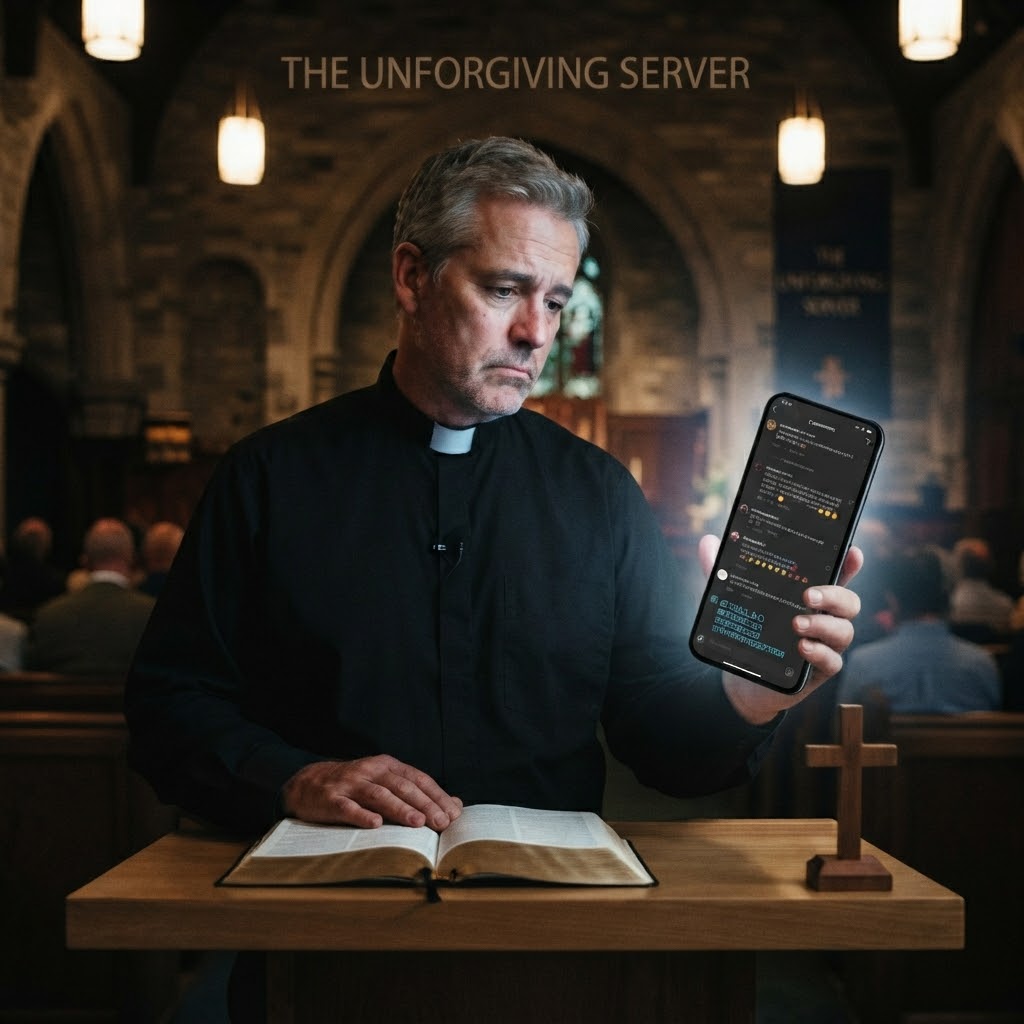
The digital public sphere is an unforgiving server. It remembers what we would rather forget, surfaces what we thought was buried, and distributes what we assumed was private. Research on forgiveness in the internet age has observed that the capacity to forgive is closely tied to the capacity to forget, and that digital memory makes forgetting increasingly difficult. The crowd does not forgive because it has no mechanism for forgiveness. It has only the mechanism of punishment. It can cancel, but it cannot restore. It can expose, but it cannot redeem. The church serves a Lord who does both. The gospel does not deny the reality of sin, but it insists that sin is not the final word. The church’s public witness must therefore be shaped by the conviction that judgment belongs to God, that repentance is possible, that restoration is real, and that the story is not over until the Author says it is.
This does not mean that pastors are exempt from accountability. It means that accountability must be ecclesial, transparent, and redemptive, not algorithmic, anonymous, and punitive. The church must not outsource its discipline to the mob. It must not allow the crowd to do what the elders are called to do. And it must not pretend that the crowd’s verdict is the same as the Lord’s verdict. The pastor who has failed may need to step down. The pastor who has been falsely accused may need to be vindicated. But these are matters for the church, not for the comment section.
Stewards of a Story We Do Not Control
Let me conclude will this statement: “The Lagos dispute will eventually be resolved, or it will not. Leaders will come and go. Platforms will rise and fall. But the underlying lesson will remain: the church has been given a public witness that it cannot control, in a medium that it did not design, before an audience that it cannot pastor. The only faithful response is to become a community of wiser speech, deeper governance, and more robust spiritual formation.”
So,our Pastors must stop treating social media as a promotional tool and start treating it as a sphere of spiritual warfare. Also, Churches must stop improvising in crisis and start building the institutions, protocols, and teams that can weather the storm. Church Leaders must stop performing for the crowd and start shepherding the flock. Lastly, new covenant believers must stop participating in the digital tribunal and start practising the discipline of listening, silence, and slow speech.
Friends this I know, the server may be unforgiving, but the Lord is not. The algorithm may remember every failure, but the blood of Christ speaks a better word. The church’s confidence is not in its ability to manage the narrative. It is in the God who raises the dead, who justifies the ungodly, and who will one day bring every hidden thing to light and every true thing to glory. Until then, the church must walk wisely in the public square, not because the crowd is worthy of its fear, but because the gospel is worthy of its care.
Prof. Sarumi, a disciple of Jesus Christ and teacher of the Word of God, writes from Lagos. Tel. 234 803 304 1421. Email:oyewolethecoach@gmail.com
