

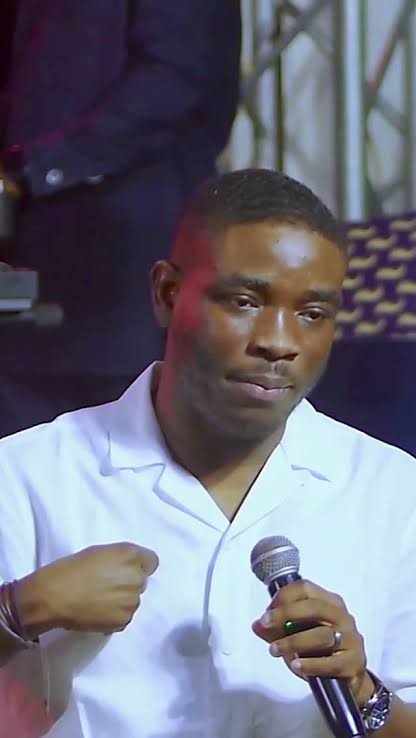
Lead Pastor of The Zoe Household Global (also known as Zoe Household Church or Zoe Place Church, Dolapo Lawal has given insight into several Bible verses that encourage believers to place demands on God, explaining why many do not get results when using such scriptures in prayer.
He shared these insights during a recent message posted on YouTube.
According to Lawal, many Christians take scriptures like “Ask and you will receive” out of context, using them to ask God for anything they desire.
He explained that Jesus’ instruction was given within a specific context. “If you read that scripture in the book of Luke 11:9–13, you will understand that it is not just anything you ask for that God will give you. There is a context to whatever you ask.
‘Ask and you shall receive’ pertains to spiritual things because, if you read further down in that passage, Jesus says, ‘How much more will your Heavenly Father give the Holy Spirit to those who ask Him?’”
He further noted that although God owns the heavens and the earth, He only grants things that hold true value for us and serve His purpose—not items that fuel human greed.
He added that as children of God, whatever we request must align with God’s purpose and will.
Expanding on his point, Lawal said, “Asking in His name means asking as though Jesus Himself were asking. God is saying our requests must accord with what Jesus would ask.”
According to him, God is not obligated to answer prayers offered with the wrong motives. “What people call delay is often the consequence of their own stubbornness. They refuse to learn while waiting on God for answers to their prayers,” he stated.
Sharing a personal example, he said, “There is something called coming out of the fire. I had to close two churches, and four pastors left me. For 18 months, I was just being a Christian, not a preacher. I couldn’t pray; I was merely playing at prayer.
“I went through fire. When I came out of that season, I stopped blaming others. If what those who left me did was bad, God allowed it for a reason. We must stop passing the blame and instead take responsibility for what we go through.
“We cannot blame God for our woes. How can you blame God? He put His Son, Jesus, on the cross to make His enemies His sons—and you want to blame Him? You must reach a point where it is either God or nobody else.”
Lawal reasoned that Christians often remain stuck in life’s wilderness because they refuse to learn what God is trying to teach them during their waiting period.
“The children of Israel were supposed to spend few days on their journey to Canaan, but it took them 40 years because they refused to learn. It is during delays that the impurities in our lives come out. Moses was away on the mountain for 40 days, and in that short time, the people exposed themselves as idol worshippers.”
He noted that many people love God for what He provides rather than for who He is. “Some of us think we love God until a delay occurs. The wilderness experience is meant to humble and test us, as seen in Deuteronomy 8:2–3.
“God allows you to hunger and then feeds you with manna to show His love. Even in your time of crisis, He shows up. However, you fail the test if you focus on the crisis instead of magnifying His provision.”
He emphasized that believers experience undue delays not because God is withholding answers, but because they fail the tests presented during those seasons.
“Delay isn’t caused by God; it’s caused by your behavior while waiting for what He promised. People often maintain the wrong disposition during their wilderness experience. As James 1:2–4 teaches, if it is faith, there must be waiting. It is not just the waiting itself, but the patience we display while waiting that counts. If it is of God, waiting is involved—you must get used to it. God promised Abraham a son, but he waited 25 years for Isaac. God wants to give you blessings, not idols. If He sees that you cannot surrender Isaac, He won’t give him to you. God’s goal is to purify our desires.”
Pastor Lawal also warned against attempting to “blackmail” God in prayer. “We must avoid prayers like, ‘If You know You are God, do this for me in one month.’ He might give you what you demand, but as the Bible says, He will send leanness to your soul. Our prayer should not be ‘God give me this or that,’ but rather seeking His will and keying into it.
“What God gives is context-specific. Elijah can mentor someone, but another leader doesn’t have to follow Elijah’s exact pattern. When a person functions within their own area of grace, it appears effortless. There is a book written about your life—it’s not about just doing something noble, but about doing what has been written specifically about you.”
He urged Christians to cultivate the habit of seeking God’s face to know His specific direction rather than forcing selfish desires upon Him. “God is raising lovers, not users. The problem is never with God. Why do you want what you want? Is it because you saw someone else with it?
“If nobody around you were married, would you still desire marriage? You must reach a point where your desires are purified. The blessing of being used by God is simply being used by Him—nothing more. If you get offended because He didn’t reward you in a specific earthly way after using you, you miss the true blessing.”
