

By Dayo Emmanuel
’A coalition of civil society organisations in Lagos has strongly condemned the ongoing demolition exercise in Makoko, accusing the Lagos State Government of carrying out what it described as “systemic, illegal, cruel and deceitful forced evictions” deliberately targeted at the urban poor.
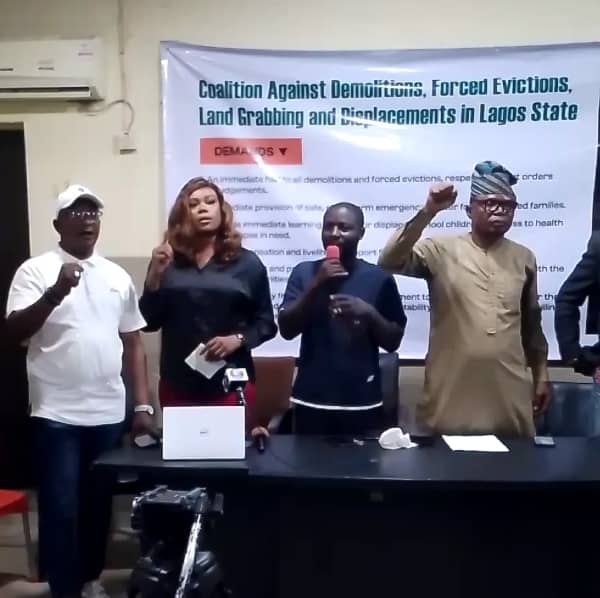
The coalition, which converged on the International Press Centre (IPC), Lagos, on Thursday January 22 said the demolitions have displaced thousands of residents, destroyed homes and livelihoods, and deepened humanitarian crises in waterfront and informal communities across the state.
A joint statement was signed by representatives of the coalition — including Israel Idowu, Student Coordinator of the Makoko Waterfront Community; Comrade Abiodun Ahmed, Chairman of Owode Motor Spare Parts Market and Comrade Tunde Yusuf of the Ajegunle Peoples Movement (APM)
Olanrewaju Olusegun of the Coalition of Oworonshoki Demolition Victims and Betty Abah of the Centre for Children’s Health Education, Orientation and Protection (CEEHOPE) also signed the statement
The group accused the state government of pursuing land acquisition through violence and deception.
The rights activists noted in the statement that the demolition of Makoko follows a disturbing pattern previously witnessed in Otodo Gbame, Oworonshoki, Monkey Village and other informal settlements across Lagos.
“We strongly condemn the Lagos State Government’s systemic, illegal, cruel and deceitful demolitions, forced evictions, displacement and land grab in underprivileged communities, including Makoko, Oworonshoki, Owode Onirin, Otumara and Baba-Ijora,” the coalition said.
Urban renewal
According to the coalition, the demolitions represent “a deliberate pattern of state-enabled violence against the urban poor,” allegedly carried out to clear valuable land for elite interests and private mega-developments without notice, consultation, compensation or resettlement.
The group rejected the government’s description of the demolitions as urban renewal, describing the exercise instead as “state-created homelessness engineered through brute force.”
“What is unfolding in these waterfront and informal settlements is not urban renewal as claimed by the state; it is state-created homelessness,” the statement read. “These demolitions overwhelmingly target fishermen and women, traders, women, children, the elderly and persons with disabilities who lack the political power or economic means to resist.”
The coalition warned that the destruction of homes without alternatives has plunged thousands of families into humanitarian distress, exposing residents to hunger, disease, illiteracy, violence and death.
“This is a vicious cycle in which the state creates homelessness and then abandons the victims to survive on their own, a situation that has been shown to also increase crime in societies,” it added.
Pattern of evictions across Lagos
Tracing what it described as a “pattern of forced evictions,” the coalition recalled that between November 2016 and April 2017, more than 30,000 residents of Otodo Gbame were expelled in defiance of court orders. It added that Oworonshoki was demolished in 2023, followed by Orisunmibare in February 2024, Otto in March 2024, and Oko Baba in September 2024.
On Ilaje-Otumara and Baba Ijora, the group said demolition squads invaded the communities in March 2025, leaving over 10,000 people homeless.
“Residents were evicted without prior notice and forced to flee with no time to collect their belongings as bulldozers razed their homes, businesses and places of worship,” the statement said. “Many are now sleeping on the streets, having lost not only their homes but also their livelihoods.”
The destruction of markets and fishing areas, the coalition said, has worsened food insecurity, leaving many families struggling to access daily meals.
On Oworonshoki, the activists accused the Babajide Sanwo-Olu administration of defying court orders, recalling that in October 2025 hundreds of homes were demolished at night while residents were asleep.
“Bulldozers pulled down homes with occupants inside. Tear gas was indiscriminately fired, residents were injured, beaten, arrested and detained in Kirikiri and Ikoyi prisons,” the coalition alleged.
The group said the demolitions continued despite an interim injunction secured by human rights lawyer Femi Falana (SAN), restraining the government from further action.
Makoko demolitions
On Makoko, the coalition said demolitions began on December 23, 2025, affecting more than 3,000 homes and displacing over 10,000 residents.
“Homes were set on fire with little or no notice, in some cases while residents were still inside. Tear gas was deployed against women, children and the elderly,” the statement said, adding that about 12 people, including two babies, reportedly lost their lives.
The group disputed the government’s claim that the demolitions were limited to buildings close to high-tension power lines, insisting that homes up to 500 metres away were destroyed.
“The law prescribes a maximum setback of 30 metres for 330KV lines. Yet the government has gone far beyond that distance, levelling homes, schools and clinics so vested interests can grab the land,” it alleged.
The coalition also criticised what it described as government hypocrisy in branding waterfront communities as environmental hazards.
“For decades, the state failed to provide sanitation, potable water, healthcare, schools and housing support. It is now weaponising that neglect to justify demolitions,” the group said.
Reacting to Governor Babajide Sanwo-Olu’s promise of palliatives for Makoko victims, the coalition rejected the offer.
“They are not beggars. They need their homes, their schools, their clinics and their livelihoods back,” the statement declared.
The coalition demanded an immediate halt to demolitions, compliance with court orders, emergency shelter for displaced families, compensation for demolished properties, a transparent resettlement plan, and a public apology from the governor.
“Lagos cannot claim global-city status while treating its poorest residents as disposable obstacles to profit,” the coalition warned, adding that “anything less than justice, compensation and resettlement will remain a permanent stain on the state’s conscience.”
Voices from the communities
Moderating the session, Comrade Taiwo Hassan Soweto decried what he described as the incessant demolition of poor communities by the Lagos State Government and urged affected communities to unite and stand up for their rights.
He assured residents of the coalition’s continued support in amplifying their voices against what he termed oppression and intimidation.
Speaking at the event, Comrade Lekan Akinpelu, a stakeholder at the Owode Onírin market, criticised the government’s priorities.
“The government should be providing education for the citizens and not killing them,” he said.
He continued that, “This government will soon wind up. By this time next year, Governor Sanwo-Olu will be winding up. I don’t know what legacy they want to leave. I know by the special grace of God, there is karma. What you sow is what you reap.”
Akinpelu questioned the democratic credentials of current leaders, asking: “When we were fighting for this democracy, where were the people in government today?”
According to him, insecurity in northern Nigeria is linked to the failure of leaders to prioritise education, warning that the demolitions in Lagos are pushing children out of school and creating a future crisis.
‘It is land grabbing’ — Makoko youth leader
Comrade Israel Idowu, student leader of the Makoko community, described the demolitions as outright land grabbing.
“What is happening in the community is simply land grabbing by the Lagos State Government,” he said.
Idowu narrated how the government allegedly kept changing the agreed setback distance from power lines, beginning with 30 metres, then 50 metres, and later 100 metres, before eventually deciding to clear the entire waterfront.
According to him, community members initially resisted but later agreed to the 30-metre setback after verifying that international standards ranged between 30 and 50 metres.
“We demarcated 30 metres. They demolished the 30 metres. Then they moved forward again. They said it was now 50 metres. We measured 50 metres. They demolished it. Later, we were told the order from above was to clear all waterside, not 30 metres,” he said.
Idowu alleged that despite the community marking 100 metres with Nigerian flags to avoid confrontation, the demolitions continued, accompanied by tear gas and violence.
He gave emotional accounts of deaths allegedly linked to the exercise, including babies and a nursing mother who, he said, bled to death after bulldozers blocked access to medical care.
“Children died because they could not withstand the tear gas. Babies died. A woman who just gave birth died because the caterpillar blocked the road while she was bleeding,” he said.
Idowu further accused officials of deception, claiming that while community members were told work had been halted, demolitions resumed shortly after.
He questioned claims that Makoko is uninhabitable and populated by foreigners, insisting that the community has existed for over a century.
“Makoko is my ancestral land. My grandfather lived there. My father is over 73 years old and still lives there. I was born there,” he said.
Governor ‘cannot claim ignorance’ — CAPPA
Answering questions from journalists, Zikora Ibeh, Assistant Executive Director of the Community Action for Popular Participation (CAPPA), dismissed claims that Governor Sanwo-Olu was unaware of the demolitions.
“How is it possible for the governor not to know? He has been governor for seven years. This is not a new matter,” she said.
Ibeh argued that visible sand-filling activities around Makoko indicate ongoing development interests.
“This is not just about power lines. Development is coming up there. Journalists should investigate who is behind the development going on,” she said.
She stated further that, information available to civil society groups suggests that international partners once proposed upgrading Makoko rather than displacing residents.
“The easiest thing for the government is to take the land outright from the people and build high-rise buildings,” she said.
NGOs respond to allegations
Also speaking, Ambassador Willie Workman Ogah of CEE-HOPE responded to claims that NGOs oppose the demolition because they benefit from Makoko.
“There is no country in the world without slum communities. What other countries do is upgrade them and make them habitable,” he said.
Ogah argued that the presence of NGOs in Makoko reflects government failure.
“If NGOs are working there, it means the government failed to provide basic amenities. NGOs are actually helping the government to do its job,” he added.
Baales, police and political complicity
On allegations that some Baales collected money from the government, Comrade Idowu said the community was prepared to challenge its own traditional leaders if evidence emerged.
“If the government is sure they paid our Baales, they should come out and name them and say how much was paid,” he said.
The struggle is over a decade old- President, Egbe Omo Ilaje Worldwide
President of Egbe Omo Ilaje Worldwide, Prince Iwamitigha R. Irowainu, said the struggle against demolitions has lasted over a decade.
Irowainu criticised what he described as fear and compromise among community leaders and urged more direct confrontation.
“Press conferences alone are not enough,” he said, adding that communities have a constitutional right to defend their property.
“We have been on this struggle with them for over 10 years. Now, in 2018 when the Lagos State government conceived the idea about the riverine communities, I was there with Comrade Omotehinse and many human rights leaders we fought the State Government to a stand still and we stopped it.
Last year, I addressed a press conference where what is happening today were comprehensively highlighted that this government wants to erase the riverine communities and these riverine communities from Mile 12 are
populated by the following Majidun and a lot of others, and this is where we are involved in Makoko and others.
“I led them to the Governor’s office on Friday and personally engaged them.
But do you know most problems we are having?
“We are very, very timid and cowardly in our approach in confronting this government, and not only that, most of our leaders, so called leaders, are most of the time compromising our struggle. So what I’m going to appeal to our NGOs is that press conference alone is not enough. We must up our activities by confronting them. I have told them, we told the honorable on Friday that we have right of self defense in line with the Republic of Nigeria.
“I have told them, therefore, the Ilaje community in Lagos state is going to defend itself whatever it will take, we will give it. If you don’t want to die, you don’t have the right to ask for the property of your father. You don’t want to die, it’s because we are afraid. That is why they keep on doing what they are doing.
“I told them, the people will sue the Commissioner of Police because his primary duty is the protection of lives and property. But what we are seeing in Lagos State today is that the Lagos State government has set up a taskforce they are using to perpetrate Illegal demolition in the name of Lagos State,” he said.
Comrade Alex Omotehinse also accused the Lagos State Government and House of Assembly of acting in concert.
“This is an orchestrated plan to phase out the poor in Lagos State,” he said, stating that protests had previously been held over demolitions in Otumara and Owode Onírin.
According to him, the backing of demolitions by the Lagos State House of Assembly shows elite consensus against vulnerable communities.
