

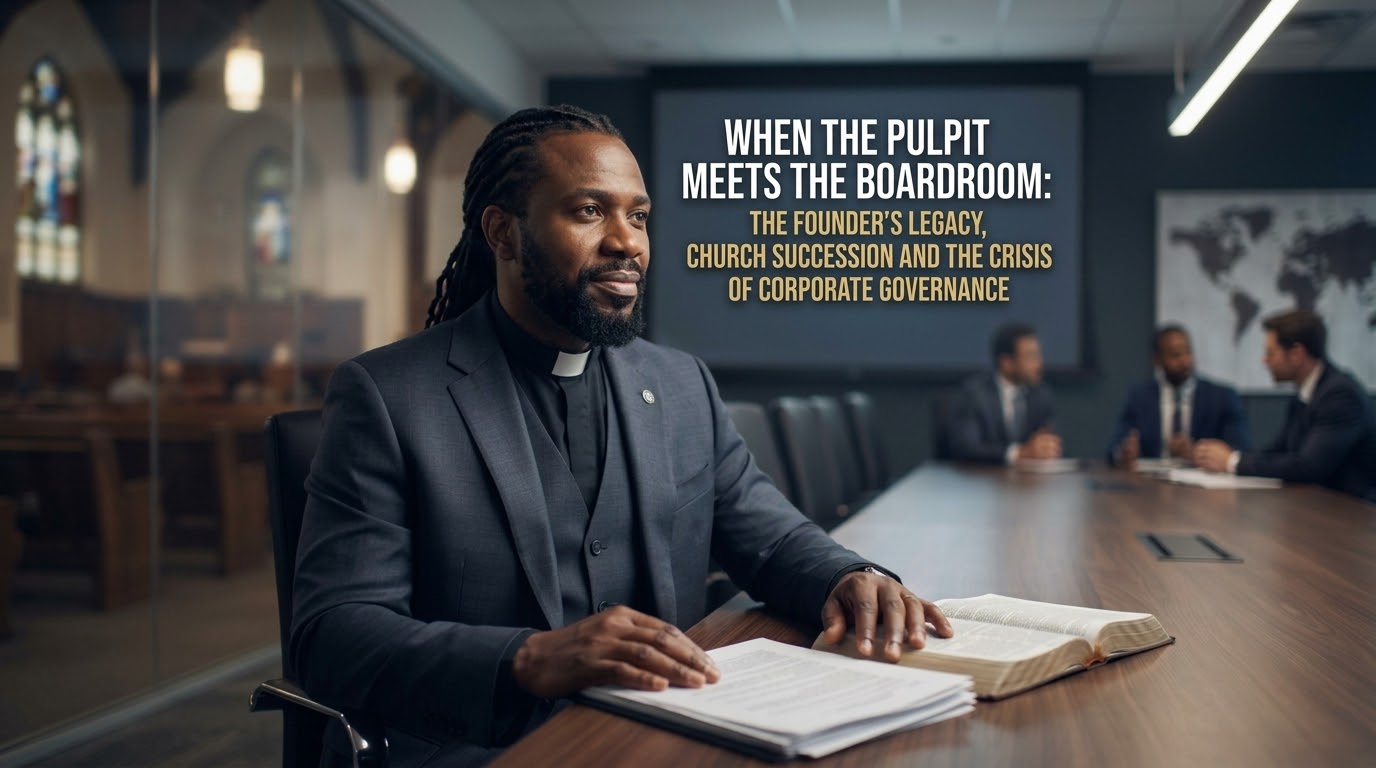
Lessons from The Fountain of Life Church, Ilupeju, Lagos, on institutional leadership, fiduciary responsibility, succession planning and the dangers of confusing spiritual authority with corporate ownership.
By Oyewole Sarumi
Introduction: When a Church’s Leadership Crisis Becomes a Governance Lesson
The unfolding leadership crisis at The Fountain of Life Church, Ilupeju, Lagos, involving Pastor Jimmy Odukoya and members of the church’s Board of Trustees, presents an important opportunity for a much wider conversation about leadership, institutional governance, succession planning and the sustainability of organisations beyond their founders.
It is particularly instructive because the issues emerging from the controversy extend beyond the identity of the next General Overseer or Senior Pastor. They raise fundamental questions about who has the authority to govern a church, who holds its assets, how succession decisions should be made, what happens when the wishes of a founder conflict with the governing constitution, and whether a religious institution can survive the personal ambitions, disagreements and competing interests of those entrusted with its leadership.
The developments have also exposed a misunderstanding that is not peculiar to churches. Many Nigerians, including some people occupying leadership positions in religious institutions, appear to regard a founder’s organisation as an extension of the founder’s personal estate. This misconception is particularly dangerous when the organisation has grown into a large institution supported by thousands of members, employees, volunteers, donors and other stakeholders.
A church may begin with the vision, sacrifice and spiritual leadership of one individual or a family. However, once it becomes an incorporated institution, its legal identity, governance responsibilities and institutional interests cannot simply be equated with the personal wishes of its founder.
A founder may establish an institution, but that does not necessarily confer permanent personal ownership over the institution or an unrestricted right to determine its future.
This distinction is central to understanding what is happening at Fountain of Life Church.
The issue deserves serious attention from church founders, General Overseers, pastors, trustees, denominational leaders, board members, Christian organisations and, indeed, corporate executives. The lessons extend well beyond the religious sector.
Let us examine the issues from the perspectives of corporate governance, Nigerian law, leadership succession and institutional sustainability.
1. The Fountain of Life Church: Understanding the Issues Behind the Crisis
The Fountain of Life Church was established in 1992 by Pastors Taiwo and Bimbo Odukoya. Following the death of Pastor Bimbo Odukoya in 2005 and subsequently that of Pastor Taiwo Odukoya in August 2023, the church entered a new chapter in its leadership history.
Pastor Jimmy Odukoya was appointed Senior Pastor in September 2023. His appointment was subsequently accepted and announced by the church’s leadership.
However, in November 2026, a serious disagreement emerged between him and a group identifying itself as the church’s Board of Trustees.
According to statements attributed to the trustees, a video recording made by the late Pastor Taiwo Odukoya in December 2021 contained instructions concerning his preferred succession arrangement. The trustees alleged that the recording identified another senior minister, Pastor Kunle Areogun, as the preferred successor, while assigning Jimmy administrative and youth-ministry responsibilities.
The trustees further alleged that the recording was not presented when Jimmy’s appointment was considered in 2023 and that they only became aware of it in December 2025.
They subsequently announced that Jimmy was no longer recognised as Senior Pastor, citing their interpretation of the church’s constitution and the late founder’s instructions.
Jimmy and the church’s counterstatement rejected the removal, maintaining that his appointment had been validly approved and that the trustees responsible for the announcement had acted outside the church’s constitutional procedures. They also raised allegations concerning the conduct of some trustees.
The matter escalated considerably when the trustees announced an interim leadership arrangement under Pastor Rotimi Okpaise.
On 18 November 2026, the Lagos State High Court reportedly granted an interim ex parte order restraining Jimmy Odukoya from presenting himself as Senior Pastor and Spiritual Head and from interfering with the church’s governance and administration. The order was made without prejudice to his right to challenge it or respond to the substantive claims.
Subsequently, Jimmy initiated a separate legal challenge at the Federal High Court, Lagos, questioning the validity of meetings and resolutions that allegedly led to his removal.
These developments have created a complicated situation involving competing claims about the legitimacy of the trustees’ decisions, the authority of the founder’s recorded instructions, the validity of the 2023 appointment and the interpretation of the church’s constitution.
The important distinction here is that allegations made by either side should not be mistaken for judicially established facts. Neither the competing public statements nor an interim court order should be treated as a final determination of all the underlying questions.
The substantive legal issues must be resolved through the appropriate constitutional and judicial processes.
Nevertheless, one important question emerges:
How can an institution that has existed for more than three decades find itself in a situation where the leadership succession of its founder becomes a source of institutional instability?
The answer takes us to the principles of incorporation and corporate governance.
2. A Church Is an Institution, Not the Personal Estate of Its Founder
Although, I am not a lawyer, but one of the most important issues to understand is the legal distinction between the founder of a church and the incorporated entity established to advance its religious objectives.
Under the Companies and Allied Matters Act (CAMA) 2020, religious associations may be registered through the mechanism of Incorporated Trustees under Part F of the Act.
Also, Section 823 provides for the incorporation of trustees appointed by communities or associations established for religious, educational, charitable and other specified purposes.
This is an important legal distinction. An incorporated church is not simply a gathering of people operating under the personal authority of its founder. It is a corporate body with its own legal identity.
Upon incorporation, the entity acquires legal personality and perpetual succession. This means that it can hold property, enter into contracts, sue and be sued, and continue to exist notwithstanding the death, retirement, resignation or replacement of its founder or trustees.
The death of a founder does not terminate the existence of the church. Neither does it automatically transfer the church’s assets to the founder’s children, spouse or relatives.
This is the fundamental principle of institutional continuity.
A church may bear the name associated with its founder, and its members may continue to regard that individual as the spiritual father of the ministry. However, the legal personality of the incorporated institution is distinct from the natural person who founded it.
It is therefore misleading to assume that because someone founded a church, that individual automatically possesses the same proprietary rights over the church as an entrepreneur possesses over a personally owned business.
There is a difference between founding an institution, leading an institution, governing an institution and owning an institution.
These are four distinct concepts.
The founder may provide the original vision. The General Overseer may provide spiritual direction. The trustees may exercise legal and fiduciary responsibilities. The governing council may oversee institutional administration. The congregation may constitute the membership or community whose interests the institution exists to serve.
These roles may overlap under a particular church’s constitution, but they should never be assumed to be interchangeable.
The institution must be bigger than the individual who founded it.
That is what distinguishes a sustainable institution from a personality-driven organisation.
The legal foundation for this distinction is found in CAMA 2020, particularly sections 823–830. Accountants.ng +1
3. Who Really Owns a Church? Understanding the Board of Trustees
This is where public understanding becomes particularly important.
A common misconception is that the founder owns the church, its auditorium, land, buildings, bank accounts, investments and other assets.
Another misconception is that the trustees personally own these assets because their names appear in legal documents.
Neither assumption adequately reflects the legal position based on my understanding.
Under the incorporated trustees arrangement, the trustees are appointed to hold and administer the institution’s property and exercise their responsibilities in accordance with the law and the church’s constitution.
The assets belong to the incorporated institution, not to the trustees in their personal capacities.
It is therefore more accurate to describe trustees as custodians and fiduciaries rather than owners in the ordinary commercial sense.
This distinction is important because trusteeship carries responsibilities.
Trustees are expected to exercise their powers for the purposes for which the institution was established. They cannot legitimately treat church property as their personal inheritance, use institutional funds for unrelated private purposes or distribute the church’s resources to themselves merely because they occupy positions on the Board.
Their responsibilities include protecting the institution’s assets, ensuring compliance with its governing documents, maintaining proper records and safeguarding the organisation’s objectives.
The same principle applies to a founder who remains the General Overseer or spiritual head.
Spiritual authority does not automatically translate into unlimited legal authority over the institution’s assets and governance.
Equally, the fact that someone is a trustee does not make that person spiritually superior to the General Overseer or give that person an unrestricted right to interfere in pastoral matters.
The relationship between spiritual leadership and institutional governance must be clearly defined.
This is why the constitution of a church is so important.
The constitution is the institution’s governance contract
Section 827 of CAMA 2020 requires the constitution of an incorporated association to provide for important matters, including:
- The appointment, powers, duties, tenure and replacement of trustees.
- The conduct of meetings.
- The composition and appointment of members of the governing body.
- The powers of the governing body.
- The procedures for handling contributions and disbursing funds.
- Accounting and auditing arrangements.
These are not administrative formalities. They are fundamental governance provisions.
A properly drafted church constitution should go further by defining the relationship between the founder, General Overseer, Board of Trustees, governing council, senior pastors and congregation.
It should establish who has authority to appoint or remove a General Overseer, how that authority is exercised, what happens when the founder dies or becomes incapacitated, and how disagreements are resolved.
A constitution that leaves these matters ambiguous is an invitation to future institutional conflict.
In the case of Fountain of Life Church, the public disagreement over the validity of the trustees’ meetings, the interpretation of constitutional provisions and the circumstances surrounding Jimmy Odukoya’s appointment demonstrates why these provisions cannot be left to informal understandings.
Indeed, the Federal High Court action reported on 21 November 2026 places particular emphasis on whether the disputed meetings and resolutions complied with the church’s constitution.
This is precisely why institutional leaders must not treat constitutions as documents that are prepared merely to satisfy registration requirements.
They are instruments for protecting the institution, its leadership and its future.
Accountants.ng +2
4. Perpetual Succession: The Church Must Outlive Its Founder
One of the most valuable principles of incorporation is perpetual succession.
In practical terms, this means that an incorporated church should continue to exist regardless of changes in its leadership.
A founder may die. A General Overseer may retire. A trustee may resign. A senior pastor may be removed. Members may leave. New members may join.
None of these events should, by itself, threaten the continued existence of the institution.
This principle has important implications for church leadership.
When a founder dies, the church should not suddenly become an organisation without direction because nobody knows who is entitled to lead it.
Neither should the founder’s family automatically assume that the institution has become part of their inheritance.
The church must have a succession arrangement that is already known, documented, accepted and capable of implementation.
Consider the difference between two scenarios.
In the first, a founder dies without a properly documented succession arrangement. The trustees have different interpretations of his wishes. Senior pastors have different expectations. Members begin to take sides. Family members become involved. Questions arise about the authority of the trustees and the legitimacy of the new leader.
In the second scenario, the founder has worked with the governing body to establish a transparent succession framework. The constitution specifies the process. Qualified successors have been developed. The trustees understand their responsibilities. The congregation knows what happens when leadership changes.
The second institution has a considerably better chance of navigating the transition without serious disruption.
The difference is not necessarily the quality of the founder’s spiritual leadership.
It is the quality of institutional preparation.
A founder who genuinely desires to leave a lasting legacy must prepare the organisation for a future in which he or she is no longer present.
This is equally true of family businesses, universities, professional associations, political parties, charities and government institutions.
A leader who builds an organisation that cannot function without him has not completed the work of institution-building.
He has built dependency rather than sustainability.
5. The Founder, the Family and the Dangerous Assumption of Bloodline Succession
This is perhaps one of the most sensitive dimensions of the discussion.
There is nothing inherently wrong with a founder’s child, spouse or relative becoming the next leader of a church.
There are examples of religious organisations where family members have successfully continued the work of their founders.
The problem is not family succession itself.
The problem is treating family relationship as an automatic qualification for institutional leadership.
A church is not a family-owned business in which the founder’s shares can simply be transferred to a son or daughter.
It is an institution established around a religious mission and governed by its legal and constitutional arrangements.
A founder’s son may be spiritually gifted, administratively competent and capable of leading the church. A founder’s daughter may possess the experience, maturity and leadership capacity required for the position. A founder’s spouse may equally be the most suitable candidate.
However, the appointment should be based on the governing framework, demonstrated competence, institutional legitimacy and the requirements of the ministry.
Blood relationship should neither automatically qualify nor automatically disqualify anyone.
The danger arises when family members are placed in positions of institutional authority primarily to secure a future succession arrangement.
In some organisations, founders appoint relatives to the Board of Trustees, governing council and other strategic positions. The arrangement may appear harmless while the founder is alive.
However, it can create a governance structure in which the board is unable or unwilling to exercise independent judgement when the founder’s wishes conflict with the institution’s interests.
The board becomes an extension of the founder’s household rather than an independent governance institution.
This undermines one of the fundamental purposes of corporate governance: the ability to provide oversight, challenge leadership decisions and protect the organisation from the concentration or abuse of power.
A trustee must understand that the duty is to the institution and its lawful objectives, not to the personal preferences of the founder or the financial interests of the founder’s family.
Equally, a founder must understand that appointing relatives as trustees does not necessarily create an unrestricted family right to determine the institution’s future.
The larger question is whether the institution is being structured to serve its mission or to preserve a family dynasty.
There is a distinction between preserving a founder’s legacy and perpetuating a founder’s bloodline.
The two should never be confused.
6. The Spiritual Dimension: Can a Founder’s Instruction Override the Constitution?
This is where the Fountain of Life situation becomes particularly instructive.
The reported dispute involves a video recording allegedly made by the late Pastor Taiwo Odukoya in December 2021, in which he is said to have communicated his preferred succession arrangement.
The trustees have relied on that recording in explaining their decision.
However, a critical governance question arises:
What is the legal and constitutional status of a founder’s recorded succession instruction?
There is a need to distinguish between a founder expressing a personal preference, a founder making a valid appointment under the church’s constitution, and the governing body formally approving or implementing a succession arrangement.
These are not necessarily the same thing.
A founder may possess enormous spiritual authority and moral influence within an organisation. His or her views may carry considerable weight among trustees and members.
Nevertheless, the legal effect of an instruction must be assessed against the institution’s governing documents and applicable law.
If the constitution empowers the founder to nominate a successor, the precise procedure for exercising that power becomes important.
Does the founder’s nomination require ratification by the Board of Trustees?
Must the nomination be communicated to the trustees during the founder’s lifetime?
Does the founder have the authority to make a binding appointment, or only to recommend a candidate?
Can a nomination be revoked or amended?
What happens if the founder’s instructions conflict with an appointment already made by the governing body?
Can a video recording satisfy the formal requirements for a valid appointment?
These are questions that cannot be answered simply by declaring that the founder heard from God.
For religious organisations, spiritual discernment and institutional governance should not be treated as competing ideas.
They should complement one another.
Indeed, if a founder believes that God has revealed the identity of a successor, the responsible course is to communicate that conviction through the institution’s established governance processes while there is still time to do so.
The founder should ensure that the relevant trustees understand the instruction, that the necessary constitutional procedures are followed and that the decision is properly documented.
This does not diminish the spiritual dimension of leadership.
It protects the spiritual vision from avoidable institutional confusion.
There is an important leadership lesson here: A spiritual conviction may guide a decision, but an institution needs a legitimate process through which that decision becomes an authorised institutional action.
A recording discovered years after it was made may be important evidence of the founder’s intentions. However, its legal effect cannot be assumed without examining the church’s constitution, the circumstances of its creation, its authenticity, the relevant appointment provisions and the decisions already taken by the governing body.
This is one reason the present dispute should be allowed to proceed through a fair and transparent process rather than public speculation.
7. The Board of Trustees: Custodians or Power Brokers?
The role of a Board of Trustees is often misunderstood in religious organisations.
Some founders regard trustees as people appointed to support the vision and protect the founder’s interests.
Some trustees regard themselves as ceremonial officeholders whose primary responsibility is to endorse the founder’s decisions.
Others may eventually begin to regard their positions as sources of personal influence and power.
All three approaches create governance weaknesses.
The Board of Trustees should be neither a rubber stamp for the founder nor an independent power centre pursuing its own interests.
It should function as a responsible governance institution operating within the limits of the law and the church’s constitution.
Its responsibilities should include protecting institutional assets, ensuring compliance, overseeing governance arrangements, maintaining accountability and safeguarding the long-term interests of the church.
However, it is equally important to recognise that trustees cannot simply assume powers that the constitution does not grant them.
A Board of Trustees cannot legitimately remove a General Overseer merely because some members are dissatisfied with that individual’s leadership.
The authority, procedure, voting requirements, notice provisions and other relevant conditions must be established by the constitution.
If the constitution gives the board the power to appoint and remove the Senior Pastor, that power must be exercised in accordance with the stipulated process.
If it gives the founder a particular appointment or nomination power, the board must respect that provision.
If the constitution requires a joint decision by the trustees and another governing body, neither should unilaterally assume the authority of the other.
This is precisely why the dispute at Fountain of Life should not be reduced to a simplistic argument about whether Jimmy Odukoya should remain Senior Pastor or whether another minister should succeed him.
The deeper question is whether the institution’s governance machinery has operated in accordance with its governing documents.
The public reporting of the competing positions makes it clear that the legitimacy of meetings and resolutions is itself contested.
The courts will have to determine the relevant legal questions on the evidence and arguments presented.
There is also a broader lesson for trustees of other churches.
A trustee who cannot exercise independent judgement is not fulfilling the full purpose of trusteeship.
But a trustee who uses the office to pursue personal grievances, settle scores or capture institutional authority is equally failing in that responsibility.
Trusteeship is a responsibility of stewardship, not an entitlement to power.
8. The Financial Dimension: Who Owns the Tithes, Offerings and Church Assets?
Another important misunderstanding concerns the financial resources of churches.
Many people assume that because churches receive tithes, offerings, donations and other contributions, those funds automatically belong to the founder or the General Overseer.
That is incorrect where the funds have been received by an incorporated church for its institutional purposes.
The church’s income and property must be administered in accordance with its legal status, constitution and stated objectives.
Section 838 of CAMA 2020 addresses the application of the income and property of incorporated trustees. The central principle is that institutional resources must be applied towards the organisation’s objectives rather than distributed as personal profits to members.
This has important consequences for financial governance.
A church’s assets may include:
- Land and buildings.
- Worship centres and conference facilities.
- Bank deposits and investments.
- Vehicles and equipment.
- Educational institutions.
- Hospitals and other social facilities.
- Intellectual property and other institutional rights.
- Shares and interests in other lawful entities.
These assets must be managed in the interests of the institution and its objectives.
The fact that a founder established the church does not entitle the founder’s family to appropriate them.
Similarly, trustees cannot divide the assets among themselves simply because they are legally responsible for administering them.
Now, let me ask this question: What happens to a church’s assets if it is dissolved?
This is an especially important issue.
Under section 850 of CAMA 2020, an incorporated trustees entity may be dissolved by an order of a court on the appropriate petition and grounds.
The dissolution process is not a mechanism for distributing the church’s assets among its founder, trustees or family members.
The applicable statutory provisions, the constitution and the court-supervised dissolution process govern what happens to the assets.
The CAMA framework provides for the application of remaining assets in accordance with the relevant provisions, including transfer to an association with similar objects where applicable.
The Corporate Affairs Commission’s Insolvency Regulations 2022 also require the identification of the similar body to which assets are transferred and evidence of that transfer.
This reinforces the not-for-profit character of the institution.
The founder’s family cannot simply treat the church’s remaining assets as an inheritance.
Next question: Are churches exempt from taxation?
There is another misconception worth correcting.
Churches are not automatically exempt from every form of taxation simply because they are religious organisations.
Nigeria’s tax framework provides exemptions for qualifying ecclesiastical and charitable activities of a public character, subject to statutory conditions.
The Federal Inland Revenue Service’s Information Circular No. 2021/01, issued on 31 March 2021, explains the tax treatment of non-governmental organisations.
It identifies donations, grants, offerings, tithes and certain other contributions as income that may qualify for exemption from Companies Income Tax when received by qualifying organisations for their public-interest objectives.
However, income derived from commercial activities or investments may attract tax where the relevant statutory conditions for exemption are not satisfied.
For example, if a church operates a commercial enterprise, earns profits from selling goods or provides professional services for fees, those activities may have tax implications.
Similarly, the salaries and other taxable remuneration received by pastors, employees and other individuals are not automatically exempt from Personal Income Tax simply because their employer is a church.
The NRS (formerly FIRS) circular also makes it clear that qualifying NGOs have tax registration and annual filing obligations.
Therefore, the popular assertion that churches do not pay tax needs to be properly qualified.
The correct position is that qualifying religious and charitable income may be exempt from Companies Income Tax, but the organisation must still comply with applicable tax and reporting obligations.
9. The Family of the Founder: Protecting Dependants Without Compromising Institutional Governance
This is an area that deserves more attention than it usually receives in discussions about church succession.
Many founders have spent decades building their ministries. Their spouses and children may have made considerable personal sacrifices during the formative years of the organisation.
Some spouses may have served as co-founders, supported the ministry financially, raised children while their partners travelled extensively, and contributed to the development of the institution.
It is understandable that founders may worry about the welfare of their families after their death.
This concern should not be dismissed.
However, there is a fundamental difference between protecting a founder’s dependants and transferring ownership of an incorporated institution to them.
The two objectives should be separated.
A founder should make adequate personal financial arrangements for his or her family while still alive.
These arrangements may include personal investments, insurance, pension arrangements, estate planning, family trusts and other lawful financial structures.
Where the church wishes to support a founder’s dependants, it may also establish an appropriately structured welfare arrangement, subject to its constitution, charitable objectives, tax obligations and fiduciary responsibilities.
However, such an arrangement must be properly designed.
It should not become an excuse for transferring church assets to family members or guaranteeing them an indefinite financial entitlement from resources donated for the institution’s religious and charitable purposes.
I would therefore recommend a distinction between three separate arrangements:
First, personal family estate planning. The founder should make adequate provision for the spouse and children from personal assets that lawfully belong to the founder.
Second, founder welfare arrangements. Where justified, the church may establish a transparent and properly authorised welfare or pension arrangement for the founder and eligible dependants, subject to legal and tax review.
Third, institutional succession planning. The church should independently determine how its spiritual and administrative leadership will be transferred when the founder dies, retires or becomes incapacitated.
These arrangements should never be confused.
A founder should not have to manipulate church governance to protect his family financially.
Equally, trustees should not use institutional succession as an opportunity to punish or marginalise the founder’s family.
A well-governed church should be capable of honouring its founders, protecting their legitimate personal interests and preserving its institutional independence.
That is responsible leadership.
10. Succession Planning: Why Churches Must Stop Treating Leadership Transition as an Emergency
One of the biggest weaknesses in many Nigerian organisations is the absence of formal succession planning.
We often wait until a founder dies, a CEO resigns, a political leader becomes incapacitated or a crisis emerges before asking who should take over.
This is not succession planning. It is crisis management.
The Fountain of Life situation illustrates what can happen when a founder’s intentions, the governing body’s understanding and the eventual appointment of a successor are not aligned through a clearly documented process.
Succession planning should be a continuous institutional activity, not an event that begins when a leader dies.
Research supports this position.
A 2022 study published in Nonprofit Management and Leadership, titled Improving Nonprofit Succession Management for Leadership Continuity: A Shared Leadership Approach, argues that succession management should not be left exclusively to the board or executive leader. It emphasises shared responsibility involving governing boards, executive leaders and human resource professionals.
More recently, a 2026 study by Adonnis J. Jules, Stuart Allen and Gregory McKee, published in the same journal, examined why nonprofit organisations fail to implement succession planning.
The researchers interviewed 20 senior nonprofit managers and found that, although many organisations recognised the importance of succession planning, they encountered barriers to implementation. Some did not regard it as a priority, while others preferred alternative approaches to identifying future leaders.
The findings are particularly relevant to churches.
A religious organisation may have a strong spiritual culture, a large congregation and an influential founder but still lack the systems necessary to manage leadership transitions.
The problem is not necessarily a lack of talented people.
It may be a lack of a deliberate process for identifying, developing, evaluating and appointing future leaders.
This is a governance failure that can be corrected.
A church should identify its future leadership needs, develop capable ministers, provide opportunities for leadership experience and establish transparent succession procedures.
It should also distinguish between emergency succession, planned retirement succession and permanent succession following the death or incapacity of a founder.
These are different scenarios and require different procedures.
The goal should be to ensure that the church’s spiritual mission continues without unnecessary disruption.
11. The Danger of Founder Syndrome: When the Institution Cannot Separate Itself from Its Founder
There is a leadership phenomenon commonly described as founder syndrome.
It occurs when an organisation becomes excessively dependent on its founder’s personality, authority, preferences and personal relationships.
The founder may have started the organisation with remarkable vision and courage. The founder may have made enormous sacrifices, raised funds, recruited people and built the institution from nothing.
However, as the organisation grows, the founder may find it difficult to transfer authority, delegate responsibility or establish governance structures that can function independently.
Over time, the institution becomes organised around the founder rather than around its mission.
The founder may become the final authority on virtually every decision. Senior leaders may be reluctant to challenge the founder. Trustees may be selected for their loyalty rather than their competence. Leadership development may be limited to individuals perceived as personally loyal.
The result is an institution with a strong founder but weak institutional systems.
This creates several risks.
First, the organisation becomes vulnerable to leadership disruption when the founder dies or becomes incapacitated.
Second, capable leaders may leave because they cannot see a clear path to advancement.
Third, the board may become ineffective because it has lost its independence.
Fourth, the institution may experience a succession crisis because leadership authority has never been properly institutionalised.
Finally, the founder’s family may become unnecessarily entangled in institutional affairs because no clear separation exists between personal family interests and organisational responsibilities.
This is not a problem limited to churches.
We have seen similar challenges in family-owned businesses, political parties, educational institutions and even some professional associations.
The lesson is simple:
The ultimate test of a founder’s leadership is not how much authority he or she accumulates, but how much institutional capacity is developed to sustain the organisation beyond the founder.
A truly successful founder builds people, systems, processes and institutions that can survive leadership transition.
12. Spiritual Authority and Corporate Governance Must Work Together
There is a tendency in some religious circles to regard corporate governance as a secular concept that should not interfere with spiritual leadership.
This is a false dichotomy.
Corporate governance is not designed to replace spiritual discernment, biblical authority or the spiritual mission of a church.
It provides an institutional framework for ensuring that the mission is properly protected and administered.
The Bible itself contains several examples of leadership structures, delegation, accountability and orderly administration.
In Exodus 18, Jethro advised Moses to establish a system of delegated leadership because the concentration of responsibility in one person was becoming unsustainable.
In Acts 6, the early church appointed qualified individuals to manage an important administrative responsibility so that the apostles could concentrate on their primary ministry.
In Acts 15, the early church addressed a significant doctrinal dispute through collective deliberation and an agreed process.
These examples demonstrate that spiritual leadership and organised institutional administration are not incompatible.
A church can preserve the authority of its spiritual leadership while establishing transparent financial controls, clear governance responsibilities, succession procedures and independent oversight.
Indeed, good governance can protect the church’s spiritual mission from unnecessary conflict.
The challenge is to establish a healthy relationship between spiritual authority and institutional accountability.
A General Overseer should not use spiritual authority to bypass every governance process.
A Board of Trustees should not use corporate authority to undermine legitimate pastoral leadership.
Both should recognise that they have different but complementary responsibilities.
The objective is not to create a power struggle between the pulpit and the boardroom.
It is to ensure that both serve the mission of the institution.
13. The Reputational Cost: When Leadership Conflicts Become Public Spectacles
There is another dimension that deserves attention: institutional reputation.
A church may spend decades building public trust through preaching, community service, charitable work, education, counselling and spiritual development.
However, a prolonged leadership dispute can quickly damage that reputation.
When senior leaders publicly contradict one another, members become confused about whom to follow. Congregations may become divided. Long-standing members may withdraw. Potential members may become reluctant to associate with the institution.
The damage can extend beyond attendance and membership.
Church employees may become uncertain about their reporting lines. Donors may question how their contributions are being managed. Business partners may become cautious about institutional engagements. Other religious organisations may become reluctant to collaborate.
Digital communication can make the situation worse.
Competing statements, social media posts, recordings and online commentary can turn an internal governance dispute into a national controversy.
The public may begin to focus more on the personalities involved than on the spiritual mission of the church.
This is a serious reputational risk.
The situation at Fountain of Life also demonstrates the importance of having an authorised institutional communication policy.
When competing groups issue statements using the name, logo and social media platforms of an institution, the public may struggle to determine which communication represents the legitimate position of the organisation.
A church should therefore have clear procedures for official communication, particularly during leadership transitions and governance disputes.
Such procedures should identify who is authorised to speak on behalf of the institution, how official statements are approved and how misinformation is corrected.
Leaders should also avoid using the pulpit, social media or congregation as instruments for personal attacks.
The church’s members should not be made to choose sides in a dispute that should be resolved through established institutional processes.
A leadership crisis should never become a spiritual referendum on the loyalty of ordinary worshippers.
14. The Lessons for Corporate Leaders: The Church Is Not the Only Institution at Risk
Although the immediate subject is a church, the leadership lessons are relevant to virtually every organisation.
Consider a family-owned company whose founder dies without a succession plan. The children disagree about who should become Managing Director. The board is divided. Senior executives begin supporting different family factions. Shareholders become concerned about the company’s future.
The same situation can occur in universities, professional associations, political parties, NGOs, foundations and other institutions.
In some Nigerian organisations, the founder occupies multiple positions simultaneously: principal shareholder, chairman, chief executive, spiritual head, principal decision-maker and sometimes the final authority on every operational issue.
This concentration of power may appear efficient during the early stages of an organisation’s development. However, it creates significant institutional vulnerabilities as the organisation grows.
When the founder eventually exits, the organisation may discover that it has no independent governance capacity.
The real issue is therefore not whether the founder’s son, daughter, spouse, deputy or another senior executive should succeed him.
The issue is whether the organisation has developed a legitimate, transparent and sustainable process for determining who should lead it.
There are five important lessons for corporate leaders.
First, leadership authority must be institutionalised. The organisation should not depend on undocumented personal understandings or informal arrangements.
Second, the board must be independent enough to provide oversight. A board whose members cannot challenge the founder constructively is unlikely to protect the organisation when a serious crisis emerges.
Third, succession must be planned before it becomes necessary. The identification and development of future leaders should be part of the organisation’s continuous leadership development strategy.
Fourth, personal interests must be separated from institutional interests. Founders should make personal arrangements for their families without compromising the organisation’s assets or governance.
Fifth, organisational reputation must be protected. Leaders must understand that internal disputes can destroy decades of institutional credibility if they are allowed to become prolonged public confrontations.
These are not merely theoretical considerations. They are essential requirements for building institutions that can survive generations.
15. My Recommendations: What Nigerian Churches and Other Institutions Must Do Differently
The developments surrounding Fountain of Life Church should stimulate a serious governance review across religious institutions in Nigeria.
I would make the following recommendations to church founders, General Overseers, trustees, denominational leaders and other institutional stakeholders.
1. Conduct an independent governance audit of the church
Every established church should commission a comprehensive review of its legal and governance arrangements.
The review should examine its CAC registration documents, constitution, trustee appointments, governing council structure, property ownership records, financial controls and succession arrangements.
The exercise should identify contradictions, outdated provisions and areas where authority is insufficiently defined.
Where necessary, the constitution should be reviewed and amended through the appropriate legal and statutory procedures.
This should not be done only when a founder is approaching retirement or is seriously ill.
It should be a regular governance exercise.
2. Clearly distinguish the roles of the founder, General Overseer and Board of Trustees
Every church should establish a clear separation of responsibilities.
The founder may be the spiritual visionary and founding leader. The General Overseer may provide spiritual direction and pastoral leadership. The Board of Trustees may exercise the responsibilities assigned to it under the law and constitution. A governing council may oversee administration, strategy and institutional performance.
The constitution should clearly define these relationships.
It should also specify which decisions require consultation, approval, ratification or independent oversight.
There must be no ambiguity about who has authority to appoint, suspend or remove the General Overseer.
Equally, trustees should understand the limits of their authority.
3. Establish a formal succession planning framework
Every mega church and established religious organisation should have a documented succession policy.
The policy should cover at least three circumstances:
- Planned succession following retirement or voluntary resignation.
- Emergency succession following death, illness or incapacity.
- Leadership replacement following misconduct, constitutional violations or loss of confidence, where the constitution provides for such action.
The process should identify the qualifications expected of potential successors, the selection procedure, the role of the founder, the responsibilities of the trustees and the appropriate involvement of the congregation.
The organisation should also maintain a leadership development pipeline.
Senior pastors, departmental leaders and other capable ministers should receive opportunities to develop the competencies required for higher responsibilities.
The objective should be to create several qualified and credible leadership options rather than an organisation with only one person considered capable of leading it.
4. Make leadership succession transparent and properly documented
Where a founder wishes to nominate a successor, the nomination should be formally documented.
If the constitution requires the Board of Trustees or governing council to approve the nomination, that process must be followed.
Relevant decisions should be recorded in properly maintained minutes.
Where appropriate, legal advice should be obtained to ensure that the founder’s wishes are consistent with the constitution and applicable law.
The organisation should not depend on private conversations, informal promises, verbal instructions or recordings whose legal status may later become contested.
A founder’s intentions should be converted into a valid institutional process while the founder is still alive and capable of participating.
5. Establish independent and competent Boards of Trustees
The composition of the Board of Trustees matters enormously.
A church should avoid creating a board that consists exclusively of the founder’s relatives, personal assistants or individuals whose principal qualification is unquestioning loyalty.
The board should have members with appropriate experience in law, finance, accounting, governance, administration, risk management and institutional leadership.
This does not mean that every church needs a board dominated by corporate executives.
It means that the trustees should possess the competence, integrity and independence necessary to discharge their responsibilities.
There should also be clear provisions for tenure, rotation, removal, conflicts of interest and replacement.
Trusteeship should be treated as a serious fiduciary responsibility, not an honorary appointment.
6. Create a founder’s family welfare and estate planning framework
Founders should not leave their families financially vulnerable because they have spent their productive years building a ministry.
However, the church should not become a substitute for personal estate planning.
Founders should make adequate provision for their spouses and children through personal investments, insurance, pensions, family trusts and other lawful arrangements.
Where the church establishes a welfare arrangement for a founder’s dependants, it should be properly authorised, transparent, financially sustainable and consistent with the institution’s charitable objectives.
Independent legal and financial professionals should review such arrangements to avoid conflicts of interest or improper distribution of institutional assets.
The objective is to protect the founder’s family without compromising the independence and financial integrity of the church.
7. Strengthen financial transparency and accountability
Religious organisations must recognise that contributions from members are held for institutional purposes.
They should therefore maintain proper accounting records, independent audits, documented expenditure approvals and appropriate financial controls.
The trustees and governing council should receive periodic financial reports.
Large asset transactions should receive the approvals required by the constitution and applicable law.
Churches should also comply with CAC filing requirements and applicable tax obligations.
The larger the institution, the greater its responsibility to demonstrate accountability.
Transparency should not be interpreted as a lack of faith.
It is an expression of responsible stewardship.
8. Introduce an institutional conflict-resolution mechanism
Not every disagreement should end in litigation.
Churches should establish appropriate internal mechanisms for resolving governance disputes.
These may include independent mediation, governance committees, neutral senior ministers and agreed dispute-resolution procedures.
However, internal mechanisms must not be used to deny anyone access to the courts or override statutory rights.
The procedures should encourage early intervention before disagreements escalate into public confrontations.
Where litigation becomes necessary, all parties should respect the judicial process and avoid prejudicing the proceedings through inflammatory public statements.
9. Develop a formal crisis communication policy
Every large church should have an authorised communication framework.
It should specify who can issue official statements, who controls the institution’s communication platforms and how sensitive governance decisions are communicated.
Where a leadership dispute arises, the church should communicate verified information through authorised channels.
The congregation deserves clarity, not conflicting messages.
The church should also discourage members from engaging in online attacks against individuals involved in the dispute.
Leaders must remember that the institution’s reputation belongs to a much wider community than the people currently occupying its leadership positions.
10. Conduct periodic leadership and governance succession simulations
This recommendation may appear unusual for churches, but it is particularly important for large religious organisations.
Churches should periodically conduct governance simulations to test what would happen if the founder became incapacitated or the General Overseer suddenly became unavailable.
- Who assumes responsibility?
- Who authorises financial transactions?
- Who convenes the governing body?
- Who communicates with the congregation?
- Who has authority to appoint an interim spiritual leader?
- How are disagreements resolved?
- What happens if two groups claim to represent the legitimate Board of Trustees?
These questions should be answered before an emergency occurs.
A church that cannot answer them is not adequately prepared for leadership transition.
16. A Proposed Church Governance and Succession Model
I would recommend that large Nigerian churches adopt a governance structure built around five interconnected pillars.
A. The Five Pillars of Sustainable Church Governance
1. Spiritual Leadership
Vision, doctrine, pastoral direction and spiritual formation
2. Corporate Governance
Trustees, constitutional authority, oversight and fiduciary responsibility
3. Institutional Management
Administration, finance, human resources, operations and risk management
4. Leadership Development and Succession
Talent identification, mentoring, succession readiness and continuity
5. Institutional Sustainability
Mission continuity, financial integrity, public trust and generational impact
The five pillars are interconnected. There’s no single pillar that should operate independently of the institution’s mission and constitution.
The model recognises that a church is simultaneously a spiritual community and an institution with legal, financial, administrative and human-resource responsibilities.
Spiritual leadership without sound governance may expose an institution to avoidable conflict.
Corporate governance without respect for the church’s spiritual mission may produce an administrative structure that loses sight of its purpose.
Institutional management without leadership development creates dependency.
Leadership development without succession planning creates uncertainty.
And succession planning without institutional sustainability merely transfers problems from one generation to another.
The five pillars must therefore operate together.
17. The Bigger Question: Are We Building Ministries or Sustainable Institutions?
This is perhaps the most important question arising from the Fountain of Life situation.
Nigeria has produced remarkable religious leaders who have built ministries with international influence.
Many of these leaders began with very limited resources. Through vision, faith, sacrifice, commitment and considerable personal effort, they developed organisations that now operate schools, universities, hospitals, media organisations, humanitarian programmes and large worship centres.
These are significant institutional achievements.
However, we must ask whether the governance structures of these organisations have developed at the same pace as their physical and financial growth.
- Have we built institutions that can survive the departure of their founders?
- Have we deliberately developed the next generation of leaders?
- Are our Boards of Trustees sufficiently independent and competent?
- Do our constitutions adequately address leadership transition?
- Are the church’s assets protected against personal appropriation?
- Are our financial systems transparent?
- Do our senior ministers understand the distinction between spiritual authority and corporate responsibility?
These are uncomfortable questions, but responsible leadership requires us to ask them.
A church should not need the death of its founder to discover that its succession arrangements are inadequate.
A university should not lose its identity because its founding Vice-Chancellor has retired.
A family business should not collapse because the founder’s children cannot agree on who should lead it.
A political party should not become paralysed because its founding leader is no longer available.
An institution that cannot survive a leadership transition has not yet achieved institutional maturity.
Conclusion: The True Measure of a Founder Is the Institution That Survives Him
The unfolding events at The Fountain of Life Church should be approached with sensitivity, fairness and respect for all the people involved.
Pastor Jimmy Odukoya, the trustees, the Odukoya family, the senior ministers and the congregation are dealing with a deeply consequential institutional dispute. It would be inappropriate to pronounce judgment on competing allegations while the relevant legal proceedings remain unresolved.
However, we should not allow the personalities involved to distract us from the larger governance lessons.
The central issue is bigger than who becomes the Senior Pastor of Fountain of Life Church.
It is about the future of institutions established around the vision of influential individuals.
It is about the difference between founding an institution and owning it.
It is about the responsibilities of trustees, the limitations of personal authority, the importance of constitutional governance and the need for succession planning.
It is also about the responsibility of founders to prepare their organisations for a future beyond their personal leadership.
A founder should be able to leave an institution without leaving behind a succession war.
A Board of Trustees should be able to protect an institution without becoming a rival power centre.
A successor should be able to assume leadership through a legitimate process without having to fight for recognition.
A founder’s family should be protected without having to inherit an institution that was never their personal estate.
And a congregation should be able to continue its spiritual journey without being compelled to choose sides in a leadership dispute.
There is a lesson here for every Nigerian leader, whether in the church, corporate sector, public service, education or entrepreneurship.
Do not build an institution that depends entirely on your presence. Build one that is strengthened by your presence but remains sustainable in your absence.
Your legacy is not merely the buildings you construct, the congregation you gather, the followers you attract or the wealth you accumulate.
Your legacy is the institution you leave behind, the leaders you develop, the systems you establish and the values that continue to guide the organisation long after you have exited the stage.
As I often emphasise in leadership development, leadership is not about creating permanent dependence on the leader. It is about developing the capacity of the institution to continue delivering value beyond the tenure of the individual.
The church belongs to its mission, not to the ego of its leaders.
The board exists to protect the institution, not to capture it.
The pulpit is a sacred responsibility, not a hereditary entitlement.
And the founder’s greatest achievement should be an institution that does not need another founder to survive.
The ultimate test of leadership is not how successfully you build an institution around yourself, but how successfully you build an institution that can outlive you.
My final challenge to Nigerian church leaders and corporate executives
If you are a founder, General Overseer, CEO, chairman, trustee or board member, take time to examine your organisation.
Ask yourself three questions:
- If I am no longer available tomorrow, can this institution continue to function effectively?
- Have I established a transparent, legitimate and documented process for determining my successor?
- Am I building an institution for future generations, or am I building an institution that will struggle to survive without me?
Your honest answers may reveal more about your leadership effectiveness than your current position or achievements.
My leadership proposition:
“An organisation becomes an institution when its mission, governance, systems and leadership succession are no longer dependent on the personality of its founder.” — Prof. Oyewole Sarumi, PhD
REFERENCES AND FURTHER READING
The following sources provide the legal, governance and research foundations for the discussion.
1. Companies and Allied Matters Act 2020 (Nigeria). Particularly Part F, sections 823–850, dealing with Incorporated Trustees, their constitutions, governing bodies, property, accounts, annual returns and dissolution. [Read the CAMA 2020 official gazette text](https://oo.hacdn.io/media/documents/Nigeria_-_Companies_and_Allied_Matters_Act_2020.pdf
2. Federal Inland Revenue Service (2021). Information Circular No. 2021/01: Guidelines on the Tax Treatment of Non-Governmental Organisations. [Read the FIRS circular](https://old.firs.gov.ng/wp-content/uploads/2021/04/Circular-on-Taxation-of-NGOs.pdf
3. Jules, A. J., Allen, S. and McKee, G. (2026). Understanding the Lack of Leadership Succession Planning in Nonprofit Organizations. Nonprofit Management and Leadership. [Read the research abstract](https://onlinelibrary.wiley.com/doi/abs/10.1002/nml.70053
4. Improving Nonprofit Succession Management for Leadership Continuity: A Shared Leadership Approach (2022). Nonprofit Management and Leadership. [Read the research study](https://onlinelibrary.wiley.com/doi/10.1002/nml.21508
5. The Cable (17 November 2026). Fountain of Life Church removes Jimmy Odukoya as senior pastor. [Read the report] https://www.thecable.ng/breaking-fountain-of-life-church-removes-jimmy-odukoya-as-senior-pastor/
6. The Cable (19 November 2026). Court restrains Jimmy Odukoya from acting as senior pastor of Fountain of Life Church. [Read the report](https://www.thecable.ng/court-restrains-jimmy-odukoya-from-parading-himself-as-senior-pastor-of-fountain-of-life-church/
7. The Guardian (21 November 2026). Jimmy Odukoya sues sister, trustees over removal as Fountain of Life pastor. [Read the report](https://guardian.ng/news/nigeria/metro/jimmy-odukoya-sues-sister-trustees-over-removal-as-fountain-of-life-pastor/
8. Premium Times (19 November 2026). Fountain of Life crisis: Court restrains Jimmy Odukoya as senior pastor. [Read the report](https://www.premiumtimesng.com/entertainment/naija-fashion/926518-fountain-of-life-crisis-court-restrains-jimmy-odukoya-as-senior-pastor.html
NOTE
Editorial and legal clarification: There are two important technical qualifications to the legal discussion.
First, Incorporated Trustees are a common registration structure for churches in Nigeria, but it would be too categorical to suggest that a religious organisation can never use any other not-for-profit corporate structure. CAMA also recognises companies limited by guarantee, which cannot distribute profits to members. A private company limited by shares is not an appropriate structure for an organisation established as a non-profit religious body.
Second, the precise dissolution and asset-transfer provisions applicable to an Incorporated Trustees entity should be distinguished from those governing a company limited by guarantee. The legal requirements and the organisation’s constitution must be examined before making a definitive statement about the destination of its assets.
CAVEAT EMPTOR:
This article is a leadership and governance analysis, not a legal opinion on the pending Fountain of Life litigation.
