By Chika Abanobi
Davis who? Offor! Do you know him? If you don’t, chances are that you were not born or were still a toddler in 1980s when he and other team of actors and actresses made “The New Masquerade,” a must-watch comic sit-com by keeping millions of Nigerian viewers and other nationals glued to the Nigeria Television Authority (NTA).
Some news/entertainment programmes on the national TV station were so popular that, at a point, the television authorities boasted of being watched by more than 30 million viewers, in terms of audience reach.“Clarus Mgbeojirikwe” as his stage name is, was part of the cast that thrilled the 30 million viewers, week after week, with rib-cracking episodes.
He, alongside Chika Okpala (alias Chief Zebrudaya Okoroigwe Nwogbo); his actress-wife, Lizzy Evoeme (alias Ovuleria); Claude Eke (alias Jegede Shokoya, and, by the grace of God, the “only millionaire” in the whole universe); James Iroha, (alias Gringory Akabogu); Christy Essien-Igbokwe (alias Apeno) and later Veronica Njoku (alias Ramota), Romanus Amuta (alias Natty) and other characters, by dint of flawless acting skills, ensured that Nigerians had a lot of societal foibles to laugh at, every week.
That was before Nkem Owoh (Osuofia), Atunyota Akporobomerere (Ali Baba), Bright Okpocha (Basketmouth), Bovi Ugboma (Bovi), Ayo Makun (AY), Kenny Ogunjimi (Kenny Blaq), Okechukwu Anthony Onyegbule (Okey Bakassi), Kenneth Ogwuche (Sarkin Dariya), Bowoto Jephthah Oluwatiseyifumi Tanimola (Akpororo), Oghenekowhoyan Onaibe Desmond (Destalker), Emmanuel Chukwuemeka Ejekwu (Oga Sabinus), Samuel Animashaun Perry (Broda Shaggi), Emmanuel Chukwuebuka Amuzi (Brain Jotter), Debo Adebayo (Mr. Macaroni), Maryam Apaokagi (Taaooma) and other comedians arrived Nigeria’s entertainment scene with relatable character-driven humour and disarming satires.
Unforgettable Episode of Comic Sitcom*
In one of the unforgettable episodes of “The New Masquerade”, “Gringory” and “Clarus” (mischievous houseboys to Chief Zebrudaya and his wife, Ovuleria) decided to address, in a dramatic way, the issue of water scarcity. And, which in turn had been making it difficult/impossible for state and federal firefighters to put out rampaging fires that broke out, from time to time, in many parts of Nigeria.
In that episode, the two actors brought two empty buckets or containers and started weeping ‘uncontrollably.’ And, while they were at it, they supposedly allowed their purported ‘tears’ to drop into them.
Everybody, including Chief Zebrudaya, Jegede, Ovuleria, Ramota, Natty and even viewers, were expected to contribute their own quota of tear-drops.
In turn, they hoped to donate the buckets full of people’s tears for the use of the Nigerian Fire Service stations so that its firefighters that had been complaining of water scarcity could have enough “water” with which to quench the raging fires razing market stalls and other infrastructures across the country.
*Meeting and striking up friendship*
It was such witty acting that endeared my heart to “Clarus the Acting Big Boy” as he always liked to be addressed. You can imagine my surprise when, in the line of duty as a journalist, I ran into him in his apartment then located somewhere off Aba-Owerri Road, Aba.
It turned out that he too had been reading my journalistic reports and writings and liked the way I write. We exchanged phone numbers.
A little probing would later reveal that, being blind, he picked interest in the way I write from people around him who always bought copies of “The Sun” newspaper, where I worked then, and had favourite writers they always liked to read and talk about their reportage.
*Untold Stories of Aba*
That year, 2017, I was in Aba to do a story on the history and development of Aba, known popularly among the Igbo as the “Enyimba City.”
Aba is said to be the first Ngwa man to receive the Whiteman or colonial masters. Hence, the city is known as Aba Ngwa. Among those I interviewed were a group of Hausas who had lived in the city for more than 50 years, in fact, who were born and bred there and spoke Igbo language more fluently than many natives.
Apart from His Royal Majesty, Eze Isaac Ikonne, Davis Offor (alias Clarus), who lived almost all his life in the city, turned out to be one of my most credible news sources.
Other well-known Nigerian actors who spent their early years in the Eastern Nigerian commercial city of Aba include Ola Balogun, Osita Iheme (Pawpaw), Nkeiru Sylvanus and Benita Nzeribe.
One of the funny stories that “Clarus” shared with me was how, in the olden days when the crime of pick-pocketing was so rampant in Aba that someone could snatch your surname off your first name without you knowing, a pickpocket/bag-snatcher snatched from a well-dressed man, a portmanteau he believed to be full of cash. Thereafter, he disappeared with it into the crowd.
He then ran up the street as the police and bystanders gave him a hot chase. Unfortunately for him, they caught up with him somewhere at a street junction linking other streets. Then they asked him to open the briefcase so that they could see what was inside.
As he had no key to open it with, he was forced to break it open. To his utmost horror and that of the police and other civilian captors, the portmanteau contained neatly packed human body parts.
As captors and onlookers angrily descended on him with blood streaming down his face and body, according to Clarus, he was heard saying/confessing: “My people, although I am a well-known pickpocket/bag-snatcher in this Aba, God is my witness, and some of you here know me too, that I have not graduated to the crime of killing my fellow human being and putting his parts in a portmanteau. So, please, don’t kill me. I am only a pickpocket. I stole this bag from one useless man passing through the street over there before the police and others saw me and started pursuing me.”
Even though his life was spared from lynching by the angry crowd because of prompt intervention by the police, only God knows his final fate after the case was formally charged to court. As for the real owner of the portmanteau, knowing full well the implication of coming forward to identify it as his, the “useless man”, as the pickpocket described him, simply disappeared from the scene.
*Memorable photos and news of his death*
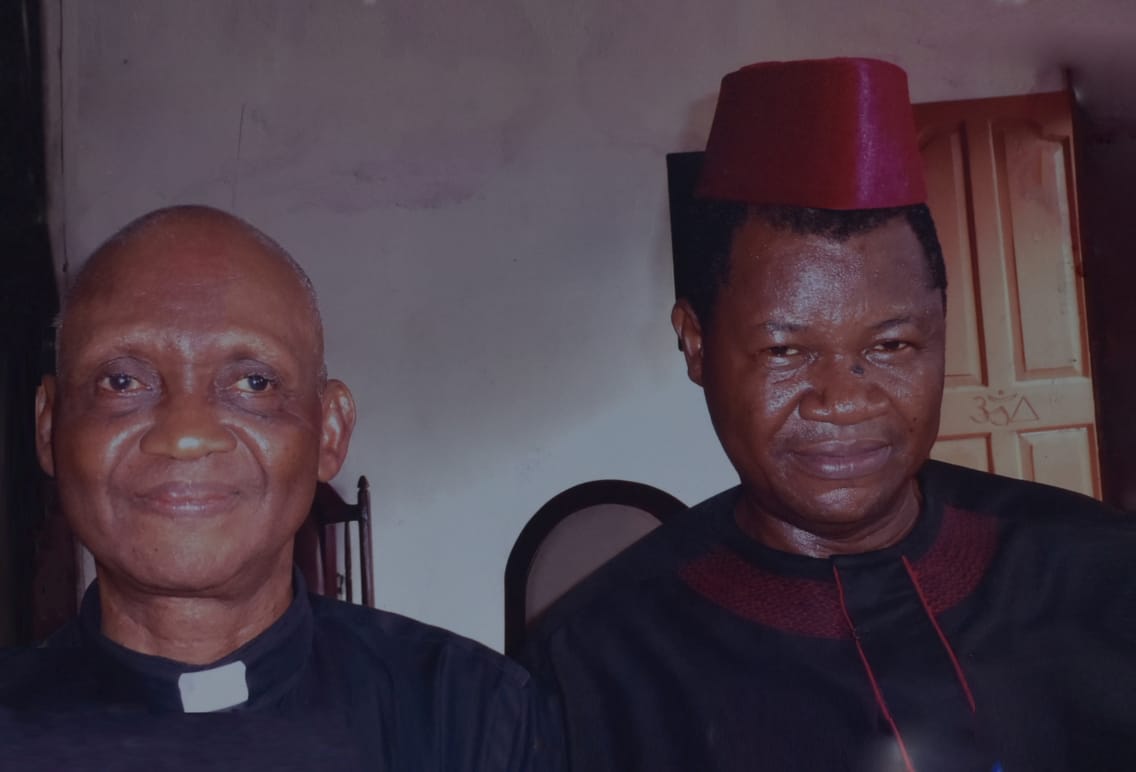
Before the “Enyimba City” story, five years earlier, in 2012, I had interviewed “Clarus”, through a phone call, on the death of James Iroha.
But in subsequent encounters that took place, we had a good time to sit together for memorable photographs. But generally, over the years, we have maintained a fairly constant phone touch with each other.
But nothing prepared me for the shock I received when recently his actor-colleague, Tony Akposheri (Zacky), broke the news on his Instagram page. Reportedly born in 1941, Clarus died on April 6, 2026, at a relatively ripe age of 85. Contrary to some newspaper reports, he is from Item, Bende, Abia State. But, his passage has left me with some sobering moral lessons:
*#1: Life is short and fleeting, live it wisely*
There are people who live only for what they can get out of life. And, when you look at what they get, it is nothing but bubbles that exist for a while and then are seen no more.
I mean, the accolades, fame, honour, achievements, wealth, pleasures, men’s respect, relationships, etc. William Shakespeare, the famous English playwright put the truth succinctly when, through the mouth of Macbeth, he described life as a “walking shadow, a poor player/that struts and frets his hour upon the stage/And then is heard no more. It is a tale/Told by an idiot, full of sound and fury/Signifying nothing.”
You could be tempted to dismiss that Shakespearean quote with a wave of hand. But the ugly truth staring all of us in the face is, no matter how hard we try to dismiss it by partying hard and enjoying pleasures of life, no matter how determined we are at pursuing wealth and fame and the accompanying honour, respect and accolades, one day we will come to agree with the Shakespearean counter-intuitive observation.
*Proofs of Shakespearean observation*
All you need to prove whether the Shakespearean observation is true or not is, take a look at all the famous actors, actresses, musicians, preachers, pastors, scientists, historians, etc that have come and gone.
Where are they today? I mean one-time A-list Nollywood actors and actresses. Not to forget music artistes. They all now seem to belong to the past. A proof that they have left the stage of strutting for fame and honour or fretting for them and are no longer alive or as popular or famous as they used to be!
One mystery about death is that it does not happen by age: the old die as sure as the young; the sick as well as the healthy. It can come at any time and by whatever means: by accidents and incidents; by fire or water; by sword or gun; by bomb or bullet; by violence or peaceful means.
But no matter through which means it comes, it does not remove anything from the observation of William Shakespeare. Or, the ensuing maddening rat race that defines human pursuits and ambitions.
Long before Shakespeare came up with his famous timeless observation about the fleeting nature of life, the Bible had already said as much in many places.
In Job 7:7 we read that our life is like a wind, (some Bible translations say “breath”). In Psalm 39:4, the Psalmist prayed: “Lord, make me to know mine end, and the measure of my days, what it is, that I may know how frail I am” (KJV). In Psalm 144:4, he remarked that “man is like… vanity: his days are as a shadow that passeth away”(KJV).
*The unvarnished truth*
In James 4:14, we read that life, however you see or view it, is “even a vapour that appeareth for a little time and then vanisheth away”(KJV). But the irony of it all is, the mad pursuit of its promises does not allow us to remember this truth always, to place it before us as a guiding light.
This is why, in Psalm 90:12, Moses prayed: “so teach us to number our days, that we may apply our hearts unto wisdom”(KJV).
But we need to admit that sometimes self-imposed pressures to achieve something before we die so that people, friends and neighbours majorly, will not laugh at us or make mockery of us or gossip about us make us not think deeply about the trajectory our lives are assuming.
The unvarnished truth is while the kingdom of earth runs on wealth, achievements, fame, popularity and honour, the kingdom of God runs on righteousness and holiness. And, oftentimes, the two are like two opposing parallel lines that cannot meet, even in infinity or eternity.
But when we talk about life or living, some truths stand out: “The memory of the just is blessed” (Proverbs 10:7, KJV).
Some weeks ago, I wrote in “Church Times,” about William J. Seymour the fiery black preacher/pastor whom God used to bring about the great Azusa Street Pentecostal Revival that took place in Los Angeles, California, United States, about 120 years ago.
That time, my great, grandparents had not been born. Not to talk of me. But here was I writing about a man that existed more than half a century ago before I was born as if I was there when everything happened.
This is a clear proof of the fact that the memory of the just is blessed.
*Memories of the just*
The same thing can be said about other famous men and women of God like Brother Lawrence, Thomas A Kempis, John Wesley, Charles Wesley, Charles Spurgeon, Charles Finney, William Booth, Billy Graham, Kenneth Hagin Snr, Kathryn Kuhlman, Aimee Semple McPherson, Maria Woodworth-Etter, Mildred Wicks, Lucy Farrow, Catherine Booth, Phoebe Palmer, etc.
While nothing much can be said about writers, music stars, actors/actresses, scientists that made waves during their times, except perhaps in lecture rooms, an average believer can be greatly influenced by just reading about the lives of these famous men and women of God who lived, perhaps, many centuries ago, before he or she was born.
This knowledge should help us know how to apply the wisdom Moses spoke about in our day-to-day life.
Whatever happens, know that the world, whether outside the church or inside it, emphasises achievements, fame, honour, ego or pride that go with them. But God emphasises simplicity, humility, peace and righteousness.
*#2: Know what you believe because what you believe will ultimately determine your soul’s destiny.*
Many people profess different religious beliefs today, and sometimes use those beliefs or doctrines to assess or judge whether God is pleased with others who claim to believe and worship Him.They judge whether they are getting it right or not, although that may not be included among their briefs.
Take, Clarus, for instance. While alive, he belonged to the Aetherius Society or Temple, a London-based mystic order with a branch at Aba, Abia State.
Ordained in London in 1989 as its priest or pastor, he remained so till the time of his death. But one thing its members don’t believe is in the vicarious death of Jesus on the Cross at Calvary for the entire mankind.
Rather, they believe that everybody must pay for their sins, if not in this world, then in the next to come through reincarnation. They call it the law of Karma.
They also believe in reincarnation. As a matter of fact, Clarus believed that his loss of sight may not be anything medical but having to do with something he did wrong in his past world and for which he needed to atone for it by being punished in the present world.
*Reincarnation and the Biblical truth*
Adherents believe that John the Baptist was Elijah come back to life (Mark 9:11-13) and that he paid for his sin of killing 450 prophets and 400 worshippers of Baal which ate at the table of Jezebel (1 Kings 18:19, 40) by being beheaded in prison (Matthew 14:1-12; Mark 6:14-29).
They have problem, though, explaining how the same Elijah who is believed to have been reincarnated by John the Baptist could appear on the Mount of Transfiguration together with Moses (Matthew 17:1-13; Mark 9:2-13; Luke 9:28-36).
Bible scholars like Pastor W.F. Kumuyi, General Superintendent, Deeper Life Bible Ministry, explains that the Lord’s remarks on the personality of John the Baptist, “if you will receive it, this is Elias, which was for to come. He that hath ear to hear, let him hear”(Matthew 11:13-14, KJV), does not mean that he reincarnated Elijah in the same sense that members of Aetherius Temple and many African traditional worshippers understand it.
Rather, he believes that it means that John the Baptist will operate “in the spirit and power of Elijah to turn the hearts of the fathers to the children, and the disobedient to the wisdom of the just; to make ready a people prepared for the Lord (Luke 1:17, KJV; Malachi 4:5-6; John 1:19-28).”
Oftentimes, I would argue with Clarus on some of these beliefs, without making much impression on him. But it did not affect our friendship nor the mutual respect we had for each other.
*Sins and forgiveness*
But there’s need to examine critically the issue of forgiveness. When Jesus, in Mark 2:5, said to the man who was brought through the roof by four of his friends, into the place where He was preaching in Capernaum: “Son, thy sins be forgiven thee”, which sins was He talking about: the ones he committed against God as we read in Matthew 6:12 or the ones he committed against his fellow men (Matthew 5:23, 24)?
The same question applies with regard to Jesus’ prayer on the Cross: “Father, forgive them for they know not what they do” (Luke 23:34, KJV). The truth is, Jesus teaches that there are two kinds of sins: one against God with whom we are in a vertical relationship and another against men with whom we are in a horizontal relationship.
And, even among men, we have crimes against the state which can attract various terms of punishment, including capital one (Romans 13: 3-4; 1 John 5: 16).
While pointing people to Jesus, John the Baptist, said in John 1:29: “Behold, the Lamb of God, which taketh away the sin of the world” (KJV). The question that arises is, what kind of sin is this verse referring to? The ones against our fellow human beings and against the state? Or, is it the ones against God?
While it is in our hand to forgive or not to forgive wrongs or offences done against us or to hold them forever against the doers, we certainly cannot use the foregoing verses to justify our refusal to forgive because in Matthew 6: 14, 15, Jesus said pointedly “if you forgive men their trespasses, your heavenly Father will also forgive you: But if ye forgive not men their trespasses, neither will your Father forgive your trespasses”(KJV).
*Shades of mercies and forgiveness*
So? Paying your tithes and giving offerings regularly or sowing financial seed in a bid to ‘provoke’ God cannot, in all honesty, fetch you the kind of forgiveness Jesus is talking about here.
So is being prayed for by a ‘powerful’ pastor, senior pastor, evangelist, Bishop, Archbishop or General Overseer.
Rather, you obtain it by only forgiving others after you might have worked through your differences, iron out some areas of disagreement, unburden your grievances and prayed through about them.
On the vicarious death of Jesus on the cross for our sins, it’s only for who those who believe. If you don’t believe, there’s nothing He or anybody can do about it.
Clemency is granted, from year to year, to prisoners who the prison authorities and government feel deserve it. But granting clemency is one thing, accepting and signing it is quite another. If the government grants you clemency and you refused to accept or sign for it, there is nothing anybody can do about it except to allow you suffer the full weight of the law that your sin or offence deserves.
As with clemency so with the forgiveness that Jesus provides through His vicarious death on the Cross at Calvary.
*#3: Although the Bible said something about the ultimate fate of sinners, none of us can really say what happens to people at the point of death*
Dr. Tai Solarin, founder of Mayflower School, Ikenne, Ogun State and later, Chairman, People’s Bank of Nigeria, while he lived, was a self-confessed atheist who did not believe in the existence of God nor went to church.
All the same, he had some regards for Pastor W.F. Kumuyi. A one-time Mathematics teacher in his school, he was a highly disciplined religious leader who did not subscribe to Solarin’s atheistic belief.
But so happy was he, with who or what Kumuyi eventually became, that one day, he (Solarin) took his time to visit him (Kumuyi) at the Gbagada Lagos headquarters of his church, the Deeper Life Bible Church.
*Controversy and ‘barbed’ question*
But, at his death in 1994, a controversy arose as to whether he went to heaven or hell, given his well-known stance on God and other religious beliefs concerning Him.
So? Journalists sought the opinion of Pastor Kumuyi on the matter. And, they did so with what is generally regarded in journalism profession as ‘barbed’ question.
A ‘barbed’ question is a deceitfully simple or ordinary question that could end up putting you in big trouble if you don’t think very well before you answer it. The question was: “given all you know about the fate of sinners/non-believers as outlined in the Bible, could you sincerely tell us whether Tai Solarin is in heaven or hell?”
Now, if he had answered that the man was in hell, the banner headline, the following day, would have read: “TAI SOLARIN’S IN HELL – KUMUYI.” If he said he was in heaven, the banner headline would still not be too different: “TAI SOLARIN’S IN HEAVEN – KUMUYI.”
So, perceiving their intention, the man of God chose his answer carefully and wisely.
He started by citing an example with one of the thieves who went from the cross to Paradise. He then ended it by stating that most times, you really cannot say what happens to people or where they went, at the point of death.
If the thief was a member of some churches, who knows, he might have been required to go through some church/religious rituals like baptismal class/converts class, water baptism, etc.
But those processes were waived for the thief on the Cross at simply because he repented and believed. What’s more, it is possible that those he offended by stealing their property might have believed that he went to hell, because “it is written, cursed is everyone that hangeth on a tree” (Galatians 3:13; Deuteronomy 21:23).
But the Bible convincingly recorded that he actually went to Paradise.
The author, member, Journalists For Christ Outreach International, sent the piece from Mgbakam-Okwuohia, Obowo, Imo State.*