By Chika Abanobi
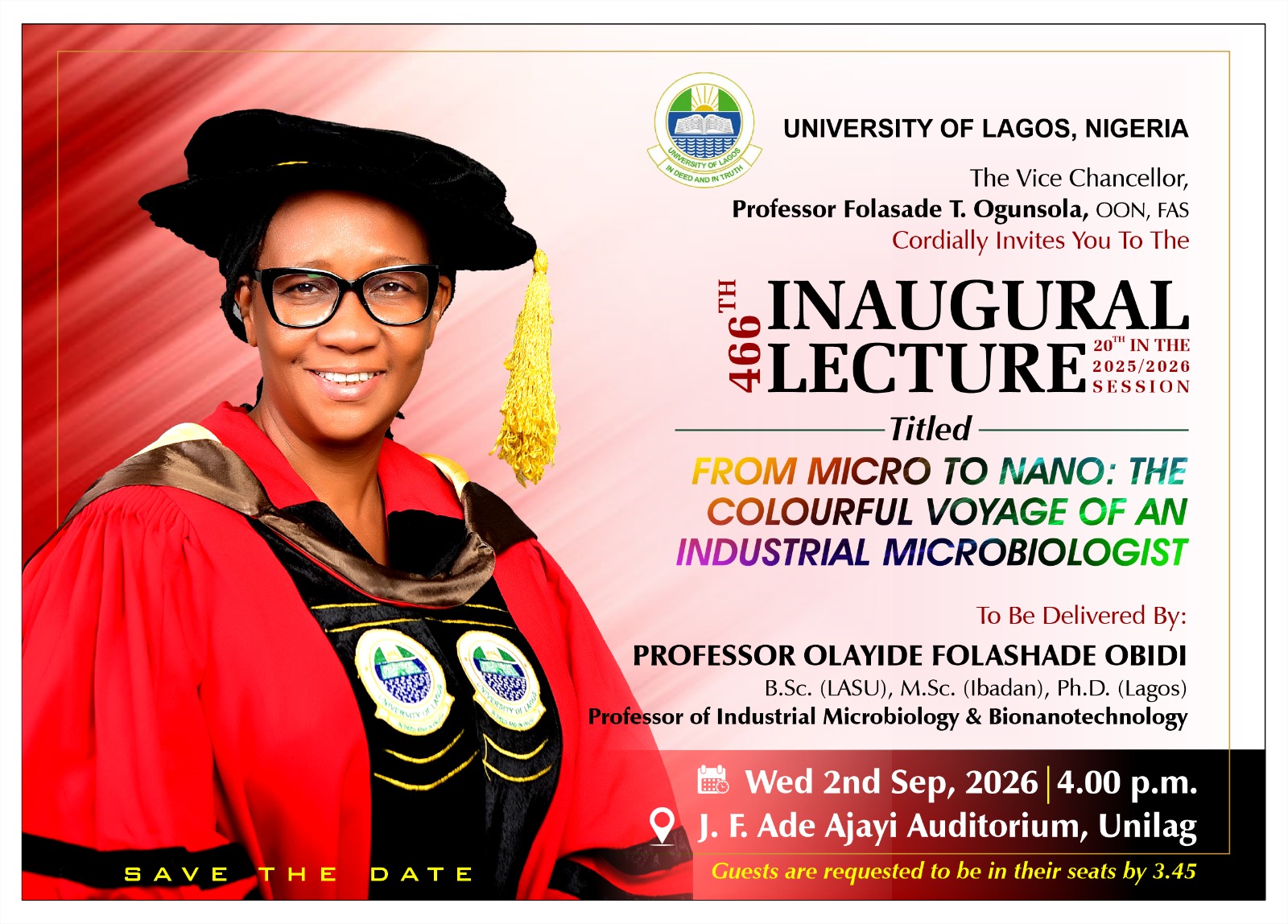
On Wednesday, September 2, 2026, Prof. Olayide Folashade Obidi, Head, Department of Microbiology, Faculty of Sciences, University of Lagos, delivered her inaugural lecture at the J.F. Ade Ajayi (main) auditorium of the university.
Titled: “From Micro to Nano: The Colourful Voyage of an Industrial Microbiologist,” she made those who sat under her lecture, and they include academic researchers and members of the university community, understand that although water-based paints formulations offered some environmental benefits over solvent-based alternatives or oil paints, all the same, their higher water content make them more vulnerable to microbial growth.
When we talk about delivering a well-researched lecture on a university campus, it is a purely academic/intellectual thing that has nothing to do with one’s faith which is and which ought to be a purely personal matter between one or one’s conscience or God.
But the researcher/lecturer being one of the women leaders in Deeper Life Bible Church and an outstanding one for that matter makes it imperative that her Christian credentials and what they represent to both the believing and non-believing worlds should be interrogated, Christianity-wise, in the course of her colourful voyage.
The Vice Chancellor, University of Lagos, Prof. Folasade Ogunsola congratulating Prof. Obidi after the lecture
Faith, fate matters, leaving a legacy
Agreed! An academic is an academic, an intellectual an intellectual. So, don’t talk as if we have “Christian” brains and “non-Christian” brains. Nature does not know anything about such classification or bigotry.
All the same, this writer unapologetically believes that all that happened that day should stand as a clear repudiation of the generally contemptible view that non-believers and scoffers often hold about believers and their practice of Christianity.
‘Look at dis one. Na wetin you sabi? Na wetin you get to showcase except carrying Bible up and down as if you no get any other work?’
The foregoing line forms part of a typical Nigerian Pidgin English jibe often thrown at Bible-believing Christians. While alive, Fela, the Afrobeat music legend and Nigerian irrepressible social critic, in his characteristic “yabbis,” used to scoff at and derogatorily regard them as “perambulators” or “waka waka waka.”
But in the view of this writer, Prof. Obidi, has, by her discovery and solution to the ever-growing problem of microorganisms often found in water paints and leading to the shortness of its shelf life, proved that a Christian or a believer need not be, in the words of Fela, a “perambulator” or “waka waka waka.”
Apart from the Bible, a believer should strive to leave a legacy that makes the world around him or her, a better place to live. The thrust of her findings which cut across industrial, microbiology, environmental science and nanotechnology is, she has found what will definitely turn out to be of immense help to owners/operators of paints and coatings industry.
Why the research is worth celebrating
In the course of her lecture, she explained how her studies examined microorganisms found in paints and on painted surfaces, and how they not only affect the spoilage, deterioration of water paints/coating products but also lead to the eventual reduction of their shelf-life.
On this score, the cerebral and celebrated woman who is a visiting professor/academic to many universities, in Nigeria and outside it, a highly respected authority, worldwide, in the field of nanotechnology, has provided a well-researched solution to the problem of microbial growth associated with water-based paints and coatings.
In 2024, Prof. Mrs. Obidi, a recipient of many awards, scholarships and research grants received the Project Innovation to Market Prototype and Start-Up Grant’s for the marketing of the fruit of her intellectual cum research labour.
The grant supports the development of research with potential industrial application. To this end, she has registered a paint and coatings company incorporated under the companies and allied matters act 2020 and many industry players, namely house builders and painters, are looking forward to benefiting from the fruit of her intellectual labour that provides the much-needed bridge between gown and town.
A roll-call of Christian inventors/discoverers
By that singular discovery, Prof. Obidi’s “colourful voyage” has led her into the hallowed precinct of Christian innovators. Others on the list include:
Sir Isaac Newton: A scientist, he was a staunch member of the Anglican Church, now Anglican Communion. During his lifetime, he attended church services and participated in many church projects.
They include printing and distribution of Bibles amongst the poor as well as serving on a committee that helped build new churches in London metropolitan.
But in the scientific world, he is known for inventing, in 1668, the Reflecting Telescope, an optical instrument that uses a combination of curved and flat mirrors to gather light as to magnify images of distant objects. Its invention/discovery later greatly helped astronomers in their various researches and probes of the galaxies.
Cyrus Hall McCormick: He accepted Christ as his Lord and personal Saviour at a very young age. An avid farmer and a committed believer, at a particular time in his lifetime, he decided that he wanted to fight hunger by inventing and marketing machines that will help increase harvest yields.
He later invented the “Virginia Reaper” which helped to increase crop yields, reduce the number of field hands needed for the harvest, lowered costs and ultimately revolutionised farming.
He later founded the McCormick Harvesting Machine Company, which later became part of the International Harvester Company in 1902. He also provided easy credit to farmers by allowing them pay for his machines later.
The easy credit option led many farmers to buy his reaper. In 1845, he wrote in his diary: “Business is not inconsistent with Christianity, but the latter ought to be a help to the former.”
You can also say the same thing about other inventions/discoveries that had been made by Christians over the years, including that of Prof. Obidi.
The Wright Brothers: Wilbur and Orville Wright are credited with inventing or building the first successful airplane in human history in December, 1903. But before then their lives had assumed a different spiritual/moral trajectory when, like McCormick, they surrendered their lives to Christ, during their youth. Throughout their lives, they refused to work on Sundays. And, they neither drank, smoked nor gambled. And, when fame and fortune came, following their discovery, they remained humble.
George Washington Carver: During the early years of his life, farmers complained that they had no market for their products, namely peanuts and soybeans which reportedly helped restore soil fertility. To create a market, Carver, who testified in many fora that his faith in Jesus was the only mechanism by which he could effectively pursue and perform the art of science, developed 300 products from peanuts and 118 from sweet potatoes.
The development was so rapid and widespread that by 1940, peanuts became South America’s second-largest crop. During World War 11, he developed 500 dyes but patented only three out of his 500 agricultural inventions.
According to findings, this was because he wanted his products to benefit all, He later bequeathed all his savings from the marketing of the products to Tuskegee Institute, Alabama, United States to continue with researches relevant to the betterment of human living.
S. Truett Cathy: Said to be “a devoutly religious man who built his life and business on hard work, humility, and biblical principles,” Cathy is reputed for developing the recipe as well as inventing the first fast-food chicken sandwich in America later trademarked as “Chick-fil-A” in 1963. In 1964, he started Chick-fil-A, Inc. Three years later, he founded a restaurant chain. In fact, he is reputed to have helped pioneer the concept of opening restaurants in shopping malls.
But throughout his business operations, because of his strong Christian belief, he never opened his restaurants on Sundays, no matter the pressure that was brought to bear on him. Secondly, he remained a Sunday School teacher in his church for more than 50 years.
Samuel Morse: A deeply religious and devoted Christian scientist, he invented or developed Morse Code a telecommunications system that turns letters and numbers into short and long sounds, lights or electrical pulses.
His invention was a forerunner to Telegram, Telegraph, Telex and other telecommunications services that preceded the digital telecommunications in the Internet age.
His deep faith in God was proved when he sent “What God has wrought” or done – a passage he culled from Numbers 23:23 – as his first message upon discovering, in the 1830s, the new means of communication. He viewed his invention as a tool for connecting humanity from one part of the world to another. Later, an European conference updated it to the International Morse Code in 1851 so it could handle non-English texts like French, German, Russian, Chinese, Arabic, Hebrew, Portuguese, etc.
Anthony Talamo Rossi: Rossi was born and grew up a Catholic. But his experience of a terrifying earthquake in his hometown, Messina, Italy, prompted him to start asking serious questions about God, Judgement Day and Heaven. Convinced that something more terrible than earthquake might happen to him if he didn’t do anything about the convictions of his conscience, he later surrendered his life to Jesus.
After spending sometimes in America as a businessman, he sold his large grocery store and moved down to the South of America to take up farming. At the same time, he began reading the Bible voraciously. He and his first wife, Florence, later joined the First Methodist Church in 1941 and afterward Calvary Baptist in Braderton, Florida in 1965.
But before joining the Calvary Baptist church, earlier in 1952, he traveled back home in Italy, to promote the evangelism and missionary works among his people. In the 1960s, he established the Aurora Foundation which helped fund Christian educational institutions, missions, and other charities. But in the secular world, the highly accomplished farmer is best remembered for finding in 1947, Tropicana Products, a producer of orange juice.
In 1954, he invented and patented a pasteurization process aseptically pack pure chilled juice in glass bottles, and which made it possible to be shipped and stored without refrigeration. Tropicana Products eventually became one of the world’s largest producers and marketers of citrus juice.
Henry J. Heinz: Born in the United States to German immigrants, he lived a devout Christian life. This deeply shaped his business ethics, philanthropy and personal life.
He was reported to be heavily involved in promoting Sunday School education in Pittsburgh and in other parts of the world. He was said to have devoted much of his personal time to promoting youth religious education.
And, in his final will, he was said to have written that the most important item he has was his confession of faith in Jesus Christ as his Saviour. He added that his faith in Him had actually sustained him through life’s moments of joy and sorrow.
Talking about his secular legacy, he began packaging foodstuffs on a small scale in 1869, in Sharpesburg, Pennsylvania. Later, he founded an American food processing company whose products are today found on the six continents and more than 200 countries of the world. The products include baked beans, salad creams, mayonnaise, apple cider vinegar, pasta sauce, baby food, dry bouillon, horse radish, frozen foods, tomato ketchup and frozen potato.
From gown to town
Of the listed individuals, only Sir Isaac Newton, George Washington Carver and Samuel Morse started or conducted critical aspects of their breakthrough research on university campuses like Prof. Obidi did.
While Newton did his at Trinity College, Cambridge University, United Kingdom, George Washington Carver started his early academic research at Iowa State Agricultural College (now Iowa State University), United States of America, before going on to establish his iconic agricultural research programme and industrial labs on the campus of the Tuskegee Institute (now Tuskegee University). Samuel Morse was said to have developed his electromagnetic telegraph system while working on the campus of the University of the City of New York (now New York University).
Contrary to whatever the world around us may think of us or call us – “perambulators”, “waka waka waka” Christians “carrying Bible up and down” – it is good and comforting to know that many of those so-called “loafers”, as it were, had, over the years given the world product ideas that helped make it a better place to live in. On Wednesday, September 2, 2026, one of our own, Prof. Obidi, put the icing on the cake by standing up to be counted.
Abanobi, pioneer Staff Writer, “Weekend Concord”, formerly Associate Editor, “The Sun” newspaper, Lagos, and winner, Governor Olusegun Mimiko Prize for Foreign News Reporter of the Year: 2018 Nigeria Media Merit Award (NMMA) is member, Journalists For Christ International Outreach.
1 comment