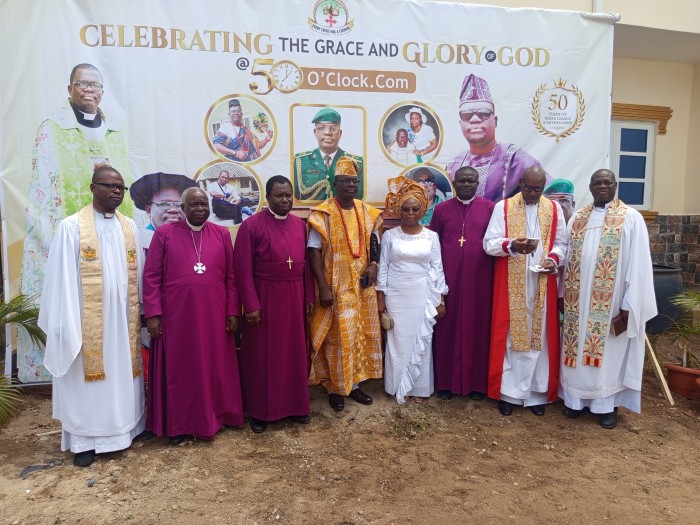
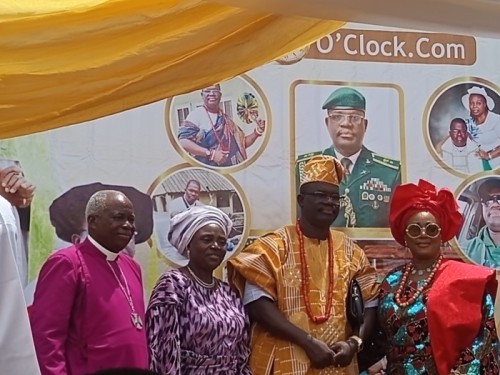
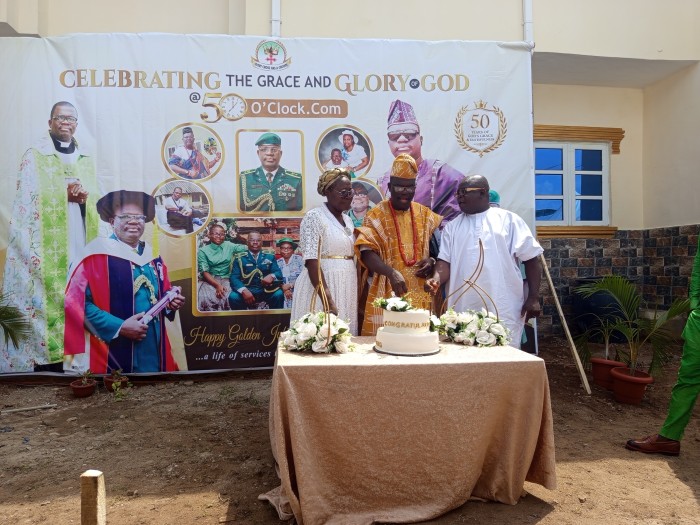
Ven. Lt Col. Olufemi Olusada recently clocked 50. Friends, family, and the church community gathered at his Ijebu-Imusin, Ogun State, country home on Friday, June 5, to celebrate with him.
It was a refreshing time before the Lord as the Lt. Colonel, who is a priest in the Anglican Church, used the occasion to return the glory to God for keeping him safe over the years.
At the event, the Anglican Bishop of Lagos South West, The Rt. Rev. Ebenezer Adewole, gave a charge urging the celebrant to use the occasion to rededicate himself to the cause of humanity. He spoke about the appropriation of grace and the need to always be thankful, while also highlighting the reasons for the celebrant to be grateful to God.
A Church Times correspondent was at the celebration and had a brief chat with Lt Col. Olusada, who shared his life experiences over the last 50 years. Below are excerpts from the interview:
How does it feel turning 50 as a soldier?
I feel grateful and thankful to God. A lot of water has passed under the bridge since I came into this world. Looking back, I can only thank God for sparing my life, given the fact that He has seen me through the challenges of life. I think it’s a great privilege for me, and it is not because I was better than those who did not survive. I am grateful that I am alive—and not just alive, but alive and able to think straight. All the glory goes back to God. Indeed, it takes the thoughtful to be thankful.
What would you consider your greatest achievement in the last 50 years, or perhaps your high moments?
Achievement is of the Lord. There are many things to be thankful for, both as a priest and a soldier. But I will just submit and say: but for the Lord, I would have been consumed.
When I recall my days in the jungle of Ekiti West Diocese as a priest where there was no electricity—where only the bishop’s court and the king’s palace had access to power through generators—I remember how, as the Bishop’s chaplain, I would go and turn on the generator at the bishop’s court with my torchlight and return to my base. When I look back at that experience, I can’t help but thank God.
I also recall my exploits in different villages in Ekiti, such as Aramoko and Efon Alaaye. These are places I served. To the glory of God, it is now history. I also thank God for seeing me through some deadly operations as a military officer. I recall my days in an international conflict during the UN Peacekeeping Mission in Sudan.
I can’t forget my missionary journey to the Northeast of Nigeria during the fight against insurgents in Borno State. I remember whenever we had the grace to leave Baga and enter Monguno on our way to Maiduguri, it felt like coming to London for us. When we entered Monguno and got a network signal on our phones, we would jump up as if we had just hit the jackpot.
As you leave Monguno and enter Maiduguri, seeing other human beings gives you a breath of fresh air that completely overwhelms you. Baga was the war theatre. Nobody just passed by. There was no civilian vehicle movement. It was shoot-on-sight if you saw anything move. I am talking about 2013 to 2015 when the war against insurgents was at its peak. I was a chaplain on the battlefield. We had to conduct burials for some of our colleagues who fell in battle. You can imagine such an experience.
In cases where deaths were caused by bomb blasts, you would see the remains of soldiers packed like cargo. After such experiences, I usually had difficulty eating meat because the imagery of the remains of fellow soldiers was always right before me.
Yet, that would not stop us from conducting another burial the following day. I was heading three different brigade battalions at that time. Back then, I was a young officer—focused, committed, and ready to go anywhere. Looking back, I can only thank God for giving me the grace to see my 50th birthday. It is simply God’s benevolence at work.
There is an assumption that death means nothing to soldiers since you have to sign away your lives at the onset. How do you react to this?
That is not true. Life is not meaningless to us. We also want to live life to the full. The point is, we are trained not to be afraid of death. By the way, why should I be afraid of death? I have buried all kinds of people, including church members and colleagues on the battlefield.
We have been trained to be brave. To be a gallant officer, you are meant to be fearless. There are people who believe we are given special injections that make us tough. There have been several times people misunderstood us and jumped to hasty conclusions about military officers. But the truth is that we are human beings, and we have our weaknesses too. We are only privileged to have been given a different orientation toward life.
What are your views on the security situation in the country? Many Nigerians believe the military is overwhelmed and seems to be losing the battle against insurgency. How will you react to this?
Security is the duty of everyone. We all have to be security-conscious. We all talk about security, which is what the government is expected to provide with the cooperation of its citizens. But what we actually need is safety, and no man can provide that. Safety is of the Lord; security is of men. If security could be a substitute for safety, some presidents of the world would not have been assassinated, and certain attacks we experience here and there would not have succeeded. Man cannot provide safety. The best we can provide is security.
But do you think the security agencies are doing well in terms of providing adequate security for Nigerians?
I think we are not at our best, but to say we are not doing well is a fallacy. We are not where we were yesterday. As a nation, I do not think we are doing badly, and we are certainly not the worst. Some nations in Africa are worse off. We know what the situation is in many of these West African countries. You will value what we have in Nigeria if you compare it with some other nations of the world.
One of our major challenges is our inability to manage our huge population. We are not the most populous in the world, but we are one of the most populated. It’s easier to manage a small population, but with a huge population like Nigeria’s, it is quite challenging. That is what we are yet to get right.
Don’t you think the military has been compromised—that there are moles within it making the battle against insurgents difficult?
That has not been established. Before we can arrive at a particular theory, there must be research to buttress that point. If somebody wakes up and says the military has been compromised, the question is: on what premise did they arrive at that conclusion? People who have never even entered a military barrack sometimes just throw out all kinds of postulations that have no scientific basis. I am not saying the army is perfect; there is no perfect institution in the world. But for anybody to say categorically that the military has been compromised, there must be concrete evidence.
Are you saying reports about moles in the military giving information to insurgents and sabotaging efforts to eradicate insurgency are false?
I think those reports are meant to bastardize our minds and paint a negative picture of the military. They are unfounded. It’s unfortunate that we have gotten to a point in Nigeria where people cook up stories about the military to dampen the morale of those on the front lines and make the nation look vulnerable. This is why many Nigerians speak ill of the country; they act on hearsay. When people curse Nigeria, we are indirectly cursing ourselves. There are challenges in the country—nobody is disputing that—but we should not be seen running down our own country with our tongues.
I don’t take kindly to people who use negative words on me or the country because, as a preacher of the gospel, I know the implications of the spoken word.
I advocate that we recognize there is no perfect society. We must also understand that no single president can bring solutions to all the problems of a nation. We all have to play our own roles in bringing Nigeria to where we want it to be. I remember driving to Lagos one day and stumbling upon a scene where a man was running after another person with a cutlass. I had to stop to arrest the situation. I came down from my vehicle, dashed toward the man, and commanded him to put down the cutlass. I had to play that role to save a life. People were wondering what kind of person I was. As a nation, I think we should all be sensitive to where we are going and work collectively toward it.
You have a chapel in your house. Is it for public church services or just a prayer place for your family?
It’s where my family and I pray. I think it would be naive of me not to have a dedicated place for prayer, given what the Lord has done in my life over the years.
You seem to have a strong connection to Ijebu-Imusin, your country home.
It is all about being thoughtful. If you are not thoughtful, you won’t act right. I never chose this place as my hometown; God chose it for me. I would be foolish to value another community more than my own town. I knew no fear as a privileged young boy growing up here. From childhood, I have had no fear. God has been my keeper. I walk at any time of the day with the full assurance that God is with me. So, identifying with my roots is simply the right thing to do.
Looking ahead, what are your plans now that you have turned 50?
Well, it is to continue to serve the Lord and do His will. Attaining 50 is entirely by grace. I believe if the Lord gives me the grace for more years, it will be used to serve Him and be more committed to humanity. My desire is to continue to make an impact in my own little space. This birthday event has been a wonderful opportunity for me to give back to my immediate community and be a blessing to people. I want to continue being a blessing