How Senator Solomon Olamilekan Adeola’s Lakunsi Yayi Energy Prosperity Agenda Can Position Ogun State as Nigeria’s Flagship for Energy-Led Economic Transformation
By Adesegun Osibanjo
Overview
The Electricity Act 2023 is arguably Nigeria’s most consequential economic reform since the return to democratic governance in 1999. Although widely viewed as legislation for the electricity sector, its true significance lies in redefining how electricity can drive economic transformation across Nigeria’s States.
For the first time, the Act establishes a clear constitutional and regulatory framework through which States may progressively develop and regulate Intrastate Electricity systems, while the Federal Government retains responsibility for Interstate Electricity and other constitutionally assigned functions. This new Governance architecture fundamentally changes the relationship between electricity and economic development.
Electricity is no longer simply an infrastructure service to be centrally managed. It has become a strategic economic asset that States can deliberately align with industrialisation, investment promotion, agricultural development, digital transformation and long-term competitiveness.
The implications are profound.
Economic leadership in Nigeria will increasingly belong to the States that build the most competitive State Electricity Systems.
For Ogun State, the opportunity is exceptional. As Nigeria’s leading industrial destination, the State possesses a diversified manufacturing base, strategic transport corridors, expanding logistics infrastructure, strong entrepreneurial capacity and immediate access to the Lagos metropolitan economy. Yet persistent electricity constraints continue to increase production costs, discourage investment and reduce industrial productivity.
This article advances the central proposition underpinning The LakunsiYayi Energy Prosperity Agenda:
The Electricity Act 2023 is fundamentally a State Electricity Systems Development Law. States that build the most competitive State Electricity Systems will build Nigeria’s most competitive Economies.
Accordingly, this article argues that Senator Solomon Olamilekan Adeola’s LakunsiYayi Energy Prosperity Agenda provides a practical implementation framework for translating the opportunities created by the Electricity Act 2023 into sustained economic transformation. Through competitive State Electricity Systems, Integrated Low Carbon Energy Systems (ILCES), Integrated Electricity Facilities (IEFs), institutional excellence and Strategic Prosperity Partnerships, Ogun State can reposition electricity from a development constraint to the foundation of industrial competitiveness, productive investment and shared prosperity.
Figure A
Nigeria’s Transition to State Electricity Systems
Electricity as the Foundation of Economic Competitiveness
Every major period of economic transformation has been powered by reliable electricity systems.
From the Industrial Revolution to today’s digital economy, sustained prosperity has consistently depended upon energy systems capable of supporting production, innovation and investment. Electricity is therefore no longer merely a public utility; it is the operating platform upon which modern economies function.
Manufacturing requires dependable electricity to sustain production. Agriculture increasingly depends upon electricity for irrigation, processing, storage and value addition. Healthcare, education, telecommunications, logistics, financial services and emerging digital industries all rely upon Electricity systems that are reliable, resilient and commercially sustainable.
The quality of electricity systems has consequently become a defining determinant of economic competitiveness.
Where electricity is dependable, industries expand, productivity improves, investment increases and innovation accelerates.
Where electricity remains unreliable, businesses incur higher operating costs, investment weakens and economic potential remains constrained irrespective of natural resources or entrepreneurial capacity.
Ogun State illustrates this reality.
Its industrial strength has made it Nigeria’s foremost manufacturing economy, yet thousands of enterprises continue to rely extensively on expensive self-generation. Capital that should finance expansion, technology, innovation and workforce development is instead diverted towards meeting basic energy requirements. The result is lower productivity, higher production costs and reduced competitiveness.
These are not merely electricity challenges.
They are economic challenges.
The Electricity Act 2023 creates an opportunity to address them through a fundamentally different development philosophy.
Rather than treating electricity as an isolated sector, the Act enables States to integrate electricity planning with industrial policy, infrastructure development and long-term economic strategy. Electricity policy therefore becomes economic policy, and electricity investment becomes investment in productivity.
This philosophy lies at the heart of The LakunsiYayi Energy Prosperity Agenda.
The Agenda recognises that sustainable prosperity will not be achieved simply by generating more electricity. It will be achieved by building integrated State Electricity Systems capable of supporting competitive industries, productive enterprises and resilient communities.
Its central proposition is straightforward:
Electricity systems are not merely infrastructure; they are the operating systems of modern economies. States that build them well create the conditions for enduring productivity, industrial competitiveness and shared prosperity.
Figure B
Comparative Readiness of Emerging State Electricity Systems
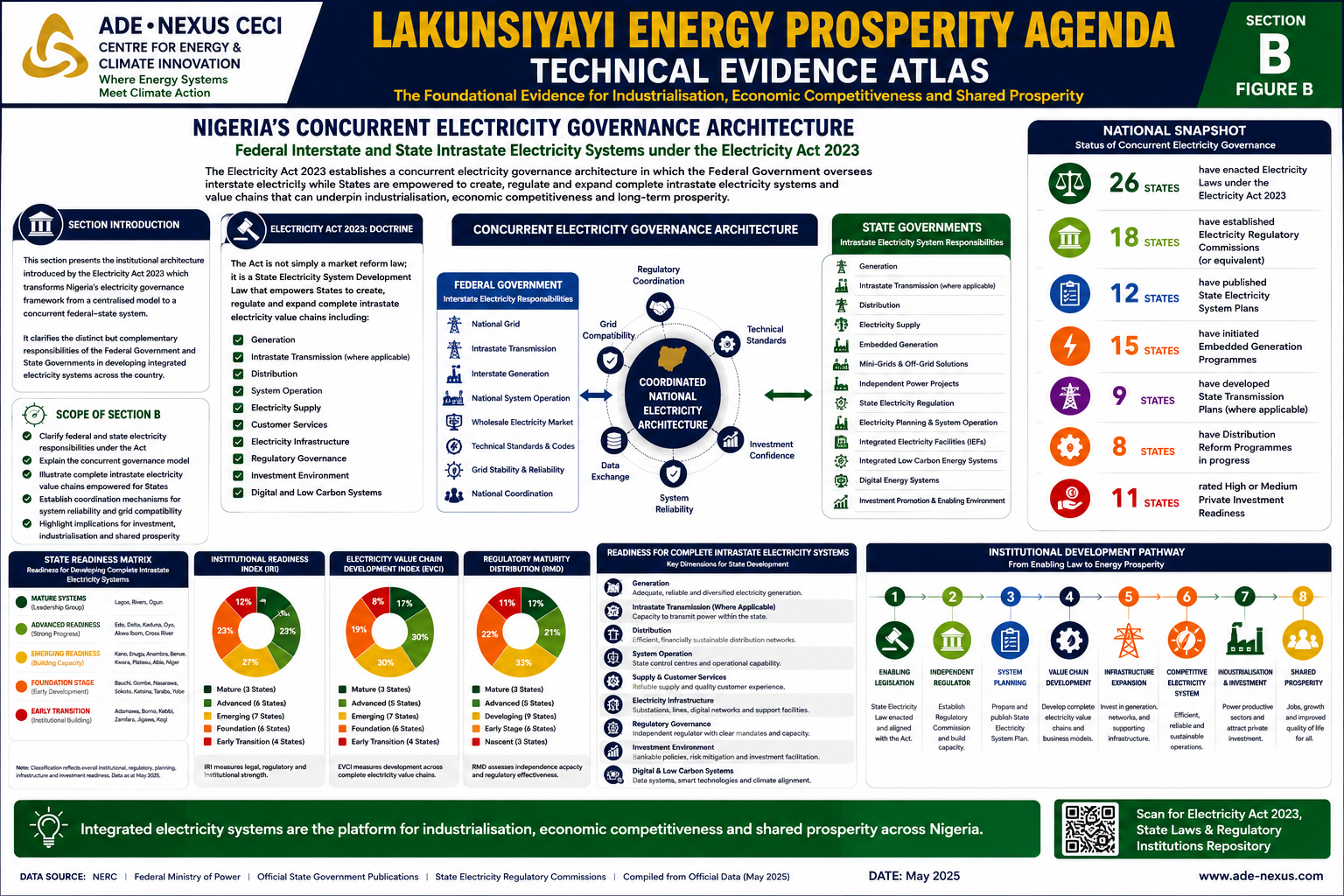
The Electricity Act 2023: A New Federal–State Electricity Architecture
The Electricity Act 2023 is more than an electricity reform statute; it is a restructuring of Nigeria’s electricity governance architecture.
For decades, electricity planning remained largely centralised, limiting the ability of States to align electricity development with their own economic priorities. Industrial expansion frequently outpaced electricity infrastructure, while investment opportunities were constrained by institutional arrangements that offered limited flexibility for State-led development.
The Electricity Act 2023 introduces a new framework.
Under the Act, States may regulate and develop intrastate electricity systems, while the Federal Government retains responsibility for interstate electricity systems and national market functions. Rather than fragmenting Nigeria’s electricity sector, this arrangement creates complementary responsibilities that preserve national coordination while enabling subnational innovation.
The significance of this transition extends well beyond electricity regulation.
For the first time, States can systematically integrate electricity planning with industrial corridors, manufacturing clusters, logistics hubs, commercial centres, agricultural value chains and emerging digital economies. Electricity can therefore become a strategic instrument of economic policy rather than simply a public service.
International experience consistently demonstrates that the world’s most competitive economies integrate electricity planning with broader development strategy. Reliable electricity lowers production costs, strengthens investor confidence and expands industrial capacity. Nigeria now possesses the legislative framework to pursue the same path.
For Ogun State, this creates an historic opportunity.
Its established industrial ecosystem already provides a strong economic foundation. The next stage of development depends upon building a competitive State Electricity System capable of supporting sustained industrial growth, attracting productive investment and strengthening long-term competitiveness.
The Electricity Act 2023 provides the legal framework.
The challenge now is disciplined implementation through institutions, infrastructure and strategic partnerships capable of converting regulatory reform into enduring prosperity.
Building Competitive State Electricity Systems
The success of the Electricity Act 2023 will not ultimately be measured by the number of State Electricity Regulatory Commissions established or licences issued. Its true measure will be whether States succeed in building electricity systems that stimulate investment, improve productivity and sustain long-term economic growth.
This distinction is fundamental.
Electricity markets are important, but markets alone do not create prosperity. Prosperity is created by competitive State Electricity Systems—integrated frameworks in which sound institutions, modern infrastructure, commercial discipline, technological innovation and long-term investment operate as a coordinated whole.
A competitive State Electricity System extends beyond electricity generation and distribution. It integrates policy, regulation, infrastructure, digital technologies, financing mechanisms and market governance to deliver reliable, affordable and resilient electricity capable of supporting a modern economy.
Five strategic principles underpin such systems.
First, regulatory certainty encourages long-term investment by ensuring transparency, consistency and commercial predictability.
Second, integrated planning aligns electricity development with industrial policy, transport infrastructure, agriculture, housing, healthcare, education and digital transformation.
Third, commercial sustainability enables financially viable participation across generation, embedded generation, distribution, mini-grids, storage and emerging energy services.
Fourth, system reliability improves industrial productivity by reducing operating costs and strengthening investor confidence.
Finally, continuous innovation ensures that electricity systems evolve through smart-grid technologies, advanced metering, digital energy management, battery storage and intelligent network operations.
Together, these principles transform electricity from a public utility into strategic economic infrastructure.
That is the systems philosophy embedded within The LakunsiYayi Energy Prosperity Agenda.
Figure D
Building Competitive State Electricity Systems
Integrated Low Carbon Energy Systems (ILCES)
Competitive electricity systems require more than reliable infrastructure; they require an integrated energy architecture capable of balancing reliability, affordability, resilience and sustainability.
This is the role of Integrated Low Carbon Energy Systems (ILCES).
Rather than promoting individual technologies in isolation, ILCES integrates complementary energy resources into a coordinated electricity ecosystem.
Natural gas provides dependable baseload generation.
Solar energy contributes clean daytime electricity.
Battery Energy Storage Systems improve operational flexibility and grid stability.
Embedded generation strengthens local reliability.
Waste-to-Energy supports both environmental management and electricity production.
Smart grids, advanced metering infrastructure and digital energy management systems optimise system performance through intelligent monitoring and operational control.
The strength of ILCES lies not in any single technology but in the way these technologies function together.
Integration improves reliability.
Integration enhances resilience.
Integration reduces costs.
Integration supports economic competitiveness.
Consequently, electricity investments should no longer be evaluated solely by installed capacity. They should be assessed by the industries they enable, the investment they attract, the productivity they improve and the employment they generate.
Within the LakunsiYayi Energy Prosperity Agenda, ILCES provides the operating architecture for Ogun State’s future State Electricity System.
Figure E
Integrated Low Carbon Energy Systems (ILCES)
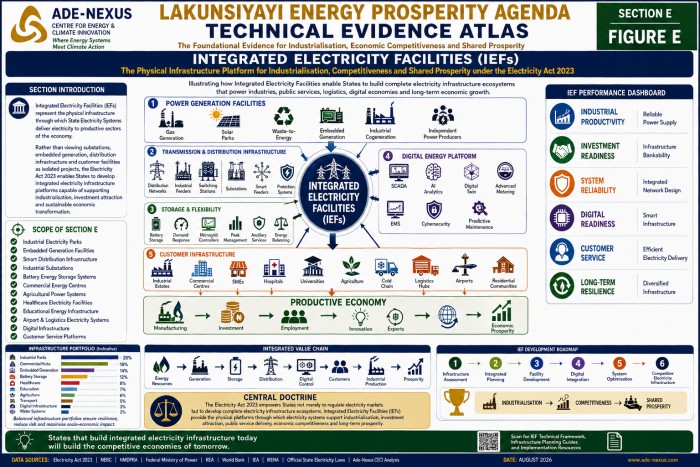
Integrated Electricity Facilities (IEFs)
If ILCES provides the operating architecture, Integrated Electricity Facilities (IEFs) provide its physical implementation.
Traditional electricity projects have often been developed as isolated engineering assets. Generation, storage, distribution and customer infrastructure have frequently been planned independently of wider economic objectives.
The LakunsiYayi Energy Prosperity Agenda proposes a different approach.
Integrated Electricity Facilities are designed as interconnected infrastructure platforms serving identifiable economic ecosystems.
Industrial estates.
Manufacturing clusters.
Agricultural processing zones.
Commercial centres.
Healthcare institutions.
Educational campuses.
Logistics corridors.
Digital innovation hubs.
Planning therefore begins with a strategic question:
What Economic opportunity should this Electricity infrastructure unlock?
By reversing the planning process, electricity infrastructure becomes an instrument of industrial policy rather than simply an engineering investment.
Integrated Electricity Facilities also provide attractive platforms for long-term private investment by bringing together Independent Power Producers, engineering companies, technology firms, infrastructure developers, manufacturers and financial institutions within commercially sustainable project structures.
The result is infrastructure that supports production as much as power delivery.
Figure F
Integrated Electricity Facilities (IEFs): Infrastructure for Prosperity
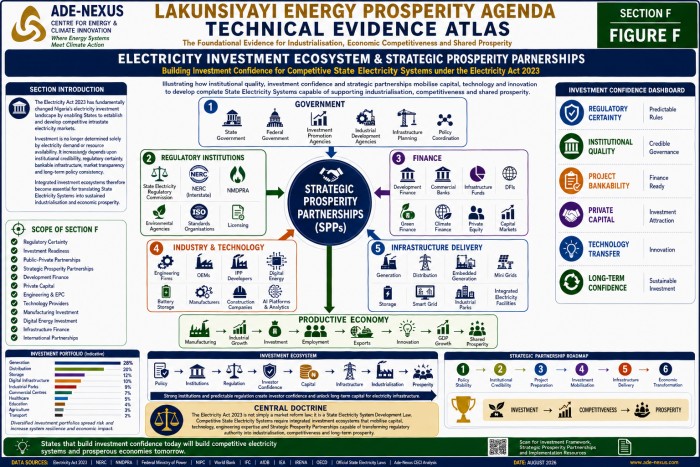
Institutions and Strategic Prosperity Partnerships
Infrastructure alone cannot sustain competitive electricity systems.
Successful electricity markets are built upon institutions that provide regulatory certainty, commercial discipline and public confidence.
The Electricity Act 2023 establishes the legal framework.
Strong institutions translate that framework into effective implementation.
Government provides strategic direction and policy certainty.
Private investors contribute capital, technology and operational expertise.
Engineering firms deliver infrastructure.
Financial institutions mobilise long-term investment.
Universities and research organisations strengthen innovation and workforce development.
Professional bodies reinforce technical excellence.
Within the LakunsiYayi Energy Prosperity Agenda, these relationships are formalised through Strategic Prosperity Partnerships.
Unlike traditional development models centred on assistance, Strategic Prosperity Partnerships are founded upon mutual value creation. They mobilise investment, technology, knowledge and institutional capability to accelerate economic transformation while maintaining commercial sustainability.
Prosperity is not transferred.
It is built through capable institutions, productive investment and competitive markets.
Figure G
Strategic Prosperity Partnerships: Building the State Electricity Investment Ecosystem
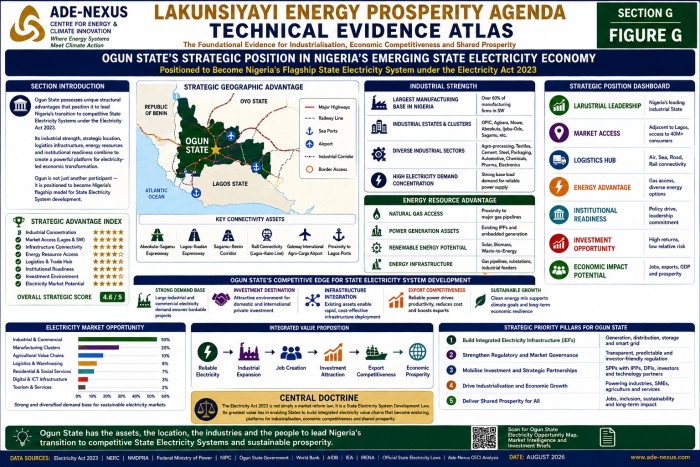
Conclusion
The Electricity Act 2023 represents far more than electricity reform.
It provides Nigeria’s States with an unprecedented opportunity to integrate electricity planning with economic development and to construct competitive State Electricity Systems capable of supporting industrialisation, investment and long-term prosperity.
For Ogun State, the opportunity is unique.
Its industrial strength, strategic geography and entrepreneurial capacity provide an exceptional platform for leadership. By implementing the LakunsiYayi Energy Prosperity Agenda through competitive State Electricity Systems, Integrated Low Carbon Energy Systems, Integrated Electricity Facilities, institutional excellence and Strategic Prosperity Partnerships, the State can establish a new benchmark for electricity-led economic transformation in Nigeria.
Success should not be measured solely by megawatts generated or kilometres of network constructed.
It should be measured by factories established, enterprises expanded, investments attracted, jobs created and improvements in the quality of life of citizens.
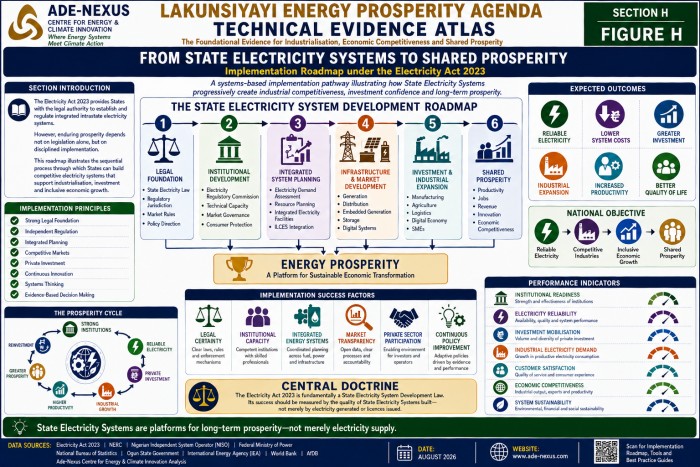
The Electricity Act 2023 provides the framework.
The LakunsiYayi Energy Prosperity Agenda provides the implementation pathway.
The opportunity now is to convert regulatory reform into enduring prosperity.
Figure H
Implementation Roadmap for Electricity-Led Economic Transformation
About the Author
Adesegun Olutayo Adeolu Osibanjo, BEng, MBA, is an Energy & Climate Strategist, Author, and Systems Transformation Architect operating at the intersection of Energy Systems, Infrastructure, Economic Development and Institutional Reform. He is a COREN-Registered Engineer in the Federal Republic of Nigeria.
About This Series
This Article is Part 1 of The LakunsiYayi Energy Prosperity Agenda, a Thematic Series examining how the opportunities created by the Electricity Act 2023 can be translated into competitive Electricity markets, integrated Energy systems and sustainable Economic development through Institutional excellence, innovation and strategic partnerships.