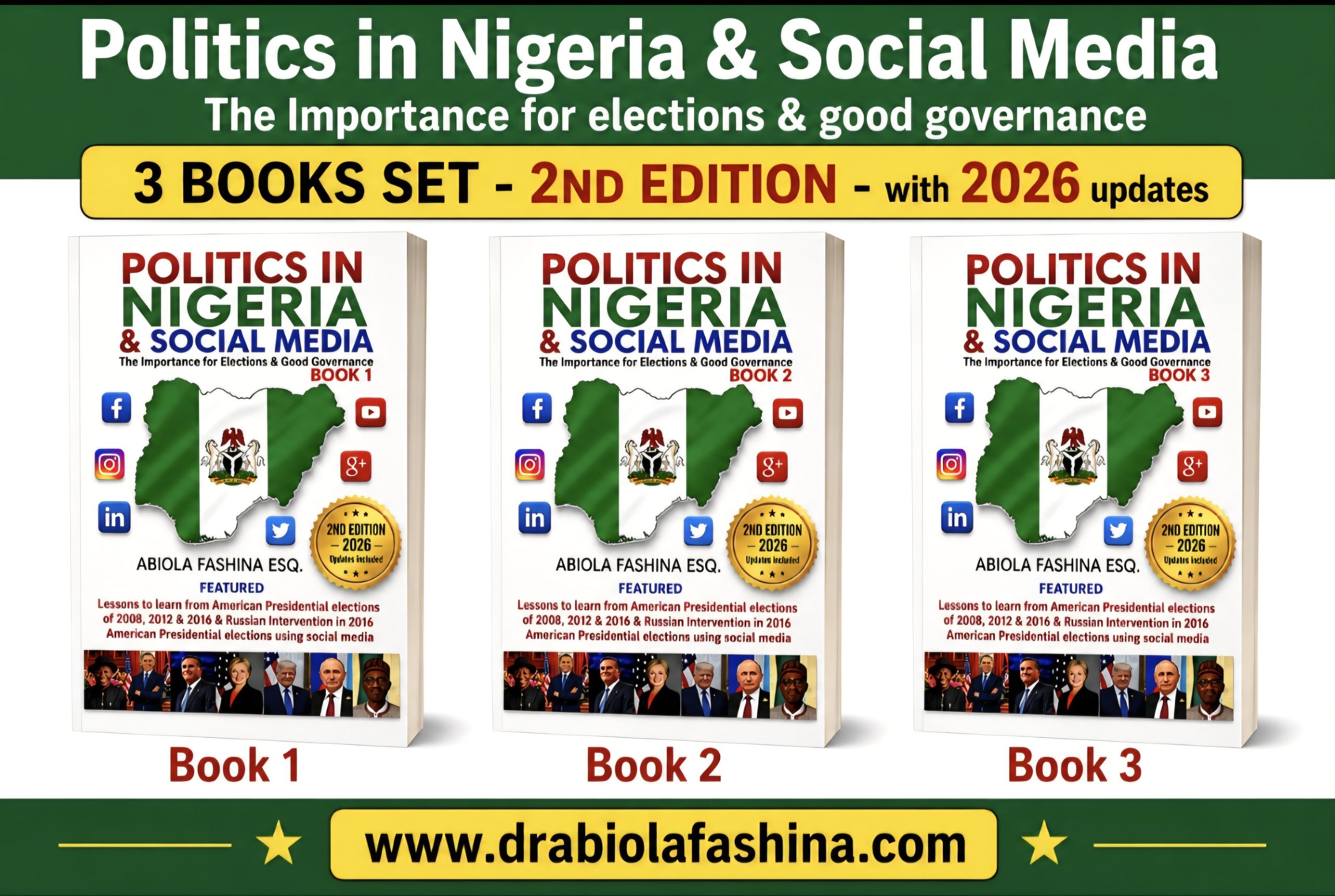
Nigerian lawyer and entrepreneur, Abiola Fashina, has released a three-part book series on social media and politics in Nigeria.
The publication aims to help public office seekers optimize social media in their campaigns while educating them on the political terrain in Nigeria.
The books—available in print, e-book, and audiobook formats on platforms including Amazon, Selar, and Payhip—are gaining momentum.
They have sparked the interest of both Nigerian politicians and international aspirants seeking public office in their respective countries.
Speaking recently with Church Times about her work, Fashina stated that it took several years of gathering information across many countries to complete the series.
”I researched over 18 elections across the globe,” she said while also adding, “My goal is to help people know their rights and make informed decisions at the polls. While it focuses on Nigeria, the insights in the book are applicable to any country where social media is used in politics.”
She added that the three-part series is a vital resource rich in current references, research documents, reports, journal articles, and published books highlighting the growing trend of social media in modern politics.
The books explore the history of Nigeria, its people, state structures, politics, and elections, how to leverage social media, data, and analytics to set up, manage, and run effective political campaigns.
it explores guidelines on using social media after elections to foster good governance and increase citizen participation in public affairs.
Detailed analyses of Nigeria’s 2011, 2015, 2019, and 2023 presidential elections and the impact of social media on each outcome was explored in the book.
Also in the book is an overview of the 2016 and 2024 US presidential elections in the US. The author examines how Donald Trump utilized social media during his campaigns and administration. Case studies in the book also cover political campaigns in the UK, Malaysia, Egypt, India, Ukraine, and other nations.
A comprehensive guide on using TikTok as a campaign tool; a case study of Peter Obi’s 2023 campaign and the “Obidient” movement (described as Africa’s largest social media political mobilization story); and an analysis of Bola Tinubu’s 2023 election victory.
The author gives Insights into AI-powered campaign tools, voter targeting, AI robocallers, and AI video/image generation.
Strategies for using WhatsApp’s broadcast lists and group capacities for grassroots mobilization, alongside social listening and data analysis tools is in the collection.
Fashina also addresses the dark side of digital politics, exposing the “Data Boys” phenomenon—paid political operatives in Nigeria who operate fake accounts to run unauthentic campaigns—and provides an ethical guide for digital elections, combatting deepfakes, and fighting fake news.
Beyond electoral politics, the books address key civic movements, including: The 2020 #EndSARS protests and the legacy of the Lekki Tollgate livestream. The August 2024 #EndBadGovernance protests spurred by rising inflation. The social media backlash surrounding the 2024 “T-Pain” campaign and the government’s response.
Historical and national symbols, including the story behind the design of the original Nigerian flag, the history of the Nigerian passport, and the recent reinstatement of the “Nigeria, We Hail Thee” national anthem are all treated in the books.
Fashina, who shuttles between Nigeria and the United States, is an international marketing consultant, media advisor, conference convener, book publisher, and business author.
She can be reached via email at drabiolafashina@gmail.com or through her website at www.drabiolafashina.com