By Chika Abanobi
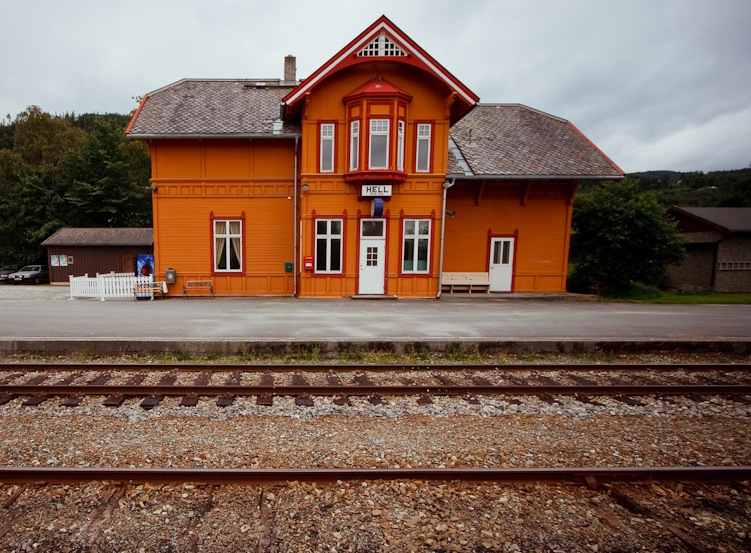
Natives know its name as “Hell.” And, many tourists who visit the place out of sheer curiosity to see things for themselves, like to take photos of themselves standing or sitting by the side of some of its signposts as a way of proving to sceptics that they had been to hell and back.
But be warned: this “Hell” is not the hell the Bible is talking about. Which is to say, this hell is not in the netherworld somewhere. But right here on earth. In faraway Norway! And, contrary to all that you have read in the Bible concerning the climate of hell, about its extreme hotness, this “Hell” is freezing cold especially during winter!
The temperature, attractions of Norway’s Hell
In fact, it is because of its extreme coldness, often dropping to about -13 degree Fahrenheit or -25 degrees Celsius that the famous English idiomatic expression “Hell freezes over” was coined.
Sources say that visitors frequently take photos by its famous train station sign, which ironically says “Hell Gods Expedition” (an old Norwegian phrase for freight forwarding).
Before the advent of social media, postcards sent from the small Norwegian village were usually stamped by postal authorities as “sent from Hell.”
With regards to merriment/entertainment, visitors to the town can enjoy activities like visiting the Vaernes Church. Or, exploring the Hell Amfi shopping centre or mall. Or even ordering food at its restaurant/eatery!
How it got its curious name
The name is derived, not from English, but from an Old Norse word “hellir” meaning “living under an overhang” or “shelter/sheltered under an overhanging rock” (as is the case with Abeokuta).
Get it right! It has nothing to do with the hell we read in the Bible as an eternal place of punishment for unrepentant sinners.
Located about 3 kilometres south of the town of Stjordalshalsen and near Trondheim Airport, Vaernes, it is not the only town in the world that took its name from natural landscape.
In Nigeria, such towns or places include: Abeokuta (meaning “under the rock” or “refuge among rocks”), Ibadan (meaning “Eba Odan” (“by the edge of savannah” or “near the forest”) and Enugu (derived from the Igbo language phrase “Enu Ugwu”, meaning “top of the hill” or “high ridge”).
Others are Jos (Gwosh, meaning “spring water” or high elevation landscape, a word from which the name “Plateau” came; Potiskum (formed from “pata” (bush) and “skum” (tree), together it means a bush-covered area or a place with trees).
States in Nigeria that took their names from natural physiology other than rocks, hills and crags include Akwa Ibom (from Qua Iboe River); Anambra (from Omambala/Ama Mbala River); Benue (from Binuwe, ‘Mother of Waters’); Cross River (from Cross River); Ebonyi (from Aboine River) and Imo (from Imo River).
World-famous figures from Hell
But the difference between “Hell” and the aforementioned Nigerian towns and states, in terms of population density is whereas their population runs into hundreds of thousands/ millions, Hell’s population is under 2,000 people.
At present, it has a grocery store, a gas or fuel station, a fast food shop/restaurant/eatery and an old people’s/retirement home.
World-famous personalities that come from Hell include Hank von Hell (1972-2021), the iconic vocalist of the Norwegian famous rock band called “Turbonegro”; Rune Gjeldnes, the renowned world-famous polar explorer known for his expeditions across Greenland and Antartica and Mona Grudt, the beautiful young lady that won Miss Norway 1990 and later Miss Universe of the same year. You should now understand why she mischievously listed herself as “The beauty queen from Hell.”
Words English people borrowed from Norway
But what many people do not know is that most of the English words we use today were originally borrowed from the Old Norse language.
They include: window (vindauga meaning “wind eye”); knife (knifr); egg (aeg, actually that was its spelling in the Old English); husband (husbondi “house occupier/master”); rugged (from “rugga”); gun (gunn); raise (reisa); scare (skirra); ugly (uggligr); Thursday (porsdagr or “Thor’s day); bug (bukr); dregs (dregg); mire (myrr); rotten (rotinn); blunder (blundra); clip (clippa); haggle (haggen) odd (oddi) and ill (illr).
In many cases, those were their adopted spellings in the Old English before they were later modified or modernised.
Hell”, “Hel” and similar words from other languages
“interestingly, in the Old Norse/Norwegian language, the word “Hel” is used to refer to Loki’s daughter, said to be the ruler of the underworld. The only difference between its spelling and the one we read from the Bible is, the word is usually not spelt with a double “l.”
But the issue of the Norwegian “Hell” bearing the same spelling with the English “Hell” but having a different meaning is not altogether a strange phenomenon in the linguistic world.
Take, for an instance, the case of “were.” In English, it is the past tense of “are” and they (both the present and past tenses) are all verbs. But in Yoruba language, “were” means “mad/insane” and belongs to a different word-class: adjective.
As a Yoruba adverb, it also means “quick or fast,” often repeated in speech making. But it has nothing to do with either present or past tense.
“Chop” in Nigerian Pidgin English, means “to eat.” But in real English grammar, it means to “cut/cut down” or “to cut to pieces.”
The word “oso” is used in some Spanish dialects to refer to something embarrassing as in “Que oso”(how embarrassing!). But in Igbo language, it means “run” or “running.”
In Yoruba, the word “ewu” is used when greeting someone, especially a pregnant woman who had just come out of a child delivery danger or somebody who just returned safely from a journey, as in “E ku ewu omo” (congratulations on your safe delivery/arrival/journey).
But in Igbo language, “ewu” means “goat.” In Igede language, spoken in lower Benue State especially Oju and Obi local government areas and in some parts of Cross River State, “egwu” means “dead” or “the dead” but in Igbo, it means “dance” or “fear.”
Why Hell is nothing to toy with
So? Like other self-deceived people, if your belief is, you cannot go to hell no matter how careless you live your life here on earth, just because you travelled and came back in one piece from “Hell” in Norway, then you may have a great shocker waiting for you.
It is written: “the Son of man shall send forth his angels, and they shall gather out of his kingdom all things that offend, and them which do iniquity. And shall cast them into a furnace of fire: there shall be wailing and gnashing of teeth”(Matthew 13:41, 42 KJV).
Remember the rich man. “In hell, he lift up his eyes, being in torments, and seeth Abraham afar off, and Lazarus in his bosom. And, he cried and said, Father Abraham, have mercy on me and send Lazarus, that he may dip the tip of his finger in water, and cool my tongue; for I am tormented in this flame”(Luke 16: 23,24, KJV).

• Abanobi, winner, Governor Olusegun Mimiko Prize for Foreign News Reporter of the Year: 2018 Nigeria Media Merit Award (NMMA) and member, Journalists For Christ Outreach International is the author “Offences and Forgiveness”, “How Youths Become Addicts to Porn” and other books.